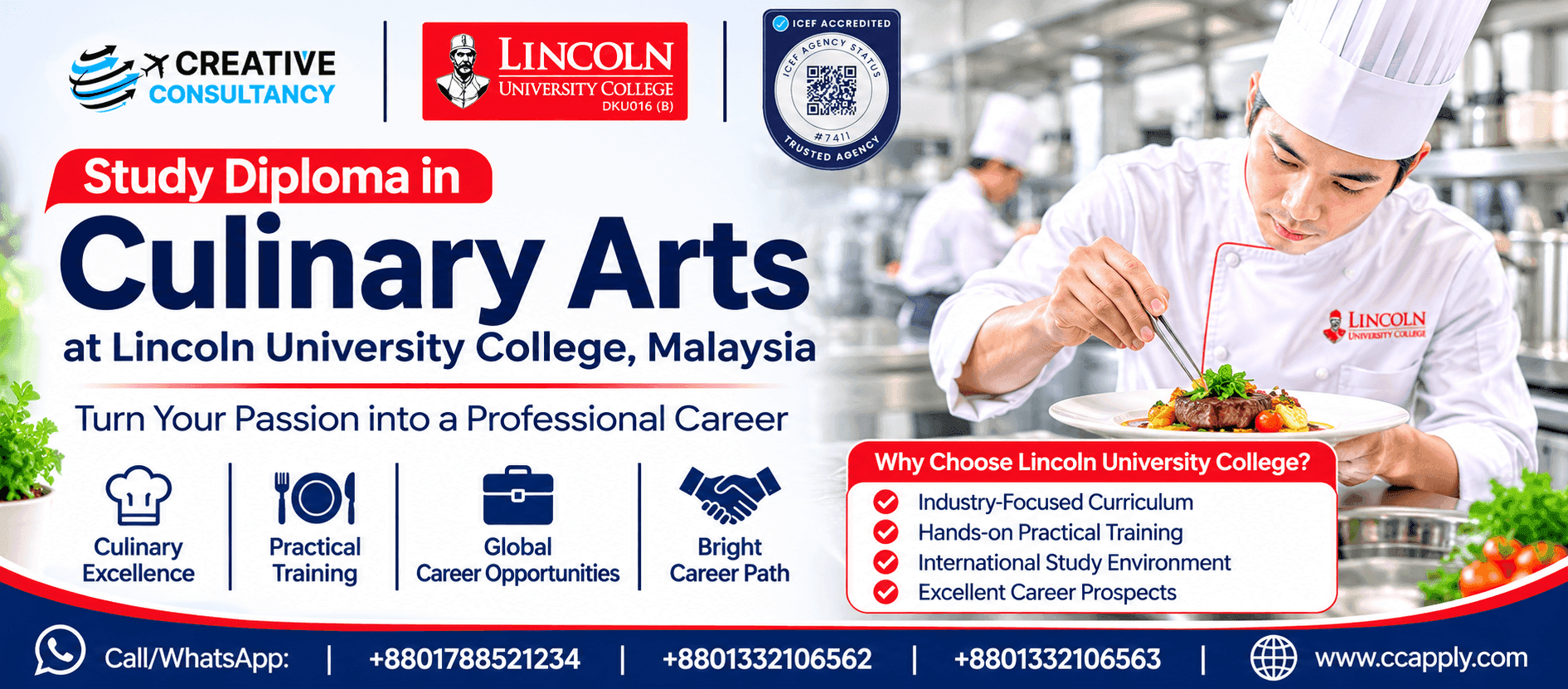
Diploma in Culinary Arts at Lincoln University College, Malaysia – Turn Your Passion for Cooking into a Professional Career
Are you passionate about cooking, food presentation, baking, and exploring different cuisines? Do you dream of becoming a professional chef, pastry specialist, or even starting your own restaurant or food business?
If you are looking for an opportunity to turn your passion for food into a professional career, the Diploma in Culinary Arts at Lincoln University College, Malaysia could be an interesting option to consider.
The culinary industry is much more than preparing delicious food. It involves creativity, technical knowledge, food science, kitchen management, presentation, teamwork, and business skills. From luxury hotels and international restaurants to bakeries, catering companies, and independent food businesses, the industry offers different career opportunities for people with the right skills and dedication.
Malaysia is also an attractive destination for culinary education because of its multicultural food culture, where Malaysian, Chinese, Indian, Middle Eastern, and international cuisines come together.
At Lincoln University College (LUC), students can explore the world of professional cooking through a structured diploma programme that combines culinary knowledge, practical subjects, hospitality education, and industrial training.
Let's explore the programme, its subjects, admission requirements, career opportunities, and why Lincoln University College may be worth considering for your higher education in Malaysia.
Malaysia has developed a diverse food culture influenced by different communities and international traditions. From traditional Malaysian dishes to modern international cuisine, students can experience a wide variety of food preparation styles, ingredients, flavours, and culinary techniques.
For students interested in building a career in the food and hospitality industry, studying in Malaysia offers an opportunity to learn in a multicultural environment.
Here are some reasons to consider Malaysia for Culinary Arts education:
1. Exposure to Different Food Cultures
Malaysia is known for its multicultural society and diverse food traditions. Students can explore Malaysian, Asian, and international cuisines while developing an understanding of different cooking techniques and ingredients.
2. Practical Culinary Education
Culinary Arts is a skill-based field. Students need more than theoretical knowledge to become successful culinary professionals. Practical learning helps them understand food preparation, cooking methods, kitchen operations, and presentation.
3. Multicultural Learning Environment
Studying alongside students from different cultural backgrounds allows learners to exchange ideas, explore different food traditions, and develop international perspectives.
4. Understanding the Hospitality Industry
Culinary education is closely connected with the hospitality industry. Students can develop knowledge of restaurant operations, food and beverage services, kitchen management, and customer service.
5. International Educational Experience
Studying abroad allows students to experience a different academic environment, develop independence, improve communication skills, and prepare for future professional opportunities.
Lincoln University College (LUC) is a private higher education institution located in Petaling Jaya, Selangor, Malaysia.
The institution offers a range of academic programmes in different areas, including business, healthcare, engineering, hospitality, and other professional disciplines.
For students who are interested in the culinary and hospitality industry, Lincoln University College offers a Diploma in Culinary Arts designed to introduce learners to the professional world of food preparation, culinary techniques, kitchen operations, and hospitality management.
The programme combines different areas of learning to help students understand both the creative and operational sides of the culinary profession.
Whether your goal is to become a professional chef, work in a hotel or restaurant, specialise in pastry and bakery, or eventually establish your own food business, this diploma can be a starting point for developing relevant academic and practical knowledge.
Here are the main programme details for students interested in applying.
Programme Information | Details |
|---|---|
University | Lincoln University College |
Programme | Diploma in Culinary Arts |
Location | Petaling Jaya, Selangor, Malaysia |
Full-Time Duration | 2 Years |
Part-Time Duration | 4 Years |
Total Credit Hours | 90 Credits |
Available Intakes | March, July & November |
MQA Reference | MQA/FA15595 |
Qualification Level | MQF Level 4 Diploma |
The programme is designed to provide students with a foundation in culinary education, combining academic subjects with practical and industry-related learning.
Note: Intake availability, study mode, and programme details should be reconfirmed with the university before applying.
One of the most interesting things about Culinary Arts is that students do not simply learn how to cook. They also develop an understanding of food ingredients, nutrition, cooking science, kitchen organisation, food safety, hospitality operations, and business management.
The Diploma in Culinary Arts at Lincoln University College covers several important areas.
This is one of the foundation areas of culinary education.
Students are introduced to basic cooking principles, food preparation techniques, kitchen tools, cooking methods, and the proper use of ingredients.
Understanding these fundamentals is essential for developing confidence and consistency in professional food preparation.
Have you ever wondered why certain ingredients change their texture during cooking or how different cooking methods affect the taste and quality of food?
Food theory introduces students to the characteristics of ingredients and the basic science behind food preparation.
This knowledge helps students understand how to work with different ingredients and improve their culinary techniques.
International cuisine allows students to explore different food cultures and cooking traditions.
Students become familiar with international dishes, ingredients, preparation methods, and presentation styles.
This knowledge is useful for those who want to work in international hotels, restaurants, resorts, and other hospitality establishments.
Malaysia is famous for its rich and diverse food culture.
Students explore Malaysian and Asian culinary traditions, including different ingredients, flavours, cooking techniques, and food preparation practices.
Learning about regional cuisines helps students develop a broader understanding of the culinary world.
If you enjoy making cakes, bread, pastries, and desserts, this area may be particularly interesting.
Students are introduced to the fundamentals of pastry and bakery, including baking ingredients, preparation techniques, and confectionery products.
It can help students explore future specialisation in bakery, pastry, and dessert preparation.
Food safety is one of the most important responsibilities in any professional kitchen.
Students learn about proper food handling, personal hygiene, sanitation, kitchen cleanliness, and safe food preparation practices.
Understanding these principles is essential for maintaining food quality and protecting customers.
A successful kitchen requires proper planning, organisation, communication, and teamwork.
Kitchen management introduces students to the operational side of professional cooking, including kitchen organisation, coordination, time management, and food production activities.
These skills are important for students who want to progress into supervisory or management positions in the future.
Running a restaurant or hotel kitchen involves more than preparing food.
Food purchasing, ingredient management, budgeting, and cost control are also important.
This subject introduces students to the financial aspects of food and beverage operations and helps them understand how businesses manage their resources.
Have you ever dreamed of opening your own restaurant, café, bakery, or catering business?
Entrepreneurship introduces students to the business side of the culinary industry.
It helps learners understand business planning and the fundamentals of establishing and managing a food-related business.
Practical industry exposure is an important part of professional education.
The programme includes an industrial training component where students have an opportunity to apply their academic knowledge and develop workplace skills in an industry environment.
This experience can help students understand professional expectations, teamwork, kitchen responsibilities, and the daily operations of the hospitality industry.
The Diploma in Culinary Arts includes a combination of culinary, hospitality, business, and practical subjects.
Some of the major subjects listed in the programme structure include:
English 1 and English 2
Fundamentals of Marketing
Introduction to Hospitality and Tourism Industry
Theory of Food
Fundamentals of Culinary
Creative Problem Solving
Entrepreneurship
Food Safety and Hygiene
Introduction to Pastry and Bakery
Accounting for Hospitality
International Cuisine
Malaysian Cuisine
Garde Manger
Asian Cuisine
Food and Beverage Service Skills
Commercial Food Production
Kitchen Management
Food and Beverage Cost Control
Fundamentals of Purchasing
Butchery
Local Hors d'oeuvres and Pastry
Industrial Training
The combination of these subjects helps students develop knowledge of food preparation, hospitality operations, kitchen management, and the business aspects of the culinary industry.
Choosing the right university is one of the most important decisions when planning to study abroad.
A good culinary programme should not only teach students how to prepare food but also help them understand the professional responsibilities, business operations, and industry expectations associated with the culinary world.
Here are several reasons why students may consider Lincoln University College for their Diploma in Culinary Arts.
One of the main reasons to consider Lincoln University College is its dedicated Diploma in Culinary Arts programme.
Instead of focusing only on general hospitality subjects, the programme includes specific culinary-related areas such as Fundamentals of Culinary, International Cuisine, Malaysian Cuisine, Asian Cuisine, Pastry and Bakery, and Commercial Food Production.
This gives students an opportunity to explore different aspects of professional food preparation.
Professional cooking requires both knowledge and practical skills.
Understanding ingredients, cooking methods, food presentation, and kitchen operations is essential for developing as a culinary professional.
The programme covers culinary fundamentals alongside practical subjects and an industrial training component.
This combination allows students to build an academic foundation while becoming familiar with the practical responsibilities of the profession.
Food culture varies from country to country, and professional chefs often need to understand different culinary traditions.
The programme includes International Cuisine, Malaysian Cuisine, and Asian Cuisine.
Students can develop an understanding of different flavours, ingredients, preparation methods, and culinary traditions.
This broader exposure can be valuable for students who wish to explore opportunities in hotels, restaurants, resorts, and international food businesses.
The culinary industry offers different specialisation opportunities.
Some professionals focus on main-course preparation, while others build their careers around cakes, desserts, pastries, and bakery products.
Lincoln's programme includes Introduction to Pastry and Bakery, giving students an opportunity to explore this area of culinary education.
For students who are interested in becoming pastry chefs, bakers, or dessert specialists, this subject can be particularly relevant.
A professional kitchen is a fast-paced working environment where organisation, teamwork, communication, and time management are essential.
The inclusion of Kitchen Management, Commercial Food Production, and Food and Beverage Service Skills introduces students to different operational aspects of the food and hospitality industry.
Students can develop an understanding of how food production and service activities are organised.
Maintaining food quality and safety is a major responsibility in the hospitality industry.
A professional culinary worker must understand how to handle ingredients, maintain cleanliness, and follow proper hygiene practices.
The programme includes Food Safety and Hygiene, helping students understand the importance of maintaining safe food preparation standards.
Not every Culinary Arts graduate wants to work in a restaurant for their entire career.
Some students may dream of opening a café, bakery, restaurant, catering company, or food-related business.
This is where the business-related subjects become valuable.
The programme includes:
Entrepreneurship
Fundamentals of Marketing
Accounting for Hospitality
Food and Beverage Cost Control
Fundamentals of Purchasing
These subjects introduce students to the business and financial aspects of the hospitality industry.
Learning about cost control, purchasing, marketing, and entrepreneurship can help students understand what goes into managing a food business.
Academic knowledge becomes more meaningful when students understand how it is applied in a real working environment.
The programme includes Industrial Training, which provides an opportunity to gain industry exposure and become familiar with professional responsibilities.
Students can develop workplace awareness, communication, teamwork, and practical experience.
This is an important consideration for students who want to prepare for future employment in the hospitality sector.
Lincoln University College is located in Malaysia, a country known for its diverse cultures and food traditions.
Studying in this environment allows international students to experience different cultures and interact with people from various backgrounds.
For Culinary Arts students, this multicultural environment can also provide a wider perspective on food, dining traditions, and international cuisine.
Culinary Arts is a broad field with different career possibilities.
Students may be interested in becoming chefs, pastry specialists, kitchen supervisors, catering professionals, or culinary entrepreneurs.
The programme covers culinary techniques, food production, hospitality operations, and business-related subjects, providing a foundation for exploring these career directions.
Overall, Lincoln University College may be a suitable option for students who want to study culinary subjects while developing knowledge of hospitality operations, food business management, and professional kitchen practices.
Students from Bangladesh who are interested in applying for the Diploma in Culinary Arts must meet the university's academic and English language requirements.
According to the published programme entry requirements, applicants may qualify through one of the following routes:
SPM with at least 3 credits in any subjects or equivalent.
STPM with a minimum Grade C (Grade Point 2.00) in any subject or equivalent.
STAM with a minimum Maqbul grade.
SKM Level 3 in a related field.
An MQF Level 3 Certificate in a related field or equivalent.
For Bangladeshi applicants, SSC and HSC qualifications will need to be assessed for equivalency and admission eligibility by the university.
The published English language requirements include:
IELTS: Minimum 4.0
MUET: Band 2
Equivalent English language qualifications may also be considered.
International students should confirm the latest accepted English qualifications and requirements before submitting an application.
Yes, Bangladeshi students can apply for the Diploma in Culinary Arts at Lincoln University College, subject to meeting the university's academic and English language requirements.
Students who have completed SSC or HSC may consider this programme depending on their academic qualifications and the university's equivalency assessment.
Whether you come from a Science, Commerce, or Arts background, your eligibility will depend on the university's assessment of your previous academic qualifications.
If you are unsure whether your academic results are sufficient, you can get your profile assessed before proceeding with an application.
One of the biggest advantages of studying Culinary Arts is the variety of career directions available within the food and hospitality industry.
After completing the diploma and gaining relevant experience, graduates may explore opportunities in restaurants, hotels, resorts, catering companies, bakeries, and other food-related businesses.
Here are some potential career paths:
Professional chefs prepare, cook, and present food in restaurants, hotels, resorts, and other food service establishments.
With experience and skill development, they may progress towards more senior kitchen positions.
Pastry chefs specialise in preparing cakes, pastries, desserts, and other baked products.
This career is suitable for individuals who enjoy baking, dessert decoration, and creative food presentation.
Restaurant cooks are responsible for preparing ingredients, cooking dishes, maintaining food quality, and supporting daily kitchen operations.
Catering professionals coordinate food preparation and service for events, corporate functions, private occasions, and other catering activities.
Kitchen supervisors help manage daily kitchen activities, coordinate staff, monitor food preparation, and maintain organisation within the kitchen.
Food and Beverage Managers work with the operational side of restaurants, hotels, and hospitality establishments.
Their responsibilities may include service coordination, staff supervision, quality management, and business operations.
Students who develop an interest in bakery and pastry can explore opportunities in bakeries, dessert shops, hotels, and specialised food businesses.
For students with business ambitions, culinary knowledge can be a starting point for establishing their own restaurant, café, bakery, catering service, or other food-related venture.
Career opportunities and progression will depend on individual skills, work experience, employer requirements, and relevant professional qualifications.
The Diploma in Culinary Arts at Lincoln University College may be worth considering if you:
Have a genuine passion for cooking and food preparation.
Enjoy exploring different cuisines and food cultures.
Dream of becoming a professional chef.
Have an interest in baking, pastry, and desserts.
Want to work in hotels, restaurants, or resorts.
Are interested in kitchen management and hospitality operations.
Want to establish your own restaurant, café, or bakery.
Want to pursue hospitality-related education in Malaysia.
You do not need to be an experienced professional chef before starting your culinary education. The programme covers foundational culinary subjects that introduce students to the field.
However, having creativity, patience, dedication, teamwork, and a willingness to learn can be helpful throughout your studies.
The published programme information lists the following study arrangements:
Full-Time Programme: 2 Years
Part-Time Programme: 4 Years
Available Intakes: March, July, and November.
Students planning to apply should confirm the availability of their preferred intake, especially as intake schedules may change.
International applicants should also consider the additional time needed for admission documentation and EMGS student visa processing.
The total cost of studying in Malaysia depends on several factors, including the selected programme, university fees, accommodation, food, transportation, insurance, and other living expenses.
For the Diploma in Culinary Arts at Lincoln University College, students should request an updated fee breakdown before making a financial decision.
The following expenses should be considered:
Application and registration fees.
Tuition fees.
EMGS and student visa-related charges.
Medical screening and insurance.
Accommodation expenses.
Food and daily living costs.
Personal expenses.
The final budget may vary depending on the student's accommodation choices and personal lifestyle.
At Creative Consultancy, students can receive guidance regarding the programme fees, admission process, and estimated study expenses.
International students planning to study in Malaysia must complete the relevant student visa procedures.
The general admission and student visa journey includes several stages:
Step 1: Choose Your Programme
Select the Diploma in Culinary Arts and review the programme requirements.
Step 2: Academic Profile Assessment
Your SSC, HSC, and other academic qualifications are reviewed to determine whether you meet the entry requirements.
Step 3: Prepare Required Documents
Students generally need to prepare their academic certificates, transcripts, passport, photographs, and other documents requested by the university.
Step 4: Submit the Admission Application
After reviewing the documents, the application is submitted to the university for admission consideration.
Step 5: Receive the Offer Letter
If the university approves the application, the student receives an offer letter.
Step 6: EMGS Student Visa Application
The relevant student visa application is processed through the applicable EMGS procedures.
Step 7: Visa Approval and Travel Preparation
After completing the required visa procedures, students can prepare for their journey to Malaysia according to the university's instructions.
The visa approval process and required documents may vary depending on the applicant's circumstances and current regulations.
Choosing the right university and completing the admission process can sometimes feel confusing, particularly for students applying from Bangladesh.
You may have questions about academic eligibility, tuition fees, university selection, offer letters, or EMGS student visa procedures.
Creative Consultancy provides educational guidance for Bangladeshi students who want to pursue higher education in Malaysia.
Our team can assist students throughout different stages of their study abroad journey.
1. University Selection
We help students explore suitable Malaysian universities based on their academic background, preferred programme, and budget.
2. Academic Profile Assessment
Before applying, students can receive guidance regarding their SSC, HSC, and other academic qualifications.
3. Programme Selection Guidance
Not sure whether Culinary Arts is the right programme for you? We can help you understand the available study options and make an informed decision.
4. Admission Application Assistance
We guide students through the university application process and help them understand the required documentation.
5. Offer Letter Processing Guidance
Our team assists students with the admission process and communication regarding offer letter requirements.
6. Tuition Fee Guidance
We help students understand the available programme fee information and payment procedures.
7. EMGS Student Visa Assistance
We provide guidance regarding student visa documentation and the relevant EMGS application procedures.
8. Pre-Departure Guidance
We also help students understand important preparations before travelling to Malaysia for their studies.
Our goal is to make the study abroad journey easier, clearer, and more organised for students and their families.
The full-time programme takes 2 years, while the part-time programme takes 4 years according to the published programme information.
Yes. Bangladeshi students can apply subject to the university's academic equivalency assessment and international student admission requirements.
The published programme requirement includes IELTS 4.0 or MUET Band 2. Equivalent English language qualifications may also be considered. Please confirm the latest requirements with the university.
Applicants from different academic backgrounds may be considered. Final eligibility depends on the university's assessment of their academic qualifications.
The published entry routes do not specify a particular academic stream. However, applicants must meet the relevant qualification and equivalency requirements.
Yes. The curriculum includes practical culinary-related subjects, commercial food production, and an industrial training component.
Yes. Introduction to Pastry and Bakery is included in the programme structure.
The programme includes International Cuisine, Malaysian Cuisine, and Asian Cuisine.
The programme includes entrepreneurship, marketing, accounting, and food and beverage cost control subjects that can provide useful foundational business knowledge. Establishing a successful business will also require practical experience, planning, and investment.
The published programme information lists March, July, and November intakes. Students should confirm the current availability before applying.
The published programme information lists MQA/FA15595. Students can verify the current accreditation and programme registration information through the relevant Malaysian qualification records.
Lincoln University College is located in Petaling Jaya, Selangor, Malaysia.
Yes. Bangladeshi students can contact Creative Consultancy for academic profile assessment, programme selection, admission assistance, and student visa guidance.
A career in Culinary Arts is not just about preparing food. It is about creativity, discipline, passion, innovation, and the ability to turn simple ingredients into memorable experiences.
If you enjoy cooking, exploring international cuisines, baking, or working in a professional kitchen, the Diploma in Culinary Arts at Lincoln University College, Malaysia could be a programme worth exploring.
With subjects covering culinary fundamentals, international cuisine, pastry and bakery, food safety, commercial food production, kitchen management, entrepreneurship, and industrial training, the programme introduces students to several important areas of the culinary and hospitality industry.
Choosing the right university is an important first step towards your future. Before applying, make sure you understand the admission requirements, programme structure, tuition fees, and overall study budget.
Your passion for cooking could be the beginning of something bigger. Take the first step towards building your future in the culinary world!
Planning to study Diploma in Culinary Arts at Lincoln University College, Malaysia?
Let Creative Consultancy guide you through your Malaysian higher education journey.
We assist students with university selection, admission applications, academic profile assessment, offer letter processing, and EMGS student visa guidance.
Call / WhatsApp:
+8801788521234
+8801332106562
+8801332106563
Website: https://www.ccapply.com
Explore the Programme & Apply Online:
Creative Consultancy – Your Trusted Guide to Studying in Malaysia. 🇲🇾🎓
More posts you may want to read.
Share your details and our experts will contact you.