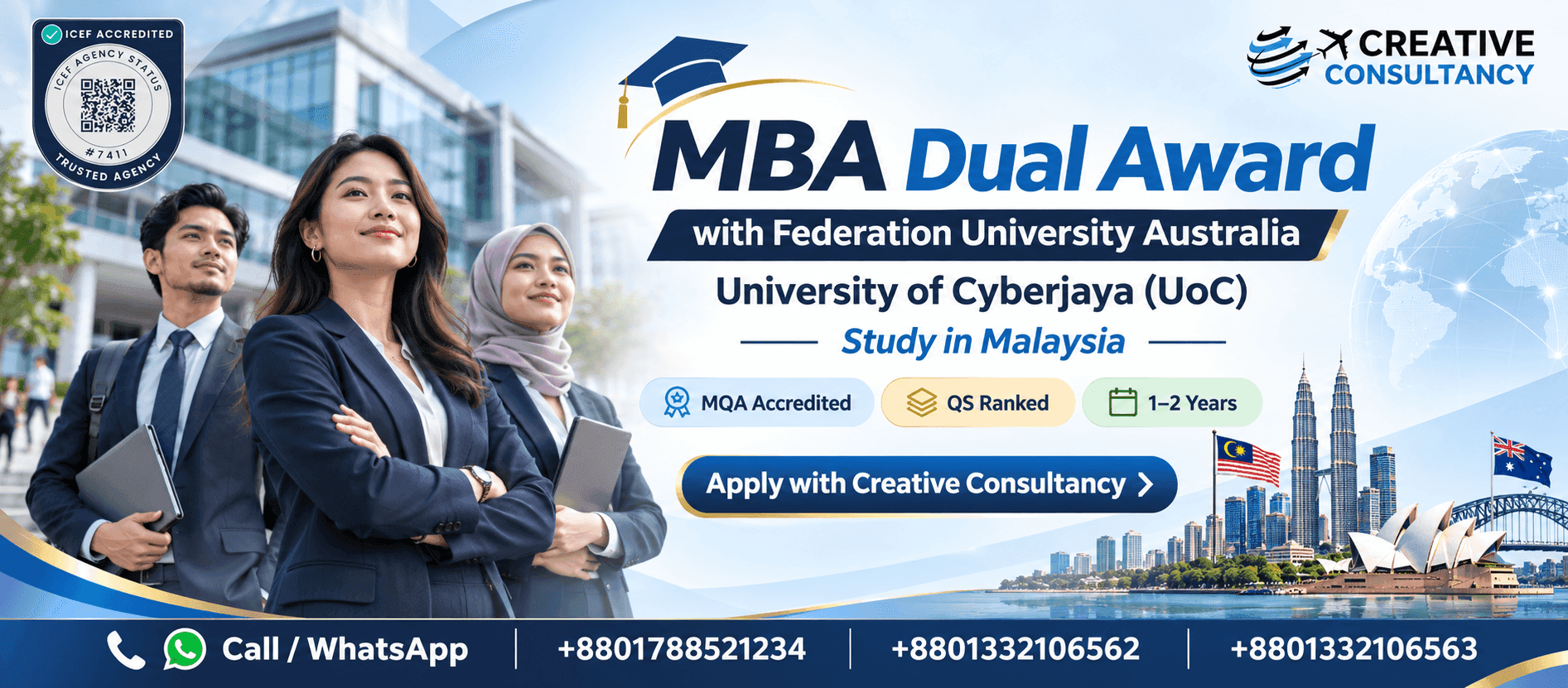
Looking to earn an internationally oriented MBA in Malaysia? Discover the Master of Business Administration (MBA) Dual Award with Federation University Australia at the University of Cyberjaya (UoC). Develop advanced business knowledge, strengthen your leadership skills and explore global management opportunities with an international academic partnership.
Are you a recent graduate planning your next academic step? Are you a working professional looking to move into management? Or perhaps you are an entrepreneur who wants to develop stronger business, financial and leadership skills?
Whatever your ambition, an MBA can be an important step towards expanding your professional knowledge and preparing for new responsibilities.
Today's business environment is changing rapidly. Digital transformation, international competition, evolving customer expectations and technological innovation are influencing how organisations operate. Businesses increasingly need professionals who can think strategically, manage people, understand financial performance and make informed decisions.
For students seeking an international postgraduate qualification, the MBA Dual Award with Federation University Australia at the University of Cyberjaya (UoC), Malaysia, offers an interesting opportunity.
What makes this programme particularly attractive is its dual-award structure, combining the prescribed academic requirements of two higher education institutions:
University of Cyberjaya, Malaysia.
Federation University Australia.
Students study core business and management subjects, explore specialist areas such as Digital Business and Digital Marketing, and undertake additional academic modules prescribed by Federation University Australia.
The programme is designed for individuals who want to strengthen their understanding of modern business practices while gaining exposure to international management perspectives.
In this guide, we explore everything you need to know about the MBA Dual Award in Malaysia, including its university rankings, dual-award structure, curriculum, specialisations, tuition fees, admission requirements, career opportunities and the advantages of applying through Creative Consultancy.
A successful business requires more than a good product or service. It needs effective leadership, financial planning, marketing strategies, operational management and the ability to respond to changing market conditions.
An MBA brings these business functions together through postgraduate-level education.
Unlike an undergraduate qualification that generally focuses on a particular academic discipline, a Master of Business Administration provides a broader understanding of how organisations operate, compete and grow.
It helps students explore the relationship between different business departments and understand how management decisions influence overall organisational performance.
Strategic Management
Understand how organisations establish business objectives, evaluate competition, allocate resources and develop long-term growth strategies.
Leadership and Human Resource Management
Learn how to manage teams, motivate employees, develop talent and improve organisational performance.
Financial Management
Develop an understanding of financial statements, budgeting, accounting principles, investment decisions and business performance.
Marketing and Customer Management
Explore consumer behaviour, market research, branding, digital marketing and competitive positioning.
Entrepreneurship and Innovation
Understand how to identify business opportunities, develop business plans and establish sustainable ventures.
International Business
Explore global markets, international trade, cross-cultural management and the challenges faced by multinational organisations.
Digital Business and Transformation
Understand how technology, data analytics, e-commerce and digital strategies are changing modern organisations.
This qualification may be particularly relevant for:
Recent graduates who want to pursue postgraduate business education.
Working professionals preparing for managerial responsibilities.
Entrepreneurs interested in developing their business management knowledge.
Marketing professionals looking to advance their careers.
Finance and administration professionals interested in leadership.
Business owners planning to expand their organisations.
Professionals considering a transition into business and management.
An MBA is not simply another academic certificate. It is an opportunity to develop a broader understanding of business, leadership, strategy and organisational decision-making.
The University of Cyberjaya (UoC) is a Malaysian private higher education institution located in Cyberjaya, Selangor.
Established in 2005, the university has developed an academic presence across several disciplines, including healthcare, business, technology and professional education.
Initially recognised for its strengths in medical and health-related education, the university has expanded its academic portfolio to accommodate students with diverse educational interests and career ambitions.
Its academic offerings include:
Business and Management
Medicine and Healthcare
Pharmacy
Biomedical Sciences
Nursing
Psychology
Engineering and Technology
Information Technology
Creative and Digital Disciplines
The university welcomes domestic and international students, providing an opportunity to study in a multicultural academic environment.
Established Academic Institution
With a history dating back to 2005, UoC has developed a diverse portfolio of higher education programmes.
International Recognition
The university is included in the QS World University Rankings and has received a QS 5-Star institutional rating.
Multidisciplinary Learning Environment
Students can study at an institution offering programmes across business, healthcare, technology and other professional disciplines.
Career-Oriented Education
The university emphasises the development of academic knowledge and professional capabilities relevant to contemporary industries.
Strategic Location
Located in Cyberjaya, the university offers students access to an urban environment associated with technology, innovation and business development.
International Student Experience
Studying alongside students from different backgrounds can help develop communication skills, cultural awareness and international perspectives.
For MBA students, this environment can provide opportunities to exchange ideas and understand how people from different educational and professional backgrounds approach business challenges.
University rankings are an important consideration for many international students when comparing institutions.
The University of Cyberjaya has achieved recognition in the QS World University Rankings, one of the internationally recognised university ranking systems.
Ranking Category | Achievement |
|---|---|
QS World University Rankings 2027 | #951–1000 |
QS World University Rankings 2026 | #951–1000 |
QS Stars Rating | 5 Stars |
International Benchmarking
The QS World University Rankings provide an international framework for comparing higher education institutions.
Institutional Recognition
UoC's position in the global ranking system offers another reference point for students evaluating Malaysian universities.
QS Stars Recognition
The university's QS 5-Star rating provides recognition across selected institutional performance categories, including areas such as teaching, employability and facilities.
International Academic Exposure
Students can pursue postgraduate education at an institution with an established international profile.
It is important to clarify that these rankings and the QS Stars rating refer to the University of Cyberjaya as an institution, not to the individual MBA programme.
One of the most distinctive features of this MBA is its partnership with Federation University Australia.
Federation University is an established Australian public university with a history dating back to 1870.
It has developed an academic presence across higher education, vocational education, research and industry engagement.
The university offers programmes across different disciplines, including business, engineering, information technology, education and health.
The partnership introduces an additional international academic dimension to the MBA.
Students complete the prescribed University of Cyberjaya MBA curriculum and undertake additional academic modules required by Federation University Australia to qualify for the respective awards.
This arrangement provides exposure to additional international business and management subjects.
Australian Academic Contribution
The additional modules incorporate academic perspectives from an Australian higher education institution.
International Business Knowledge
Students explore international markets, global business operations and cross-border management challenges.
Leadership Development
The additional subjects include professional development and leadership in international contexts.
Comparative Management Perspectives
Students gain exposure to management concepts and practices across different international business environments.
A Broader Academic Experience
The programme combines the academic requirements of two participating institutions rather than relying exclusively on a single institution's curriculum.
Not necessarily.
The MBA is delivered through the University of Cyberjaya in Malaysia, with additional Federation University academic modules.
The dual-award structure does not automatically provide Australian campus transfer, an Australian student visa, Australian work rights or immigration benefits.
Students should confirm the exact module delivery arrangements and award requirements for their intended intake.
A dual-award programme is an academic arrangement in which students complete the prescribed academic requirements of two participating institutions and become eligible for two respective academic awards.
For this MBA, the participating institutions are:
University of Cyberjaya, Malaysia.
Federation University Australia.
The programme integrates the prescribed academic components of both institutions.
Stage 1: Complete the University of Cyberjaya MBA Curriculum
Students undertake the required MBA subjects, including:
Human Capital Management
Marketing Management
Managerial Finance and Accounting
Managerial Economics
Research Methods
Research Project
Business Specialisation Subjects
Stage 2: Complete the Federation University Modules
Students undertake the additional academic subjects prescribed by Federation University Australia.
These include International Business, Marketing in the International Environment, Professional Development, Global Leadership and Project Management.
Stage 3: Meet Both Institutions' Award Requirements
Students who successfully complete all required academic components become eligible for the respective awards, subject to both institutions' academic regulations.
The dual-award arrangement offers an opportunity to study a postgraduate business curriculum that incorporates academic contributions from two universities.
For students interested in international business, this can provide a broader academic perspective on management, leadership and global business practices.
Before applying, it is important to understand the programme's main academic details.
Programme Information | Details |
|---|---|
Programme | Master in Business Administration (MBA) Dual Award |
Institution | University of Cyberjaya |
International Partner | Federation University Australia |
Qualification | Master's Degree |
Qualification Level | MQF Level 7 |
MQA Reference | MQA/FA3453 |
Programme Code | R2/0414/7/0005 |
Total Credits | 48 |
Study Location | Cyberjaya, Selangor, Malaysia |
Full-Time Duration | 1–2 Years |
Part-Time Duration | 2–4 Years |
Study Mode | Blended Learning |
Published Intakes | March, July and October |
Specialisms | General Management, Digital Business and Digital Marketing |
The MBA is listed with Full Accreditation in the Malaysian Qualifications Register under reference MQA/FA3453.
The available intake, study mode and duration should be reconfirmed with the university before application.
One of the main advantages of an MBA is its multidisciplinary approach to business education.
Students explore how different organisational functions work together to achieve business objectives.
The University of Cyberjaya MBA curriculum covers several important areas of business management.
Employees are among the most important resources of any organisation.
Human Capital Management examines how businesses recruit, develop, motivate and retain employees.
Students explore:
Human resource planning.
Recruitment and selection.
Employee training and development.
Performance management.
Organisational behaviour.
Employee motivation.
Leadership and teamwork.
This subject is particularly relevant for individuals interested in managing teams or developing careers in human resource management.
For example, when an organisation expands into a new market, it needs to recruit suitable employees, establish effective management structures and ensure that its workforce supports business objectives.
Human Capital Management helps students understand how to approach these responsibilities strategically.
Marketing is essential for identifying customer needs, creating value and developing competitive business strategies.
Students explore:
Marketing principles.
Consumer behaviour.
Market segmentation.
Brand positioning.
Marketing strategy.
Competitive analysis.
Customer relationship management.
This knowledge can be useful for professionals interested in marketing management, sales, branding and business development.
Financial knowledge is essential for making informed business decisions.
Managers need to understand financial performance before allocating resources, controlling costs or investing in new opportunities.
Students develop an understanding of:
Financial statements.
Budgeting.
Cost management.
Financial analysis.
Accounting principles.
Investment decisions.
Financial planning.
For example, before opening a new business branch, management must evaluate the expected expenses, potential revenue, available resources and financial risks.
This subject helps students understand the financial considerations behind such decisions.
Managerial Economics examines how economic principles influence organisational decisions.
Businesses operate within markets affected by supply, demand, pricing, competition and economic conditions.
Students explore:
Market demand and supply.
Pricing strategies.
Production costs.
Market competition.
Consumer behaviour.
Economic decision-making.
Market conditions.
This knowledge can help managers understand how external economic changes influence business performance.
Research Methods introduces students to the principles of academic and business research.
Managers often need reliable information before making important decisions.
Students learn how to identify research problems, develop research questions, review existing literature, select suitable research methods, collect information and analyse findings.
These skills are useful for evaluating business challenges and developing evidence-based recommendations.
The Research Project allows students to apply their research knowledge to a selected business or management topic.
Students investigate a relevant issue and develop a structured academic project.
This component helps develop:
Independent research skills.
Critical thinking.
Information analysis.
Academic writing.
Problem-solving.
Evidence-based decision-making.
The research component is particularly valuable for students who want to understand how business problems can be investigated systematically.
Another attractive feature of the MBA is its three main business specialisms.
These areas allow students to explore different business disciplines according to their interests and professional ambitions.
General Management is suitable for students who want to develop broad business knowledge and understand how different organisational functions work together.
Key academic areas include:
New Venture Planning
Learn how to identify business opportunities, evaluate markets and develop new business ventures.
Managing Organisational Strategy
Explore how organisations establish long-term objectives, evaluate competition and implement strategic plans.
Management Information Systems
Understand how information systems support business operations, organisational efficiency and management decisions.
Cyberlaw
Develop an understanding of legal issues associated with digital environments, information systems and business activities.
Who Should Consider General Management?
Aspiring business managers.
Entrepreneurs.
Business owners.
General management professionals.
Individuals interested in strategic leadership.
Technology has become an essential part of modern business operations.
Companies increasingly depend on digital platforms, information systems and data to improve their services and reach customers.
The Digital Business specialism introduces students to:
Transformation and Leadership in the Digital Age
Understand how organisations manage technological change and digital transformation.
New Age Start-ups
Explore technology-driven start-ups and the changing business environment surrounding innovation.
Data Ethics and Information Management
Understand responsible data management, information governance and ethical decision-making.
Management Information Systems
Explore how information systems support digital operations and organisational management.
Who Should Consider Digital Business?
Technology-oriented entrepreneurs.
Professionals interested in digital transformation.
Business development managers.
Aspiring digital business leaders.
Individuals interested in technology-driven organisations.
Digital marketing has changed how businesses communicate with customers and promote products or services.
Organisations now use websites, search engines, social media, e-commerce platforms and digital analytics to reach their target audiences.
The Digital Marketing specialism includes:
E-Commerce Analytics
Understand how businesses analyse online customer behaviour and e-commerce performance.
Strategic Digital Marketing
Explore digital marketing strategies, online engagement and campaign planning.
Data-Driven Business
Learn how data and analytical insights can support business decisions.
Management Information Systems
Understand the role of information systems in supporting marketing and business activities.
Who Should Consider Digital Marketing?
Marketing professionals.
E-commerce entrepreneurs.
Digital marketing specialists.
Brand managers.
Business development professionals.
Individuals interested in online business growth.
The programme also identifies Managing Technology and Innovation as an elective subject.
This area explores how organisations can remain competitive through technology, innovation and improved business processes.
The selected specialism is reflected in the final academic transcript rather than changing the MBA degree title. Confirm the available study plan for your intake.
The additional Federation University modules are an important part of the dual-award structure.
These subjects introduce students to international business practices and management challenges.
Learn how businesses develop marketing strategies for international markets while considering differences in consumer behaviour, culture and competition.
Explore global business operations, international trade, market entry and cross-border business challenges.
Develop professional capabilities relevant to management, leadership and organisational responsibilities.
Understand leadership in multicultural organisations and the importance of communication, collaboration and strategic decision-making.
Explore how management practices differ across countries due to cultural, economic and organisational factors.
Learn about project planning, coordination, resource management, risk evaluation and project delivery.
These additional subjects complement the University of Cyberjaya curriculum and provide broader exposure to international management.
An MBA should involve more than memorising business theories. Students need opportunities to understand how management concepts apply to real organisational situations.
The University of Cyberjaya identifies a blended teaching and learning approach for this programme.
The programme combines online learning with face-to-face workshops and seminars.
Case studies help students analyse organisational challenges, evaluate business decisions and understand different management strategies.
Collaborative activities encourage students to exchange ideas, communicate effectively and develop teamwork skills.
Students use academic and digital research resources to investigate business-related topics.
The research component provides an opportunity to explore a selected topic and apply postgraduate research methods.
Additional learning opportunities may include expert talks, webinars and industry-related activities.
Together, these learning methods encourage students to connect academic knowledge with contemporary business challenges.
Why should students consider this programme when exploring postgraduate business education?
Here are ten important advantages.
1. Dual-Award Academic Opportunity
The programme combines the prescribed academic requirements of the University of Cyberjaya and Federation University Australia.
2. International Business Exposure
Students explore international business, global marketing and comparative management through the additional Federation University subjects.
3. Three Business Specialisms
Students can explore General Management, Digital Business and Digital Marketing.
4. MQA Full Accreditation
The programme is listed with Full Accreditation in the Malaysian Qualifications Register under reference MQA/FA3453.
5. QS-Ranked Host University
The University of Cyberjaya is ranked #951–1000 in the QS World University Rankings 2027 and holds a 5-Star QS rating.
6. Leadership and Strategic Thinking
The curriculum covers organisational strategy, human capital management, finance and leadership.
7. Digital Business Knowledge
Students can explore digital transformation, e-commerce analytics and data-driven business.
8. Applied Research Experience
Research methods and the research project encourage critical thinking and evidence-based analysis.
9. Flexible Study Options
The university publishes full-time and part-time study options, subject to applicable admission and student visa requirements.
10. Broad Professional Relevance
The programme may be relevant to graduates and professionals interested in management, marketing, finance, consulting, entrepreneurship and business development.
One of the most common questions prospective students ask is:
What can I do after completing an MBA?
An MBA develops business knowledge that can be relevant across different industries and management functions.
The qualification may support career development for individuals who already have professional experience or want to explore new business-related opportunities.
Business Development Manager
Identify business opportunities, develop strategic partnerships and support organisational growth.
Marketing Manager
Develop marketing strategies, manage promotional activities and strengthen brand positioning.
Management Consultant
Help organisations evaluate challenges, improve performance and develop strategic recommendations.
Business Analyst
Analyse business information, identify operational problems and support management decisions.
Project Manager
Plan and coordinate projects, manage resources and monitor progress towards organisational objectives.
Brand Manager
Develop brand strategies, manage positioning and strengthen customer relationships.
Market Research Analyst
Study market trends, consumer behaviour and competitor activities.
Operations Manager
Oversee daily business activities, coordinate resources and improve organisational efficiency.
Entrepreneur or Business Owner
Apply business knowledge to establish, manage and expand independent ventures.
Industry | Potential Career Areas |
|---|---|
Banking and Finance | Business management, operations |
Technology | Digital business, project management |
Marketing | Marketing and brand management |
Retail and E-commerce | Sales and business development |
Healthcare | Healthcare administration |
Education | Institutional administration |
Manufacturing | Operations and planning |
Consulting | Business consulting |
Logistics | Supply chain management |
Entrepreneurship | Business ownership |
Career opportunities depend on previous experience, professional skills, employer requirements and the employment market.
An MBA can strengthen a professional profile, but it does not guarantee employment, a specific salary or a management position.
Malaysia is an established destination for international higher education, attracting students from different countries and academic backgrounds.
For Bangladeshi graduates and professionals, studying in Malaysia provides an opportunity to pursue postgraduate education in an international academic environment.
Many Malaysian universities offer postgraduate programmes taught in English, giving students opportunities to develop academic and professional communication skills.
Malaysia's multicultural society allows students to experience different cultures, traditions and perspectives.
Studying with students from different countries can help develop communication skills, independence and cultural awareness.
The University of Cyberjaya is located in Cyberjaya, Selangor, an urban area associated with Malaysia's technology and digital development.
Students can access the wider Greater Kuala Lumpur region, which offers commercial facilities, transport connections, shopping centres and other urban services.
Malaysia has a structured international student admission and visa system involving universities, Education Malaysia Global Services (EMGS) and relevant immigration authorities.
Students should prepare their finances, accommodation, insurance and visa documentation before travelling.
Are you eligible to apply for the MBA Dual Award?
The University of Cyberjaya accepts applications through several academic pathways.
Applicants generally require a recognised Bachelor's degree in a related field with a minimum CGPA of 2.50.
Applicants with a related Bachelor's degree and a CGPA of at least 2.00 but below 2.50 may be considered through a rigorous internal assessment.
Applicants with a non-related Bachelor's degree and a minimum CGPA of 2.00 may also be considered.
Depending on their academic background, relevant work experience or prerequisite courses may be required.
Other qualifications recognised by the Malaysian Government and accepted by the university may also be considered.
The published English proficiency requirements include:
English Qualification | Requirement |
|---|---|
IELTS | Minimum 6.0 |
CEFR | Mid B2 equivalent |
Other recognised qualifications | Subject to university approval |
Applicants should confirm the current accepted English proficiency tests and exemptions directly with the university.
Yes. Bangladeshi applicants with a recognised Bachelor's degree or equivalent qualification can request an individual eligibility assessment.
Their academic certificates, transcripts, CGPA and English proficiency must be evaluated against the university's international admission requirements.
Not sure whether your Bachelor's degree qualifies? Creative Consultancy can help you understand the initial eligibility criteria and guide you towards the appropriate assessment.
Preparing your documents early can make the international application process more organised.
The following documents are generally required for an initial assessment.
Required Document | Purpose |
|---|---|
Bachelor's Degree Certificate | Proof of undergraduate qualification |
Bachelor's Academic Transcript | Academic results and CGPA |
Valid Passport Copy | International identification |
Recent Passport Photograph | Application documentation |
Updated CV / Resume | Academic and professional background |
IELTS / English Certificate | If available or required |
Employment Experience Letter | If applicable |
Additional Supporting Documents | If requested by the university |
Students with non-related academic backgrounds or lower CGPA may need additional supporting documents.
Creative Consultancy can help applicants understand the documentation checklist before submission.
Financial planning is an important part of studying abroad.
Before choosing a university, students should understand the tuition fees and additional charges associated with their programme.
The University of Cyberjaya publishes the following international fee information for the MBA Dual Award with Federation University Australia.
Fee Category | Amount |
|---|---|
Tuition Fees | RM30,000 |
Resource Fees | RM4,500 |
Total Payable Fees | RM48,800 |
The published total payable amount includes additional charges beyond the tuition and resource fee categories.
Additional charges may include registration, processing, administration and EMGS-related fees.
Accommodation: Costs depend on location, room type and facilities.
Food and Daily Living: Plan a monthly budget for meals, groceries and personal necessities.
Transportation: Consider travel expenses between your accommodation, campus and other destinations.
Insurance and Medical Requirements: International students must meet the applicable medical and insurance requirements.
Personal Expenses: Include communication, study materials and other everyday expenses.
Yes. We help students understand programme fee information, identify additional costs and explore available scholarship opportunities.
We encourage students to obtain an updated written quotation for their intended intake before making financial commitments.
All tuition fees and charges are subject to university revision.
Scholarships and financial assistance can make international postgraduate education more accessible.
However, scholarship availability depends on the university's policies, funding arrangements and individual eligibility.
Students should consider:
Previous academic results.
Bachelor's degree CGPA.
Scholarship eligibility criteria.
Available funding.
Application deadlines.
Specific scholarship terms.
At Creative Consultancy, we help students explore available scholarship opportunities according to their academic backgrounds and the university's policies.
Our aim is to help students understand their financial options and make realistic plans before applying.
Scholarships are subject to university approval and are not guaranteed.
Planning to study abroad can feel complicated, particularly when you are unfamiliar with international university applications and Malaysian student visa procedures.
Creative Consultancy aims to make the process easier through structured guidance and application support.
Contact our team and express your interest in the MBA Dual Award with Federation University Australia at the University of Cyberjaya.
Provide your Bachelor's degree certificate, academic transcript, passport copy and other relevant documents.
Our team helps you understand the published admission criteria and identify additional documentation that may be required.
We guide you through the application preparation and submission procedures.
The university evaluates your application and determines whether you meet its academic and admission requirements.
After the relevant admission stage, we guide you through the documentation and procedures associated with the Malaysian student visa and EMGS application.
International students must complete the relevant medical examination and insurance requirements according to applicable regulations.
Once the necessary approvals and arrangements are in place, you can prepare for accommodation, travel and academic activities.
Throughout the process, our team aims to help you understand the next steps and prepare the necessary documentation.
Final admission and visa decisions remain with the university and relevant authorities.
Choosing an education consultancy is an important part of planning to study abroad.
Students and parents need more than someone who simply submits application forms. They need professional guidance, accurate information, transparent communication and assistance throughout the admission process.
This is the approach that Creative Consultancy is committed to providing.
Creative Consultancy is one of Bangladesh's leading education agencies for Malaysia. We are official representatives of Malaysian universities and an ICEF Accredited Agency, committed to maintaining professional standards in international student recruitment.
Our goal is to help students identify suitable academic opportunities, understand university requirements and navigate the important stages of studying abroad.
Creative Consultancy is an ICEF Accredited Agency.
We are committed to maintaining professional standards and responsible practices when assisting students with international education applications.
For students and parents, this provides an important point of reference when evaluating an education consultancy.
We understand that studying abroad involves significant financial and personal commitments. That is why we emphasise clear information, responsible guidance and professional communication.
We are official representatives of Malaysian universities.
This allows us to assist students in exploring available academic programmes and understanding the admission procedures of the institutions we represent.
Our aim is to help students identify suitable opportunities according to their academic backgrounds, interests and future ambitions.
Every student's academic background, financial situation and career objectives are different.
A programme that suits one applicant may not be appropriate for another.
At Creative Consultancy, we help students consider:
Previous academic qualifications.
CGPA and academic performance.
Programme entry requirements.
Career ambitions.
University suitability.
Financial considerations.
Preferred study destination.
We believe that university selection should be based on informed decisions rather than simply choosing a popular programme.
Applying to an international university involves several stages, from selecting a programme to preparing documents and receiving an admission decision.
Our team provides guidance with:
University and programme selection.
Admission eligibility.
Academic documentation.
Application preparation.
Application submission assistance.
Admission-related communication.
Offer letter guidance.
Additional document requirements.
We aim to make the admission process easier to understand for both students and parents.
We understand that tuition fees and living expenses are important considerations for international students.
Creative Consultancy helps students explore available scholarship opportunities based on their academic profiles and the policies of the relevant universities.
We also help applicants understand the overall cost of studying abroad, including tuition, accommodation, living expenses and administrative charges.
Our objective is to help students make realistic financial plans before starting their international education journey.
Admission is an important milestone, but international students must also complete the required student visa procedures.
Creative Consultancy assists students with guidance regarding:
Malaysian student visa procedures.
Passport and academic documentation.
EMGS-related application requirements.
Medical examination procedures.
Insurance requirements.
Application status guidance.
Subsequent visa-related documentation.
We help students understand the requirements and prepare the necessary documents carefully.
Transparency is one of the most important values of Creative Consultancy.
We believe students should understand the application process before making important decisions.
We aim to provide clear information regarding:
University admission requirements.
Programme details.
Tuition and additional fees.
Required documentation.
Scholarship eligibility.
Student visa procedures.
Application progress.
Important deadlines.
We encourage students and parents to ask questions and understand the process.
We do not make unrealistic promises or guarantee visa approvals. Our focus is professional guidance and responsible application assistance.
Trust matters when choosing an education agency.
Students and parents naturally want to understand an agency's experience in handling international applications.
Creative Consultancy encourages prospective students to review our visa success record and evaluate our services.
We believe transparency helps families make more informed decisions when choosing an education consultancy.
Our commitment is to assist students with proper documentation and professional guidance throughout the application process.
Final visa decisions remain with the relevant immigration authorities.
Applying to a Malaysian university from Bangladesh can involve unfamiliar academic and administrative procedures.
Students may need help understanding qualification equivalency, admission criteria, financial planning and visa documentation.
Creative Consultancy aims to make these steps easier to understand through guidance that considers the needs of Bangladeshi applicants.
Whether you have completed your Bachelor's degree in Business, Engineering, Science, Arts or another discipline, our team can help you explore suitable Malaysian postgraduate opportunities according to your qualifications.
Our responsibility is not limited to helping students submit application forms.
We believe that international education requires proper preparation, clear information and guidance throughout the process.
From the initial university selection stage to admission documentation, scholarship exploration and student visa procedures, we aim to help students understand the important steps involved.
Our Strength | What It Means for Students |
|---|---|
ICEF Accreditation | Commitment to professional standards |
Official University Representation | Access to Malaysian university opportunities |
Admission Assistance | Support with applications and documentation |
Scholarship Guidance | Information about potential financial assistance |
Visa and EMGS Assistance | Guidance through student visa procedures |
Transparent Service | Clear communication and responsible guidance |
Creative Consultancy is more than an education application service. We aim to be a professional education partner, helping students make informed decisions about their international academic future.
It is a postgraduate MBA programme offered by the University of Cyberjaya in partnership with Federation University Australia. Students complete the required UoC MBA modules and additional Federation University modules to become eligible for the respective awards.
The programme is delivered through the University of Cyberjaya in Cyberjaya, Selangor, Malaysia.
The published duration is 1–2 years for full-time students and 2–4 years for part-time students.
The University of Cyberjaya is ranked #951–1000 in the QS World University Rankings 2027 and holds a QS 5-Star institutional rating.
Yes. The programme is listed with Full Accreditation in the Malaysian Qualifications Register under reference MQA/FA3453.
Yes, it is structured as a dual-award programme. Students must complete the prescribed academic requirements of both participating institutions to qualify for the respective awards.
The programme is delivered through the University of Cyberjaya in Malaysia. Students should confirm the specific delivery arrangements for the additional Federation University modules with the university.
Yes. Bangladeshi applicants with a recognised Bachelor's degree or equivalent qualification can request an individual eligibility assessment.
The general entry requirement for a related Bachelor's degree is a minimum CGPA of 2.50. Applicants with a CGPA of 2.00 or above may also be considered under additional assessment pathways.
Potentially, yes. Applicants with non-related Bachelor's degrees may be considered, subject to relevant work experience, prerequisite courses and university assessment.
The published English language requirement includes IELTS 6.0 or an accepted equivalent, subject to the university's current requirements.
The programme identifies three specialisms:
General Management.
Digital Business.
Digital Marketing.
Potential career areas include business development, marketing management, business analysis, management consulting, project management, operations management and entrepreneurship.
The published total payable fee is RM48,800. Students should obtain an updated fee quotation and payment schedule from the university before applying.
Yes. We help students with university selection, programme information, eligibility guidance, application preparation and admission-related procedures.
Yes. We help students explore available scholarship opportunities according to their academic profiles and university policies.
Yes. We guide students through relevant student visa and EMGS documentation and application procedures.
An MBA can be an important investment in your professional development.
Whether you want to become a business manager, develop an entrepreneurial venture, strengthen your leadership abilities or explore international business opportunities, postgraduate business education can help you build the knowledge needed to pursue your ambitions.
The MBA Dual Award with Federation University Australia at the University of Cyberjaya offers an opportunity to study business management through an international academic partnership.
With its dual-award structure, MQA Full Accreditation, QS-ranked host university, three business specialisms and additional international management subjects, this programme is worth considering for graduates and professionals interested in advancing their business knowledge.
For Bangladeshi applicants, the next step is to understand the admission requirements, evaluate programme suitability and prepare the necessary documents.
Creative Consultancy is here to help you through that journey.
As one of Bangladesh's leading education agencies for Malaysia, an official representative of Malaysian universities and an ICEF Accredited Agency, we are committed to professional guidance and transparent service.
From university selection and admission applications to scholarship guidance and Malaysian student visa procedures, our team is ready to assist you.
CREATIVE CONSULTANCY
Your Trusted Partner for Higher Education in Malaysia.
Our Services:
Malaysian University Admission Assistance
University and Programme Selection
Scholarship Guidance
Student Visa and EMGS Assistance
Application and Documentation Support
Professional and Transparent Guidance
Call / WhatsApp:
+8801788521234
+8801332106562
+8801332106563
Explore the University of Cyberjaya:
https://ccapply.com/universities/university-of-cyberjaya-uoc
Take the next step towards your international business education. Contact Creative Consultancy today for programme information and application guidance.
Professional Guidance. Transparent Service. Global Opportunities.
More posts you may want to read.
Diploma in Medical Laboratory Technology in Malaysia: Study at SEGi College Kuala Lumpur Looking to build a future in the healthcare industry? Discover the Diploma in Medical Laboratory Technology at SEGi College Kuala Lumpur, Malaysia, and gain specialised knowledge in clinical diagnostics, laboratory science and medical testing. A career in healthcare does not always begin in a hospital ward or a doctor's consultation room. Many essential healthcare professionals work behind the scenes, helping doctors identify diseases, monitor patients and make important medical decisions. One of these professions is Medical Laboratory Technology. From analysing blood samples and identifying microorganisms to conducting clinical investigations, Medical Laboratory Technologists play an important role in modern healthcare. Their work supports accurate diagnosis, disease prevention and effective patient management. If you have an interest in Biology, Chemistry, medical science and laboratory research, studying Medical Laboratory Technology could be an interesting way to begin your journey into the healthcare sector. For students looking to pursue international education, the Diploma in Medical Laboratory Technology at SEGi College Kuala Lumpur, Malaysia , offers an opportunity to study a specialised healthcare discipline in an international academic environment. With a three-year programme structure, MQA Full Accreditation and a practical laboratory placement component, this diploma is worth considering for students who want to develop scientific knowledge and technical laboratory skills. In this guide, Creative Consultancy explores the programme in detail, including its subjects, practical training, benefits, QS university rankings, admission requirements, career opportunities and application process for Bangladeshi students. 1. What Is Medical Laboratory Technology? Medical Laboratory Technology is a specialised field of healthcare science concerned with examining clinical specimens and performing laboratory investigations to support the diagnosis and monitoring of diseases. When a patient visits a hospital, a doctor may request several diagnostic tests before deciding on the appropriate treatment. These tests are performed by trained laboratory professionals using specialised equipment, scientific methods and established laboratory procedures. Medical Laboratory Technologists work with different types of specimens, including: Blood samples Urine samples Body fluids Stool samples Tissue specimens Depending on the investigation, laboratory professionals analyse these samples to identify abnormalities, microorganisms and other medical indicators. Why Is Medical Laboratory Technology Important? Medical laboratory services are essential to several areas of modern healthcare. Disease Detection: Laboratory investigations help identify infections, blood disorders and other medical conditions. Diagnostic Support: Accurate test results provide important information that supports doctors in making clinical decisions. Treatment Monitoring: Repeated laboratory tests can help healthcare professionals monitor changes in a patient's condition. Infection Investigation: Microbiology testing helps identify microorganisms responsible for infectious diseases. Public Health: Laboratory investigations contribute to screening, disease surveillance and public health research. This makes Medical Laboratory Technology an important part of the healthcare system, even though much of the work takes place outside direct patient-facing environments. 2. Why Study Diploma in Medical Laboratory Technology at SEGi College Kuala Lumpur? For students interested in healthcare education, choosing the right institution is just as important as choosing the right subject. Established in 1977, SEGi University & Colleges is a well-known private higher education provider in Malaysia, offering academic programmes across various disciplines. Its educational offerings include healthcare, business, engineering, information technology and other professional fields. The Diploma in Medical Laboratory Technology is offered at SEGi College Kuala Lumpur , providing students with an opportunity to pursue specialised laboratory education in Malaysia's capital city. What Makes SEGi an Attractive Study Destination? There are several reasons international students may consider SEGi: Established educational history dating back to 1977. An international student community representing more than 90 countries. A wide selection of academic programmes. Exposure to different cultures and educational backgrounds. Practical and industry-oriented learning opportunities. Institutional recognition through international ranking systems. Opportunities to develop academic and professional skills. SEGi also promotes its educational philosophy through three elements: Head, Heart and Hands . This approach highlights the importance of academic knowledge, personal development and practical capabilities. For students who want to combine theoretical learning with technical skills, this educational philosophy is an attractive aspect of the institution. 3. SEGi University QS Rankings 2027: International Recognition When choosing an international education destination, students and parents often consider university rankings and institutional recognition. SEGi University has demonstrated progress in the QS World University Rankings and QS Asia University Rankings. Its 2027 ranking achievements include: Ranking System SEGi University Ranking QS World University Rankings 2027 #701–710 QS Asia University Rankings 2027 #292 QS Stars Rating 5+ Stars What Do These Rankings Mean? Improving Global Position SEGi University moved from the #731–740 band in the 2026 QS World University Rankings to #701–710 in 2027. Recognition in Asia SEGi University achieved the #292 position in the QS Asia University Rankings 2027. International Learning Environment SEGi reports students from more than 90 countries, offering an opportunity to experience an internationally diverse academic community. Industry Connections SEGi reports collaborations with more than 1,000 global industry partners, helping connect academic learning with industry perspectives. These achievements provide useful information when evaluating the institution. Important: QS rankings and the 5+ Star rating refer to SEGi University as an institution. They are not individual rankings of the Diploma in Medical Laboratory Technology programme or SEGi College Kuala Lumpur. 4. Diploma in Medical Laboratory Technology – Programme Details The Diploma in Medical Laboratory Technology is designed to introduce students to important areas of clinical laboratory science and diagnostic testing. Students develop an understanding of laboratory procedures, scientific principles, specimen analysis and the role of diagnostic services in healthcare. Programme Overview Programme Information Details Programme Diploma in Medical Laboratory Technology Institution SEGi College Kuala Lumpur Awarding Institution SEGi College Qualification Level MQF Level 4 Duration 3 Years Study Mode Full-time Location Kuala Lumpur, Malaysia Accreditation MQA Full Accreditation MQA Reference A8535 Total Credits 92 The qualification is officially listed in the Malaysian Qualifications Register under reference number A8535. This is an important consideration for students who want to understand the programme's formal accreditation status. 5. What Will You Learn? Subjects and Areas of Study One of the biggest advantages of studying Medical Laboratory Technology is the opportunity to explore different scientific disciplines. The programme covers various subjects that introduce students to human biology, clinical diagnostics, laboratory investigation and medical science. Some of the key academic areas include: A. Anatomy and Physiology Anatomy and Physiology introduce students to the structure and functions of the human body. Students learn about different organs, body systems and physiological processes. This knowledge is important because laboratory investigations often involve understanding how the human body functions and how diseases affect different systems. B. Medical Microbiology Medical Microbiology focuses on microorganisms that cause infections and diseases. Students explore: Bacteria Viruses Fungi Microbial identification Infection-related laboratory testing Laboratory culture techniques This subject helps students understand how microorganisms are investigated in clinical laboratories. C. Haematology Haematology is the study of blood and blood-related conditions. Students learn about: Red blood cells White blood cells Platelets Blood composition Blood disorders Haematological investigations Blood testing is an essential component of modern diagnostic services, making this subject particularly relevant to future laboratory professionals. D. Clinical Biochemistry Clinical Biochemistry involves examining chemical substances in blood and other body fluids. Students are introduced to investigations related to: Blood glucose Kidney function Liver function Enzymes Electrolytes Biochemical analysis These investigations help healthcare professionals identify abnormalities associated with different medical conditions. E. Immunology and Immunohaematology These subjects introduce students to the immune system and its relationship with blood. Important topics include: Antigens and antibodies Immune responses Blood grouping Blood compatibility Transfusion-related laboratory procedures F. Histopathology Histopathology focuses on examining tissues to identify abnormal changes and disease-related conditions. Students learn about tissue preparation, staining techniques and microscopic examination. G. Cytology Cytology is the study of cells. Students explore cellular structures, functions and changes that may be associated with different medical conditions. H. Medical Parasitology Medical Parasitology focuses on parasites that affect human health. Students learn about different parasites, their life cycles, transmission and laboratory identification. I. Genetics and Molecular Biology This area introduces students to DNA, RNA, genetic information and molecular processes. It provides an academic foundation for understanding modern laboratory science and molecular diagnostic methods. J. Research Methodology and Biostatistics Scientific research and laboratory work involve collecting, analysing and interpreting information. These subjects help students develop analytical thinking and understand how scientific investigations are conducted. Together, these academic areas provide a foundation for understanding the different functions of a medical diagnostic laboratory. 6. 28-Week Medical Laboratory Placement: A Valuable Practical Learning Opportunity One of the programme's most attractive features is its practical laboratory placement component. According to SEGi College Kuala Lumpur's official programme page, the programme includes a 28-week Medical Laboratory Placement in Year 3 . This is particularly relevant because Medical Laboratory Technology is a practical discipline where theoretical knowledge needs to be connected with laboratory procedures. Why Is Practical Placement Important? Real Laboratory Exposure Students have the opportunity to become familiar with professional clinical laboratory environments. Understanding Diagnostic Procedures Placement helps students understand how laboratory investigations are performed in practice. Laboratory Equipment Familiarity Students can gain exposure to the equipment and instruments used in diagnostic settings. Specimen Handling Students develop an understanding of appropriate specimen handling and laboratory procedures. Quality Control and Safety Accuracy, quality assurance and laboratory safety are essential in medical diagnostics. Practical learning helps students appreciate their importance. Professional Development Working in a professional environment can help students develop communication, teamwork, responsibility and workplace awareness. For students entering a practical healthcare discipline, this connection between classroom education and laboratory experience is an important programme benefit. Placement arrangements and duration should be reconfirmed with SEGi for the student's specific intake. The current programme page states 28 weeks, while the Malaysian Qualifications Register contains a separate industrial-training entry. 7. Key Benefits of Studying Medical Laboratory Technology Why should students consider this diploma instead of choosing a general academic programme? Here are some important benefits. Specialised Healthcare Knowledge Students focus on a specific area of healthcare science rather than studying only general subjects. Practical Laboratory Skills The programme introduces students to laboratory techniques, diagnostic procedures and clinical investigations. MQA Accreditation The programme has Full Accreditation under the Malaysian Qualifications Framework, as recorded in the Malaysian Qualifications Register. Scientific and Analytical Development Students develop their ability to understand scientific information, analyse results and follow laboratory procedures. International Education Experience Studying in Malaysia provides an opportunity to experience an international academic environment. Potential Further Study Pathways After completing the diploma, eligible graduates may explore relevant bachelor's degree programmes, subject to university admission and credit-transfer requirements. Multiple Industry Areas The qualification provides an academic foundation for exploring different laboratory-related sectors, depending on further qualifications and professional requirements. 8. Career Opportunities After Diploma in Medical Laboratory Technology A common question among students and parents is: What can I do after completing a Diploma in Medical Laboratory Technology? The programme introduces students to knowledge and skills relevant to different areas of laboratory science and healthcare. Potential employment sectors include: Hospital Medical Laboratories Hospital laboratories conduct diagnostic investigations that support doctors and other healthcare professionals. Private Diagnostic Centres Private diagnostic centres provide different laboratory testing services for patients and medical practitioners. Reference Laboratories Reference laboratories perform specialised investigations and support other healthcare institutions. Clinical Research Facilities Graduates may explore suitable technical or assistant-level opportunities in clinical research environments. Pharmaceutical Companies The pharmaceutical sector includes laboratory-related technical services, research and quality-related activities. Medical Equipment and Diagnostic Suppliers Companies involved in laboratory equipment and diagnostic products may offer technical support and related opportunities. Research and Product Development Students may also explore relevant research assistant and product development pathways. Can You Work as a Medical Laboratory Technologist Immediately After Graduation? Employment and professional recognition requirements depend on the country in which you plan to work. Some countries require additional professional registration, licensing, recognition or specific academic qualifications. Students should check the relevant requirements before planning their future employment. The diploma provides an academic foundation, but employment and professional registration are not automatically guaranteed. 9. Can You Continue to a Bachelor's Degree After the Diploma? Yes, further education may be possible depending on academic performance, subject compatibility and the receiving university's admission requirements. Graduates may explore related academic areas such as: Medical Laboratory Science Biomedical Science Medical Biotechnology Biological Science Molecular Biology Other relevant Health Sciences disciplines Some universities may consider credit transfer or advanced entry, depending on their academic policies. Students should confirm the exact progression pathway with the receiving institution before making a decision. 10. Why Study in Malaysia as a Bangladeshi Student? Malaysia is an attractive destination for students who want to experience international education within Asia. Its multicultural society, diverse education sector and international student community make it an option worth considering. English-Medium Education Many Malaysian institutions offer English-medium programmes, helping international students access a wide range of academic opportunities. Multicultural Student Community Students can meet classmates from different countries and learn about different cultures. International Academic Exposure Studying abroad encourages independence, communication skills and the ability to adapt to a new educational environment. Wide Range of Academic Programmes Malaysia offers programmes across healthcare, business, engineering, technology, hospitality and many other disciplines. Kuala Lumpur as a Study Destination SEGi College Kuala Lumpur is located in the Malaysian capital, providing access to an established urban environment with public transport, commercial facilities and student services. International Student Support Students can receive institutional guidance on admission and student administration, alongside the formal immigration and EMGS procedures. However, students should plan their tuition fees, accommodation, living expenses, insurance and visa requirements before travelling. 11. Why Choose Creative Consultancy for Your Studies in Malaysia? Choosing the right education consultancy is just as important as choosing the right university. When planning to study abroad, students and parents often have many questions: Which university is suitable for my academic background? What programme should I choose? Am I eligible for admission? Are scholarships available? What documents do I need? How does the Malaysian student visa process work? What happens after receiving an offer letter? These are important questions, and students deserve clear and responsible guidance. Creative Consultancy was established with a focus on helping students explore Malaysian higher education opportunities through professional guidance and transparent services. We are proud to be one of Bangladesh's leading education agencies for Malaysia and official representatives of Malaysian universities. We are also an ICEF Accredited Agency , committed to maintaining professional standards in international student recruitment. Our goal is to make the process of studying in Malaysia more organised, understandable and convenient for students and their families. What Makes Creative Consultancy Different? 1. ICEF Accredited Agency – Professional Standards You Can Value Creative Consultancy is an ICEF Accredited Agency. We are committed to maintaining professional standards and responsible practices when assisting students with international education applications. For students and parents, this is an important part of evaluating an education agency. We believe professional service begins with providing accurate information, explaining requirements clearly and treating each application responsibly. 2. Official Representatives of Malaysian Universities We are official representatives of Malaysian universities. This allows us to assist students in exploring available programmes and understanding the admission procedures of the institutions we represent. Rather than making university selection unnecessarily complicated, we aim to help students identify suitable academic options based on their educational backgrounds and future ambitions. 3. Personalised University and Programme Selection Every student has a different academic background, financial situation and career goal. A programme that is suitable for one student may not be the right choice for another. At Creative Consultancy, we help students consider: Previous academic qualifications. Subject background. Academic results. Personal interests. Future career ambitions. Available budget. University entry requirements. For example, students interested in healthcare may explore Medical Laboratory Technology, Nursing, Pharmacy and other related programmes, depending on their eligibility. Our aim is to help students make informed decisions rather than simply selecting a programme without understanding its requirements. 4. Complete University Admission Assistance Applying to a Malaysian university or college involves several stages. Students need to understand the admission requirements, prepare academic documents and follow the institution's application procedures. Creative Consultancy provides guidance throughout this process. Our admission support includes: Programme information and eligibility guidance. University selection. Application preparation. Academic document guidance. Application submission assistance. Admission-related communication. Guidance regarding offer letters and subsequent procedures. We aim to make the application process easier for both students and parents. 5. Scholarship Guidance and Financial Planning Financial planning is one of the most important aspects of studying abroad. Students often want to know whether they can receive scholarships or other forms of financial assistance. At Creative Consultancy, we help students explore available scholarship opportunities according to their academic qualifications and the policies of the relevant institutions. We also encourage students to understand the overall cost of studying abroad, including: Tuition fees. Accommodation. Living expenses. Student visa costs. Insurance. Other administrative expenses. Scholarship availability and awards depend on the university's eligibility requirements and final decisions. Our objective is to help students make realistic and informed financial plans. 6. Student Visa and EMGS Processing Assistance Admission is only one part of the international education journey. Obtaining the necessary student visa approval is another important stage. Malaysia has specific procedures for international student applications, including the Education Malaysia Global Services (EMGS) process. Creative Consultancy assists students with the relevant documentation and application procedures. Our guidance includes: Passport and academic documentation. Student visa application procedures. EMGS-related documentation. Medical examination and insurance requirements. Application status guidance. Subsequent visa-related procedures. We help students understand what is required at each stage and prepare the necessary documents. Final approval remains subject to the relevant Malaysian authorities. 7. Transparency Is at the Heart of Our Service At Creative Consultancy, we believe students should understand every important stage of their application. We value transparent communication and responsible guidance. We aim to explain: University admission requirements. Application procedures. Required documentation. Financial considerations. Scholarship eligibility. Visa-related procedures. Important application updates. We encourage students and parents to ask questions before making decisions. We do not believe in unrealistic promises. Instead, we focus on helping students understand their opportunities and responsibilities. 8. Our Visa Success Record – Confidence Through Transparency Trust is one of the most important factors when selecting an education consultancy. Creative Consultancy encourages students and parents to review our visa success record to understand our experience and service history. We believe our work should be transparent and that students should have the opportunity to assess our services before choosing an agency. We also understand that every application is different. Visa approval is determined by the relevant immigration authorities, and no responsible agency should guarantee a particular outcome. Our commitment is to guide students professionally and help them prepare their applications carefully. 9. Guidance Specifically for Bangladeshi Students Applying to a Malaysian institution from Bangladesh may involve unfamiliar procedures and documentation. Students may need help understanding academic equivalency, admission requirements, financial preparation and visa procedures. Creative Consultancy works to make these steps easier to understand. We provide guidance that takes into consideration the academic backgrounds and application needs of Bangladeshi students. Whether you have completed SSC, HSC, a diploma or a bachelor's degree, our team can help you explore relevant Malaysian education opportunities based on your qualifications. 10. Support Beyond Just Submitting an Application Our responsibility is not limited to helping students submit application forms. We believe students should understand the overall process and know what to expect next. From the initial university selection stage to admission documentation and student visa procedures, we aim to provide structured guidance. This student-focused approach is an important part of our commitment to professional and transparent service. Why Students and Parents Choose Creative Consultancy At Creative Consultancy, we focus on five important values: Our Strength What It Means for Students ICEF Accreditation Commitment to professional standards Official University Representation Guidance on Malaysian university opportunities Admission Assistance Support with applications and documentation Scholarship Guidance Information about available funding opportunities Visa and EMGS Assistance Guidance throughout the student visa process Creative Consultancy is not simply about helping students apply abroad. It is about helping them understand their options, make informed decisions and move forward with confidence. 12. Admission Requirements for Bangladeshi Students Students interested in the Diploma in Medical Laboratory Technology should first review the academic requirements of SEGi College Kuala Lumpur. The published general entry pathways include: SPM Qualification Pass in Bahasa Malaysia and English. Five credits, including Mathematics and Science. O-Level / UEC Qualification Pass in Bahasa Malaysia or English. Three credits, including Mathematics and one Science subject. Other Accepted Qualifications Related SKM Level 3 qualification. Health Sciences-related Certificate with a minimum CGPA of 2.75. MQA-APEL T4 pathway, where applicable. What About Bangladeshi SSC and HSC Students? Students from Bangladesh can request an individual eligibility assessment. Their SSC and HSC certificates, transcripts, subject combinations and academic results must be evaluated against the institution's international admission requirements. Students should not assume that their qualifications automatically meet the entry criteria without confirmation from the institution. Creative Consultancy can help you understand the initial eligibility assessment and documentation requirements. 13. Documents Required for Application Students planning to apply should prepare the following documents for an initial assessment. Required Document Purpose SSC Certificate Previous academic qualification SSC Transcript Academic performance HSC Certificate Higher secondary qualification HSC Transcript Subject-wise results Valid Passport Copy International identification Recent Passport Photograph Application documentation English Proficiency Certificate If available or required Additional Supporting Documents If requested by the institution The final document checklist may vary depending on the student's academic background and university requirements. 14. How to Apply Through Creative Consultancy Starting your application does not need to be complicated. Creative Consultancy helps students understand the process and prepare for each important stage. Step 1: Contact Creative Consultancy Contact our team through telephone or WhatsApp and let us know that you are interested in the Diploma in Medical Laboratory Technology at SEGi College Kuala Lumpur. Step 2: Share Your Academic Background Provide your academic certificates, transcripts and passport copy for an initial eligibility assessment. Step 3: Review Your Eligibility Our team will help you understand the published entry requirements and coordinate the necessary assessment with the institution. Step 4: Prepare Your Application Once the programme and application requirements are understood, we guide you through the documentation and submission procedures. Step 5: Receive Your Admission Decision The institution reviews your application and determines whether you meet its admission requirements. Step 6: Complete Student Visa and EMGS Procedures After the relevant admission stage, our team can guide you through the necessary student visa and EMGS-related procedures. Step 7: Prepare for Your Malaysian Education Journey Once the necessary approvals are obtained, you can prepare for your studies, accommodation and travel arrangements. The overall timeline depends on the institution, document verification and immigration procedures. 15. Frequently Asked Questions About Diploma in Medical Laboratory Technology in Malaysia 1. How long is the Diploma in Medical Laboratory Technology at SEGi College Kuala Lumpur? The programme takes three years to complete on a full-time basis. 2. Is the programme MQA accredited? Yes. The Diploma in Medical Laboratory Technology at SEGi College Kuala Lumpur is listed with Full Accreditation in the Malaysian Qualifications Register under reference number A8535. 3. Does the programme include practical laboratory training? Yes. SEGi's official programme page highlights a 28-week Medical Laboratory Placement in Year 3. Students should confirm the applicable placement structure for their intake. 4. What is SEGi University's QS ranking in 2027? SEGi University is ranked #701–710 in the QS World University Rankings 2027 and #292 in the QS Asia University Rankings 2027. These are institutional rankings, not rankings of the diploma programme. 5. Can Bangladeshi students apply? Yes, Bangladeshi students can request an individual admission assessment. Their academic qualifications must be evaluated against the institution's international admission requirements. 6. Do I need a Science background? The published entry pathways include Mathematics and Science subject requirements for certain qualifications. Individual eligibility depends on the student's academic background and the institution's assessment. 7. What career opportunities are available after graduation? Potential career areas include hospital laboratories, private diagnostic centres, reference laboratories, clinical research facilities and pharmaceutical-related laboratory services, subject to relevant professional requirements. 8. Can I continue to a bachelor's degree after the diploma? Further study may be possible in related fields, subject to academic performance, university admission criteria and credit-transfer policies. 9. Does Creative Consultancy assist with scholarships? Yes. Creative Consultancy helps students explore available scholarship opportunities based on their qualifications and the relevant university's policies. 10. Does Creative Consultancy provide Malaysian student visa assistance? Yes. Creative Consultancy assists students with relevant student visa and EMGS documentation and application procedures. 11. Why should I apply through Creative Consultancy? Creative Consultancy is an ICEF Accredited Agency and an official representative of Malaysian universities. We provide professional guidance, transparent communication, university selection, admission assistance, scholarship guidance and student visa support. Start Your Healthcare Education Journey with Creative Consultancy Choosing the right education programme is an important decision. It involves more than selecting a college or completing an application form. Students should understand what they will study, the practical experience they can gain, the accreditation of their qualification and the opportunities available after graduation. The Diploma in Medical Laboratory Technology at SEGi College Kuala Lumpur offers a specialised pathway for students interested in medical science, laboratory diagnostics and healthcare. With its three-year structure, MQA Full Accreditation and practical laboratory placement component, it is an option worth exploring for students who want to develop their knowledge and skills in medical laboratory science. For Bangladeshi students, the next step is to understand the admission requirements and determine whether their academic qualifications meet the institution's criteria. That is where Creative Consultancy can help. As an ICEF Accredited Agency and official representative of Malaysian universities, we are committed to providing professional guidance and transparent support throughout your international education journey. From selecting a suitable university to preparing admission documents, exploring scholarship opportunities and understanding Malaysian student visa procedures, our team is ready to assist you. Apply Through Creative Consultancy Today CREATIVE CONSULTANCY Your Trusted Partner for Higher Education in Malaysia. Our Services: Malaysian University Admission University and Programme Selection Scholarship Guidance Student Visa and EMGS Assistance Application and Documentation Support Call / WhatsApp: +8801788521234 +8801332106562 +8801332106563 Explore SEGi University & Colleges: https://ccapply.com/universities/segi-university-colleges Take the first step towards your future in Medical Laboratory Technology with Creative Consultancy. Professional Guidance. Transparent Service. Global Opportunities.
Study Diploma in Robotics & Automation at UNIMY Malaysia: A Complete Guide for Bangladeshi Students Have you ever imagined a machine that can perform tasks automatically, a robot that can recognise objects, or a smart factory where machines communicate with each other and complete complex operations with minimal human involvement? What once seemed like science fiction is now becoming part of our everyday lives. From manufacturing industries and healthcare to smart homes, logistics, automotive production and advanced technology, robotics and automation are changing the way the world works. Companies are increasingly using intelligent machines, automated systems and AI-powered technologies to improve productivity, accuracy and efficiency. Behind these innovations are professionals who understand programming, electronics, engineering, robotics and automated systems. This is where Robotics & Automation comes in. For students who enjoy technology, mathematics, programming and understanding how machines work, studying Robotics & Automation can be an exciting academic choice. Unlike traditional IT programmes that mainly focus on software, applications and computer systems, Robotics & Automation brings together hardware and software. Students learn how to programme machines, work with electronic components, understand sensors, control robotic systems and develop intelligent automated solutions. If you are a Bangladeshi student looking for a technology-focused diploma programme in Malaysia, the Diploma in Robotics & Automation at University Malaysia of Computer Science & Engineering (UNIMY) is an option worth exploring. The programme focuses on practical engineering knowledge, programming, robotics technology, smart automation and industrial applications. Students also get exposure to laboratory-based learning, engineering projects and industrial training. In this complete guide, we will discuss UNIMY, the Diploma in Robotics & Automation, programme duration, course modules, practical learning facilities, admission requirements, tuition fees, career opportunities and further study options. We will also explain whether this programme could be suitable for Bangladeshi students who want to build a future in robotics, automation and modern engineering. About University Malaysia of Computer Science & Engineering (UNIMY) University Malaysia of Computer Science & Engineering (UNIMY) is a technology-focused higher education institution in Malaysia. As its name suggests, the university focuses on computing, engineering and technology-related education. UNIMY offers programmes in several areas, including: Computer Science Information Technology Software Engineering Cybersecurity Data Science Artificial Intelligence Computer Engineering Robotics & Automation Digital Technology The university aims to prepare students with knowledge and practical skills relevant to the modern technology industry. One of the interesting aspects of studying at a technology-focused institution is the opportunity to learn about how different areas of technology connect with each other. For example, robotics is not limited to mechanical engineering. A modern robot may require programming, electronic circuits, sensors, microcontrollers, artificial intelligence and communication systems to perform its tasks. Students interested in these areas can explore how hardware and software work together through a specialised programme such as the Diploma in Robotics & Automation. UNIMY also highlights industry-related projects, engineering laboratories, technology partnerships and practical learning as important parts of its educational approach. For students who want to explore a future in engineering and intelligent technology, UNIMY is worth considering. Diploma in Robotics & Automation at UNIMY: Programme Overview The Diploma in Robotics & Automation is a specialised diploma programme designed for students who want to develop technical knowledge in robotics, electronics, programming and automated systems. The programme introduces students to the fundamental concepts of engineering and gradually develops their understanding of how intelligent machines and automated technologies are designed, programmed and controlled. Students learn about different areas of robotics, including robotic technology, smart automation, sensors and actuators, automatic control, microcontroller programming and embedded systems. One of the key features of this programme is its practical learning approach. Instead of studying only theoretical concepts, students get opportunities to work with programming tools, electronic components, microcontrollers and robotics-related technologies. For example, students may learn how to programme a microcontroller, connect sensors to an electronic system and use programming logic to control the movement or behaviour of a machine. These are the kinds of technical foundations that are useful in modern automation and engineering environments. Programme Information Programme Details Information University University Malaysia of Computer Science & Engineering (UNIMY) Programme Diploma in Robotics & Automation Study Level Diploma Duration 2 Years 6 Months Study Mode Blended Learning Intakes February, May & September Awarding Institution UNIMY Programme Accreditation Reference N/0713/4/0017 (PA15306) 10/28 Assessment Coursework & Final Examination Field of Study Robotics, Engineering & Automation The programme takes 2.5 years to complete, including industrial training. The study structure combines theoretical subjects, programming, practical engineering activities and project-based learning. Students should confirm the latest intake availability and programme arrangements with UNIMY before applying. What Is Robotics & Automation? Before discussing the subjects, it is important to understand what Robotics & Automation actually means. Although these two terms are often used together, they represent related but slightly different areas of technology. What Is Robotics? Robotics is the field of technology that focuses on designing, building, programming and operating robots. A robot is a machine that can perform specific tasks based on instructions, sensors and control systems. Robots are used in many industries today. For example: Manufacturing robots assemble products in factories. Medical robots assist healthcare professionals with specialised procedures. Warehouse robots move products and organise inventory. Agricultural robots help automate farming activities. Service robots assist people in different environments. Inspection robots examine areas that may be difficult or dangerous for humans to access. Robotics combines mechanical systems, electronics, computer programming and control engineering. What Is Automation? Automation refers to using technology and machines to perform tasks with reduced manual involvement. For example, imagine a manufacturing factory where products move along a production line. Instead of requiring workers to manually complete every stage, automated machines can perform repetitive tasks such as sorting, assembling, packaging and quality checking. Automation systems can improve efficiency, consistency and productivity. Students studying Robotics & Automation learn how these technologies are developed and how different components work together. How Are Robotics and Automation Connected? Robotics and automation often work together. A robot may perform a specific task, while an automation system coordinates when and how that task should happen. For example, in a smart factory: Sensors detect an object moving along a production line. A control system processes the information. A robotic arm receives instructions. The robotic arm picks up the object. The system moves the object to the next production stage. This entire process requires programming, electronic systems, sensors, motors and control technology. That is why Robotics & Automation is an interdisciplinary field combining different areas of engineering and computing. What Will You Learn During the 2.5-Year Diploma? Choosing a diploma programme is not only about the university name. Students should understand the subjects they will study and the skills they can develop. The Diploma in Robotics & Automation at UNIMY includes subjects related to mathematics, programming, electronics, robotics, control systems and engineering design. Let's explore some of the important modules. 1. Application Mathematics Mathematics plays an important role in engineering and robotics. Students need mathematical knowledge to understand calculations, electronic systems, measurements and the movement of machines. Application Mathematics introduces students to mathematical concepts used in technical and engineering applications. Topics may include: Matrices Basic calculus Differentiation Integration Functions Mathematical problem-solving For example, mathematical calculations can help engineers understand the movement of robotic components and analyse different engineering problems. Students who enjoy mathematics may find this subject particularly interesting. 2. Basic Computing Before working with advanced robotics systems, students need to understand the fundamentals of computing. Basic Computing introduces students to computer hardware, software applications and general computing concepts. Students become familiar with commonly used computer tools and learn how technology supports everyday academic and professional activities. This subject helps build a foundation for more advanced programming and engineering modules. 3. C++ Programming Programming is one of the most important skills in robotics. Machines do not automatically know what they need to do. They require instructions written through programming languages. C++ is widely used in embedded systems, robotics and performance-focused applications. Through this subject, students are introduced to programming concepts such as: Variables and data types Conditional statements Loops Functions Basic programming logic Problem-solving techniques For example, a student may write a simple programme that instructs a machine to perform a specific action when a particular condition is met. Understanding C++ can provide a useful foundation for more advanced robotics and embedded systems programming. 4. Analog Electronic Devices Robotics systems depend heavily on electronic components. Analog Electronic Devices introduces students to the basic principles of electronic components and circuits. Students learn how different electronic devices function and how they are used in electronic systems. This knowledge is useful when working with sensors, power systems and other hardware components used in robotics. 5. Principles of Electrical Circuit Electricity is essential for operating robotic machines and electronic devices. This module introduces students to the fundamental principles of electrical circuits. Students learn about electrical components, circuit behaviour and the basic concepts needed to understand how electrical systems work. These foundations are useful for understanding the electrical systems that power motors, sensors and automated machines. 6. Digital Electronics Digital electronics is another important area of modern engineering. Computers, microcontrollers and many robotic devices use digital signals to process information and perform operations. Students learn about digital electronic concepts and how electronic components communicate within a system. This knowledge is particularly useful when working with embedded systems and microcontroller-based projects. 7. Python Programming Python is one of the most widely used programming languages in modern technology. It is used in software development, data analysis, artificial intelligence, automation and robotics. During this module, students are introduced to Python programming and develop an understanding of how the language can be used to solve technical problems. Python is also useful for working with sensors, automation tools and different robotics applications. For students interested in exploring artificial intelligence in the future, Python can be a valuable skill to develop. 8. Robotics Technology This is one of the central subjects of the programme. Robotics Technology introduces students to the fundamental principles behind robotic machines and their applications. Students explore how robots are designed, how they operate and how different components work together to perform tasks. Topics may include robotic structures, movement, control and different types of robotic applications. The objective is to help students understand the technology behind modern robotic systems. 9. Smart Automation Technology Smart automation combines traditional automation with modern technologies to create more intelligent systems. For example, a traditional production system may follow fixed instructions, while a smart automation system can use sensors and programmed logic to respond to changing conditions. Students explore the principles of smart automation and understand how automated systems are applied in modern industries. This subject is relevant to the development of smart factories, intelligent production lines and connected industrial environments. 10. Automatic Control Control systems are essential for making machines operate in a planned and predictable way. Automatic Control introduces students to the concepts used to monitor and control different engineering processes. For example, a robotic arm needs a control system to move accurately from one position to another. Similarly, an automated machine may need to maintain a particular speed, position or operating condition. Understanding automatic control helps students develop the technical foundation needed to work with robotics and industrial automation. 11. Sensors & Actuators Sensors and actuators are important components of modern robotics systems. A sensor collects information from the surrounding environment, while an actuator performs a physical action based on instructions from a control system. For example: A distance sensor detects how close an object is. A temperature sensor measures heat. A motion sensor detects movement. A motor acts as an actuator to create movement. A servo motor controls angular position. Students learn how these components work and how they can be connected to embedded systems and microcontrollers. This subject helps students understand how robots interact with the physical world. 12. Robotics System & Peripheral A robotic system consists of different hardware and software components working together. These may include robotic arms, motors, sensors, controllers and other peripheral devices. This module introduces students to the components of robotic systems and how they are integrated. Understanding these systems is important for anyone who wants to work with industrial robots, automated machinery and smart engineering solutions. 13. Microcontroller Programming – Arduino & Raspberry Pi Microcontrollers are widely used in electronics, robotics and automation. Arduino and Raspberry Pi are popular platforms for developing and experimenting with different electronic and computing projects. Through this module, students gain exposure to programming microcontroller-based systems and understanding how hardware components can be controlled through software. For example, students may explore how to: Control motors using programming. Connect sensors to electronic systems. Collect information from different components. Develop simple automated devices. Build small robotics projects. These skills can help students understand the connection between programming and physical machines. 14. Engineering Drawing – AutoCAD & SolidWorks Engineering design requires the ability to communicate technical ideas through drawings and models. AutoCAD and SolidWorks are widely used tools in engineering and product design. Students are introduced to engineering drawing and computer-aided design concepts. These tools help students understand how mechanical components and engineering structures are represented before they are manufactured or assembled. This subject is useful for students interested in mechanical design, robotics and product development. 15. Final Year Project The Final Year Project provides students with an opportunity to apply the knowledge they have developed throughout the programme. Instead of focusing only on individual subjects, students can bring together different technical skills to work on a project. A robotics-related project may involve programming, electronic components, sensors, mechanical structures or automated processes. Project-based learning can help students develop: Technical problem-solving skills Research abilities Programming knowledge Design and development skills Teamwork Project presentation skills It can also help students build practical examples of their work that may be useful when pursuing further studies or applying for relevant entry-level positions. 16. Industrial Training Industrial training is an important part of the programme. It allows students to experience a professional working environment and understand how their academic knowledge can be applied in industry. During industrial training, students may gain exposure to workplace practices, technical responsibilities and industry-related activities. This experience can help them become more familiar with professional expectations before completing their diploma. The exact placement arrangements and duration should be confirmed with UNIMY. Practical Learning: Why It Matters in Robotics & Automation One of the biggest differences between studying a general computing programme and studying Robotics & Automation is the practical involvement with physical machines and electronic systems. A student may understand programming concepts in theory, but robotics requires the ability to apply those concepts to real hardware. For example, imagine building a small automated robot. You need to understand how the motor works, how the sensors collect information, how the controller processes instructions and how the programme controls the robot's movement. All these components must work together. UNIMY highlights practical, laboratory-based and project-led learning as important parts of its Robotics & Automation diploma. Industrial Robotics Laboratories The programme highlights access to robotics laboratories equipped with technology such as: Industrial robotic arms Microcontrollers PLC systems Electronic components Embedded systems platforms These facilities are intended to help students understand how automation systems work in industrial environments. Working with Raspberry Pi and ESP32 UNIMY also highlights technologies such as Raspberry Pi 5 and ESP32-S3 microcontrollers. These platforms are commonly used in electronics, embedded systems, IoT and robotics-related projects. Students can explore how hardware components communicate, how programming controls electronic devices and how connected systems can be developed. Project-Based Learning Project-based learning gives students the opportunity to use their knowledge to solve practical problems. Instead of simply memorising technical information, students are encouraged to understand how different concepts can be applied. This approach is particularly useful in engineering because real-world technical challenges often require multiple skills at the same time. AI and Robotics: How Does Artificial Intelligence Fit into This Programme? Artificial Intelligence is becoming increasingly important in modern robotics. Traditional robots often follow predefined instructions. AI-powered systems can also process information, identify patterns and support more intelligent decision-making. For example, AI can be used in robotics for: Object recognition Image processing Smart navigation Predictive maintenance Intelligent automation Data analysis UNIMY highlights an AI-integrated learning approach in relevant modules, helping students understand how artificial intelligence connects with modern engineering and automation. The university also highlights its AI-related learning initiatives and technology platforms. This does not mean that the diploma is exclusively an Artificial Intelligence programme. Its main focus remains Robotics & Automation, with programming, electronics, embedded systems and control technology forming the foundation. However, understanding how AI connects with robotics can be useful for students who want to explore advanced technology in the future. Industry Projects and Professional Certifications Another interesting aspect of UNIMY's programme is its emphasis on industry exposure and additional technology-related learning opportunities. The university highlights collaborations and industry-related engagement involving organisations such as: Dell Technologies MIMOS Cyberview Censof Favoriot Qwork CyberSecurity Malaysia TalentCorp These names represent organisations and partners highlighted in UNIMY's industry engagement information. Students should confirm the exact activities, project opportunities and benefits available to their particular intake. Additional Microcredentials UNIMY also highlights opportunities to explore additional learning and microcredentials from international universities and technology organisations. Examples include: 1. The Arduino Platform and C Programming – University of California This learning opportunity relates to Arduino technology and programming concepts used in electronic and embedded systems. 2. Raspberry Pi Projects – Johns Hopkins University Students can explore practical projects involving Raspberry Pi and computing platforms. 3. Introduction to Robotics with Webots – University of Colorado Boulder This course introduces robotics concepts through simulation-based learning. 4. Modern Robotics: Mechanics, Planning, and Control – Northwestern University This specialisation explores advanced concepts related to robotics, mechanical systems and control. 5. Embedded Systems on Arm: Get Started with the micro:bit – Arm Education This learning opportunity introduces students to embedded systems and microcontroller-related concepts. Availability, eligibility, certification arrangements and any additional costs should be confirmed with UNIMY. These additional learning opportunities can help students explore technical subjects beyond their regular diploma modules. Admission Requirements for Bangladeshi Students If you are planning to study the Diploma in Robotics & Automation at UNIMY, understanding the entry requirements is an important first step. The programme accepts students through several academic pathways. 1. SPM or Equivalent Qualification Applicants must: Pass SPM or an equivalent qualification. Obtain credits in at least three subjects. Include Mathematics among the credited subjects. Include at least one relevant Science, Technical or Vocational subject. Obtain a pass in English. 2. STPM or Equivalent Qualification Applicants may also qualify through STPM or an equivalent qualification. The published requirements include passes in Mathematics, English and one relevant Science, Technical or Vocational subject at SPM level. 3. Certificate in Engineering Students who have successfully completed a recognised Certificate in Engineering at Malaysian Qualifications Framework (MQF) Level 3 or an equivalent qualification may also be considered. 4. Other Recognised Qualifications Other qualifications may be accepted subject to approval by the University Senate. Can Bangladeshi SSC Students Apply? Yes, Bangladeshi students who have completed SSC can explore this diploma pathway. However, the university needs to assess whether the applicant's SSC qualification meets the equivalent entry requirements. Students should provide their academic certificates and transcripts for assessment. Can Bangladeshi HSC Students Apply? Students who have completed HSC may also submit their qualifications for evaluation. The final admission decision depends on the university's assessment of the academic qualification and relevant entry requirements. If you have completed SSC or HSC in Bangladesh and are interested in Robotics & Automation, it is better to check your eligibility before starting the application process. Your academic background, Mathematics result and Science-related subjects may be particularly relevant to the assessment. English Language Requirements Since international students study in an English-medium academic environment, they should confirm the applicable English language requirements before applying. The programme information reviewed for this blog does not provide a confirmed minimum IELTS score specifically for international applicants. Therefore, students should not assume a particular IELTS score or exemption without confirmation from UNIMY. If you have already completed IELTS, you can share your result for an initial admission assessment. If you have not taken IELTS yet, you can still discuss the available admission requirements and accepted English qualifications with an admission counsellor. Programme Duration and Intake Periods The Diploma in Robotics & Automation at UNIMY takes 2 years and 6 months to complete. The programme includes academic learning, practical activities, projects and industrial training. Available Intakes UNIMY publishes three main intakes for this programme: February Intake May Intake September Intake These intake periods give students different opportunities to begin their studies throughout the year. However, students should confirm the actual availability of seats and the application deadline for their preferred intake before proceeding. It is always better to prepare your academic documents and passport early to avoid unnecessary delays. Tuition Fees and Study Costs at UNIMY Malaysia Budget is one of the most important considerations for Bangladeshi students planning to study abroad. Before selecting a university, students and parents should understand the total financial commitment, including tuition fees, visa-related expenses, accommodation and daily living costs. According to UNIMY's published fee structure, the international tuition fee for the Diploma in Robotics & Automation is: <text> RM16,000 per year (published international student fee). </text> For a programme lasting 2.5 years, the tuition structure should be confirmed through an official university quotation before calculating the final payable amount. What Other Expenses Should You Consider? Apart from tuition fees, students should prepare for: Application and registration charges Student visa and EMGS processing fees Medical examination and insurance Accommodation Food and daily living expenses Transportation Books and learning materials Personal expenses Cost of Living in Malaysia Malaysia offers different accommodation and lifestyle options for international students. Your monthly expenses will depend on your accommodation, food habits, transportation and personal spending. Students can explore university accommodation or private housing depending on availability and budget. For students studying Robotics & Automation, it is also worth considering the cost of learning materials and any additional equipment required for academic projects. Parents should prepare a realistic budget before making the final decision. For the latest tuition fee, payment schedule and additional charges, students should request an official quotation from UNIMY. Career Opportunities After Completing Diploma in Robotics & Automation One of the most interesting aspects of studying Robotics & Automation is the wide range of industries where these technical skills can be applied. Robotics and automation are not limited to one particular sector. Today, industries such as manufacturing, automotive, healthcare, logistics, electronics and smart infrastructure use different types of automated technologies. After completing the diploma, graduates may explore technical and operational positions depending on their practical skills, experience, further qualifications and employer requirements. Let's look at some possible career directions. 1. Robotics & Automation Engineer Robotics and automation professionals work with machines and systems designed to perform tasks automatically. Their responsibilities may involve programming robotic systems, testing automated equipment, troubleshooting technical problems and supporting industrial automation projects. This is a relevant career direction for students interested in building and controlling intelligent machines. Some specialised engineering positions may require further qualifications and professional experience. 2. Embedded Systems Specialist Embedded systems are small computing systems integrated into electronic devices and machines. For example, smart appliances, industrial equipment, vehicles and robotics systems may contain embedded controllers. Embedded Systems Specialists work with hardware, firmware and programming to develop systems that perform specific functions. Knowledge of microcontrollers, C++, electronics and programming can be useful in this field. 3. IoT Systems Engineer IoT stands for Internet of Things. It refers to connected devices that collect and exchange information through communication networks. For example, smart home devices, industrial monitoring systems and connected sensors use IoT technology. IoT-related professionals help design, integrate and maintain these connected systems. Students who develop an interest in programming, sensors and embedded systems may consider this career direction. 4. Smart Systems Developer Smart systems combine software, hardware, sensors and automated processes to perform different tasks. Examples include smart buildings, intelligent monitoring systems and automated industrial environments. Smart Systems Developers work on solutions that help different devices and technologies communicate and operate together. This career area combines several technical skills that students can begin developing through a Robotics & Automation diploma. 5. Control Systems Engineer Control systems are used to regulate the behaviour of machines and industrial processes. For example, a control system may manage the speed of a motor, the position of a robotic arm or the temperature of an industrial machine. Control Systems Engineers work with control technologies, sensors, automation equipment and system performance. Students interested in electronics, mathematics and automatic control may find this field interesting. 6. IoT and Security Analyst As more devices become connected, protecting their systems and information becomes increasingly important. IoT and Security-related professionals explore ways to identify vulnerabilities, monitor connected systems and improve security. This career area may be relevant for students who want to combine their knowledge of connected devices with cybersecurity. Additional specialised training may be required for professional security positions. 7. AI Hardware Engineer Artificial Intelligence is not limited to software. AI applications also depend on hardware systems capable of processing information efficiently. AI Hardware Engineers work with computing hardware and specialised systems designed to support AI-related applications. Students interested in the connection between electronics, computing and artificial intelligence may explore this area through further education and specialised technical training. 8. Robotics Software Developer Robotics Software Developers create programmes that control robotic machines and automated systems. Their work may involve programming robotic movement, integrating sensors and developing software for different robotics applications. Programming languages such as C++ and Python can be useful in this career direction. 9. Automation Technician Automation technicians help install, operate, test and maintain automated equipment. They may work with industrial machines, electronic components, sensors and control systems. This can be a relevant entry-level technical pathway for graduates who want to gain practical industry experience. 10. Industrial Automation Specialist Industrial automation professionals support the development and operation of automated manufacturing and production systems. Their work may involve programmable control systems, industrial equipment, sensors and automated processes. This career area is relevant to factories and manufacturing companies that use automation technology. Which Industries Can Employ Robotics & Automation Graduates? The knowledge gained from this diploma can be relevant to several industries, including: Manufacturing Industry Factories use robotic arms, automated production lines and smart machines to improve productivity and consistency. Automotive Industry Automotive companies use automation in vehicle assembly, component manufacturing, quality inspection and production processes. Healthcare Industry Robotics and automation support specialised medical equipment, laboratory systems and healthcare-related technologies. Logistics and Warehousing Automated systems help move, sort, track and manage products in warehouses and distribution centres. Electronics Industry Electronics manufacturers use automated machines and precision equipment to produce electronic components. Smart Infrastructure Modern buildings and infrastructure use connected sensors, automated control systems and intelligent monitoring technologies. A diploma can provide a starting point for these career areas, but specific job titles and engineering responsibilities depend on the employer's qualification requirements and the graduate's practical experience. Further Study Opportunities After Completing the Diploma Another important consideration is what you can study after completing your diploma. Some students want to enter the workforce immediately after graduation, while others prefer to continue their education and complete a bachelor's degree. UNIMY highlights several academic progression options for students interested in continuing their studies. Bachelor of Computer Engineering with Honours This is a relevant progression option for students who want to develop their knowledge of computer engineering and hardware-related technology. The programme can provide an opportunity to explore advanced areas of computing, engineering and intelligent systems. Other Degree Progression Opportunities According to UNIMY's published progression information, students achieving a minimum CGPA of 2.00 in the Diploma in Robotics & Automation may be eligible for direct entry into Year 2 of selected bachelor's programmes, subject to the university's assessment and applicable requirements. These include: Bachelor of Computer Science (Hons) Bachelor of Computer Science (Data Science) with Honours Bachelor of Software Engineering (Hons) Bachelor of Information Technology (Cyber Security) with Honours Bachelor of Computer Engineering (Hons) Bachelor of Game Development (Game Technology) with Honours Bachelor of Information Technology (Hons) ODL This is an important consideration for students who want to continue their education after completing the diploma. However, students should understand that progression is subject to the university's current academic policies, programme availability and eligibility requirements. Why Is Further Study Important? A diploma provides students with a foundation in a particular field. A bachelor's degree can help them develop more advanced academic knowledge and specialise in their preferred area. For example, a student who completes Robotics & Automation may decide to continue with Computer Engineering, Software Engineering or Cybersecurity depending on their interests. This flexibility can be useful when planning a long-term academic and professional pathway. Why Consider Studying Robotics & Automation in Malaysia? Malaysia has been investing in technology, manufacturing and digital transformation. The country's industrial development plans increasingly focus on smart manufacturing, automation and advanced technological capabilities. The New Industrial Master Plan 2030 (NIMP 2030) includes a target of developing at least 3,000 smart factories. This reflects the growing importance of automation and modern manufacturing technologies in Malaysia. 1. Growing Interest in Smart Manufacturing Modern factories are moving towards automated production systems. Robotic machines, sensors and intelligent control systems are becoming increasingly important in manufacturing. Students who understand these technologies can develop skills relevant to this changing industrial environment. 2. Exposure to Different Technology Fields Robotics & Automation combines several areas of technology. Students get an opportunity to explore programming, electronics, engineering, embedded systems and control technologies within one programme. 3. English-Medium International Education Studying in Malaysia gives international students the opportunity to experience a multicultural academic environment. It can also help students develop communication skills and become more comfortable using English in academic and professional settings. 4. Practical and Project-Based Learning Engineering education becomes more meaningful when students can apply theoretical knowledge to practical problems. UNIMY highlights laboratory learning, robotics projects and industrial exposure as part of its educational approach. 5. Opportunity for Further Education Students who complete the diploma can explore eligible progression options towards bachelor's degree programmes. This gives students an opportunity to continue developing their knowledge rather than stopping at diploma level. Is Diploma in Robotics & Automation Suitable for You? Not every technology programme is suitable for every student. Before selecting this course, it is important to understand your interests and the type of learning involved. The Diploma in Robotics & Automation may be suitable for students who: Have an interest in technology and engineering. Enjoy mathematics and logical problem-solving. Want to learn programming. Are curious about how robots and machines work. Have an interest in electronics and hardware. Want to understand artificial intelligence and automation. Enjoy practical experiments and technical projects. Want to explore a career in modern engineering and technology. Do You Need Programming Knowledge Before Applying? Having previous programming knowledge can be helpful, but the programme includes introductory computing and programming modules. Students are introduced to programming concepts through subjects such as C++ and later Python. However, students should be prepared to practise regularly and develop their problem-solving abilities. Is This Programme the Same as Diploma in IT? No. Although both programmes are technology-related, their main focuses are different. Diploma in IT generally focuses on areas such as: Information technology Software and applications Computer systems Databases Networking IT support Diploma in Robotics & Automation focuses more on: Robotics technology Electronics Programming for hardware Sensors and actuators Embedded systems Automatic control Industrial automation In simple terms, Diploma in IT is generally more focused on computer systems and software, while Robotics & Automation involves working with both programming and physical machines. If you enjoy building, programming and controlling machines, Robotics & Automation may be a more relevant option to explore. Why Apply to UNIMY Through Creative Consultancy? Choosing the right university and programme is an important step when planning to study abroad. Students need to understand their academic eligibility, tuition fees, programme structure, admission requirements and student visa procedures. For many Bangladeshi students and parents, the international admission process can feel confusing, especially when applying to a specialised technology programme for the first time. This is where Creative Consultancy can help. Creative Consultancy provides education counselling and admission-related guidance for Bangladeshi students interested in studying in Malaysia. Our goal is to help students understand their options and make informed decisions before beginning their international education journey. 1. Academic Profile Assessment Every student has a different academic background. Some students have completed SSC, while others have completed HSC or hold additional qualifications. We help students review their academic profiles and understand the possible admission pathways based on their qualifications. 2. University and Programme Selection Choosing the right programme is important for your future. Our team can help you understand the difference between Robotics & Automation, Information Technology, Computer Science and other technology-related programmes. This helps you explore a course that matches your academic interests and future goals. 3. Admission Application Assistance Preparing an international university application requires accurate information and proper documentation. We guide students through the application process and help them understand the documents required for admission. 4. Documentation Support From passport copies to academic certificates and transcripts, students need to prepare several documents during the admission process. Our team provides guidance on document preparation and application requirements. 5. Student Visa Guidance After receiving an offer letter, international students need to proceed with the applicable student visa procedures. Creative Consultancy provides guidance regarding the student visa application process and related documentation. 6. Pre-Departure Assistance Moving to another country for education is a major step. Students may have questions about accommodation, travel preparation, university registration and living in Malaysia. We provide general pre-departure guidance to help students prepare for their journey. Why Students Choose Creative Consultancy ICEF-accredited education agency. University admission guidance. Programme selection support. Transparent application assistance. Documentation and student visa guidance. Walk-in consultation facilities in Bashundhara, Dhaka. Support throughout the application process. We believe students and parents deserve clear information before making an important educational decision. Our focus is not simply to help students apply to a university, but also to help them understand the programme they are choosing. Frequently Asked Questions About Diploma in Robotics & Automation at UNIMY 1. How long is the Diploma in Robotics & Automation at UNIMY? The programme takes 2 years and 6 months to complete, including industrial training. 2. Is UNIMY a private university in Malaysia? UNIMY is a technology-focused higher education institution in Malaysia, offering programmes in computing, engineering and related technology fields. 3. Can Bangladeshi SSC students apply? Yes, students with Bangladeshi SSC qualifications can submit their academic documents for an individual equivalency and admission assessment. 4. Can Bangladeshi HSC students apply? Yes, HSC holders can also submit their qualifications for assessment. Final eligibility depends on the university's admission requirements and evaluation. 5. What are the main subjects in this programme? Some important subjects include Application Mathematics, C++ Programming, Digital Electronics, Python Programming, Robotics Technology, Smart Automation Technology, Automatic Control, Sensors & Actuators and Microcontroller Programming. 6. Is programming included in the course? Yes. Students study programming languages and technologies such as C++ and Python, along with microcontroller programming. 7. Does the programme include practical learning? Yes. UNIMY highlights robotics laboratories, industrial automation equipment, project-based learning and practical engineering activities. 8. Is industrial training included? Yes. Industrial training is included as part of the programme. 9. What is the IELTS requirement? A confirmed minimum IELTS score for international applicants was not specified in the programme information reviewed for this blog. Students should confirm the current English language requirement directly with UNIMY. 10. What is the tuition fee for international students? UNIMY's published fee structure lists RM16,000 per year for international students. The final programme fee and payment schedule should be confirmed through an official quotation. 11. What are the available intakes? The published intakes are February, May and September, subject to availability. 12. What career opportunities are available after graduation? Graduates may explore opportunities related to robotics, automation, embedded systems, IoT, smart systems and technical support, depending on their qualifications and experience. 13. Can I continue to a bachelor's degree after completing this diploma? Yes. UNIMY publishes several progression pathways, including Computer Engineering, Computer Science, Software Engineering and other related programmes. Eligibility and credit transfer are subject to university assessment. 14. Is Robotics & Automation a good choice for students interested in AI? It can be a relevant choice for students interested in the connection between AI, hardware, sensors, robotics and automation. However, this is not exclusively an AI degree. 15. Is this programme suitable for students who have no previous robotics experience? Students can explore the programme even if they have not previously studied robotics. However, they should be prepared to learn mathematics, programming, electronics and engineering concepts. 16. Can I apply through Creative Consultancy? Yes. Creative Consultancy can assist with programme information, academic profile assessment, admission application preparation, documentation and student visa guidance. Is UNIMY the Right Choice for Your Future in Robotics & Automation? Choosing a diploma programme is an important decision, especially when you are planning to study abroad. If you are interested in technology but do not want to study only traditional IT or software-related subjects, Robotics & Automation is a field worth exploring. The Diploma in Robotics & Automation at University Malaysia of Computer Science & Engineering (UNIMY) introduces students to a combination of programming, electronics, robotics technology, sensors, control systems and smart automation. The 2.5-year programme focuses on developing technical foundations through academic learning, practical activities, projects and industrial training. It may be a suitable option for students who enjoy mathematics, technology, engineering and understanding how machines work. However, students should remember that a diploma is only the beginning of a professional journey. Developing technical skills, gaining practical experience and continuing further studies where necessary can all play an important role in building a successful career. Before making your final decision, consider your academic background, study budget, personal interests and long-term career goals. The best programme is not necessarily the one with the most attractive name. It is the one that matches your interests and gives you the opportunity to develop the skills you want to use in the future. Apply for Diploma in Robotics & Automation at UNIMY with Creative Consultancy Are you a Bangladeshi student interested in robotics, artificial intelligence, programming and modern engineering technology? The Diploma in Robotics & Automation at UNIMY, Malaysia, may be an option worth exploring. Whether you have recently completed your SSC or HSC, Creative Consultancy can help you understand the admission requirements and explore the available application options. Before recommending a programme, we encourage students to share their academic background, intended subject and approximate study budget. This helps us provide more relevant guidance. You do not have to figure out every stage of the international admission process on your own. With the right information and preparation, you can take the next step towards your higher education journey with greater confidence. Contact Creative Consultancy today for admission guidance and programme information about UNIMY, Malaysia. Creative Consultancy Your Dream, Our Guidance. ICEF-Accredited Education Agency Our Services: University & Programme Selection Admission Application Support Student Visa Guidance Documentation Support Pre-Departure Assistance Call / WhatsApp: +8801788521234 +8801332106562 +8801332106563 Website: www.ccapply.com Office: Bashundhara Residential Area, Dhaka, Bangladesh. Creative Consultancy — Helping Students Take Their Next Step Towards International Education.
Study Bachelor in Airlines Services Management (Honours) at MSU Malaysia: A Complete Guide for Bangladeshi Students Have you ever wondered how an airport manages hundreds of passengers every day , how airline staff coordinate flight operations, or what happens behind the scenes before an aircraft takes off? When people think about the aviation industry, pilots and cabin crew are usually the first professions that come to mind. However, the airline industry is much bigger than that. Behind every successful flight, there is a team of professionals working in airport management, ground handling, passenger services, ticketing, reservations, in-flight operations and airline administration. From welcoming passengers at the airport to managing check-in counters, coordinating ground operations and ensuring passenger safety, every department plays an important role in keeping the aviation industry running smoothly. This is where Airlines Services Management comes in. As international travel continues to connect people and businesses across the world, the airline industry needs professionals who understand both aviation operations and customer service management. It is a field that combines communication skills, management knowledge, operational responsibilities and practical industry experience. For Bangladeshi students who enjoy travelling, communicating with people, working in an international environment or building a career in the aviation industry, studying Airlines Services Management can be an interesting academic pathway. One programme worth exploring is the Bachelor in Airlines Services Management (Honours) at Management and Science University (MSU), Malaysia . The programme is designed to introduce students to different areas of the airline industry, including airport management, ground handling, ticketing and reservation, in-flight services and aviation safety. Rather than focusing only on the theoretical side of aviation, the programme also highlights practical learning and industry exposure. Students get the opportunity to develop an understanding of how airline services operate and what is expected from professionals working in this sector. In this complete guide, we will discuss MSU, the Bachelor in Airlines Services Management programme, its duration, subjects, admission requirements, English language requirements, tuition fee considerations, career opportunities and future study possibilities. We will also explain what Bangladeshi students should consider before choosing this programme and how Creative Consultancy can assist them throughout the admission process. About Management and Science University (MSU), Malaysia Management and Science University (MSU) is a private university located in Shah Alam, Selangor, Malaysia. The university offers a wide range of academic programmes across different fields, including business, management, hospitality, healthcare, information technology, engineering, aviation and other professional disciplines. MSU focuses on providing students with academic knowledge, practical skills and industry-related learning experiences. One of the interesting aspects of studying at MSU is its multicultural learning environment. Students from different countries come together to pursue their higher education, creating opportunities to develop communication skills, cultural awareness and international connections. For students interested in the aviation and airline industry, MSU offers specialised programmes that focus on different aspects of aviation services and management. The Bachelor in Airlines Services Management (Honours) is one of these programmes. It is particularly relevant for students who want to understand the operational and management side of airlines rather than pursuing a career specifically as a pilot or aircraft maintenance engineer. Studying at MSU also gives international students the opportunity to experience university life in Malaysia while developing the academic and professional skills needed for their future careers. Bachelor in Airlines Services Management (Honours) at MSU: Programme Overview The Bachelor in Airlines Services Management (Honours) is an undergraduate degree programme designed for students who want to build a career in the airline and airport services industry. The programme covers different areas of airline operations, including passenger handling, airport management, in-flight services, ticketing, reservations and aviation safety. Students develop an understanding of how airline services are organised and how different departments work together to provide a smooth travel experience for passengers. For example, when a passenger arrives at an airport, several departments are involved in the journey. The check-in team verifies travel documents, ground handling staff coordinate operational activities, airport personnel assist passengers and cabin crew take responsibility for in-flight services. All these areas require trained professionals who understand airline procedures and customer service standards. This programme introduces students to those responsibilities while helping them develop managerial, communication and practical skills. Programme Information Programme Details Information University Management and Science University (MSU) Programme Bachelor in Airlines Services Management (Honours) Study Level Bachelor's Degree Study Mode Full-time Duration 3.5 Years Total Credits 120 Credit Hours Location Shah Alam, Selangor, Malaysia Field of Study Transport Services MQA Reference MQA/FA11469 Programme Code N/840/6/0048 Faculty/School School of Hospitality and Creative Arts The programme is structured to provide students with a combination of academic learning, practical knowledge and industry-related experience. According to the Malaysian Qualifications Register, the programme is recognised as a full-time bachelor's degree at Malaysian Qualifications Framework (MQF) Level 6, with 120 credits. Students should confirm the latest programme structure, intake availability and admission details with MSU before submitting an application. What Will You Learn During the 3.5-Year Programme? One of the most important things to understand before choosing a university programme is what you will actually study. Airlines Services Management is not simply about learning how to work at an airport. It involves understanding the different departments of an airline, how passenger services are managed and how airport operations are coordinated. The programme at MSU introduces students to several important areas of the airline industry. Let's take a closer look at some of the subjects and what they mean for your future career. 1. Introduction to Travel and Aviation Industry Before understanding airline management, students need to become familiar with the travel and aviation industry as a whole. This subject introduces students to the development of aviation, the role of airlines and airports, international travel services and the different organisations involved in the aviation sector. Students can develop an understanding of: How the airline industry operates Different types of airline services The relationship between airlines and airports International travel and tourism The responsibilities of aviation service professionals This foundation is useful because the aviation industry involves many interconnected departments. Understanding how these departments work together helps students develop a broader picture of airline operations. 2. Personality Development Working in the airline industry often means communicating with passengers from different countries, cultures and backgrounds. For this reason, professional behaviour and communication skills are extremely important. Personality Development helps students understand how to present themselves professionally and interact confidently with others. Students can develop skills related to: Professional communication Personal presentation Interpersonal relationships Teamwork Confidence and self-development Professional behaviour Imagine working at an international airport where you need to assist passengers who speak different languages and have different travel needs. Having good communication skills and a professional attitude can make a significant difference in such situations. This subject helps students understand the importance of developing those qualities. 3. Ticketing and Reservation Ticketing and reservation are important parts of airline operations. Before passengers board an aircraft, they need to book their flights, confirm their reservations and receive the necessary travel information. This subject introduces students to the basic processes involved in airline reservations and ticketing. Students learn about areas such as: Airline ticketing procedures Flight reservations Passenger booking information Travel documentation Reservation-related services Passenger assistance Understanding these processes can help students prepare for roles involving airline booking systems, ticketing services and passenger support. For students who enjoy customer interaction and organised office-based work, this area may be particularly interesting. 4. Airport Management An airport is a complex environment where multiple departments work together throughout the day. Airport management involves coordinating different activities to ensure that airport services operate efficiently. This subject introduces students to the management side of airport operations. Students explore areas such as: Airport operations Passenger service management Airport facilities Operational coordination Airport administration Service quality Students develop an understanding of how airports manage daily activities and how different teams contribute to smooth airport operations. This knowledge can be useful for students who are interested in airport administration, operational management and supervisory positions. 5. In-Flight Service In-flight service is another important area of the airline industry. Once passengers board an aircraft, airline professionals are responsible for providing services that contribute to passenger comfort, satisfaction and overall travel experience. This subject introduces students to the service-related responsibilities involved in airline operations. Students explore topics related to: Passenger care In-flight service procedures Customer satisfaction Professional communication Service standards Passenger assistance It is important to understand that studying this programme does not automatically make someone a qualified cabin crew member. Cabin crew recruitment may involve separate airline requirements, training and selection procedures. However, knowledge of in-flight services can provide useful academic preparation for students interested in passenger service and airline operations. 6. Ground Handling Ground handling is one of the most important parts of airport operations. Before an aircraft takes off and after it lands, several ground-based activities must be coordinated. These activities support the aircraft, passengers, baggage and overall airport operations. Students are introduced to different areas of ground handling, including: Passenger ground services Check-in operations Baggage handling Aircraft turnaround activities Ground service coordination Airport operational procedures For example, when an aircraft arrives at an airport, ground handling teams help coordinate baggage activities, passenger movement and other necessary ground services. Understanding these operations helps students become familiar with the practical side of the aviation industry. 7. In-Flight Safety and Emergencies Awareness Safety is one of the highest priorities in the aviation industry. Airlines and airports follow established procedures to maintain safe operations and respond appropriately to emergencies. This subject introduces students to the importance of aviation safety and emergency awareness. Students develop an understanding of: Basic aviation safety principles In-flight safety awareness Emergency situations Passenger safety responsibilities Safety procedures Professional responsibilities during unusual situations Learning about safety is important for anyone interested in airline services because every department has a role to play in maintaining a safe travel environment. 8. Current Issues in Travel and Airport Management The aviation industry is constantly changing. New technologies, passenger expectations, international travel trends and operational challenges continue to influence how airlines and airports work. This subject helps students explore current developments and challenges in the travel and airport management sector. Students can develop an understanding of how the industry responds to changing circumstances and why management professionals need to stay updated. This knowledge can help students become more aware of the business and operational environment in which airlines work. 9. Industrial Training One of the most valuable parts of a career-focused degree is the opportunity to understand how the industry operates outside the classroom. MSU includes industrial training as part of its programme structure. During this stage, students can gain exposure to a professional working environment and become more familiar with workplace expectations. Industrial training can help students understand: Professional communication Workplace responsibilities Customer service practices Team coordination Daily operational activities The practical application of academic knowledge It also gives students an opportunity to connect what they have learned in the classroom with real industry-related activities. The specific placement arrangements, duration and available industry partners should be confirmed with MSU. Practical Learning and Industry Exposure at MSU When choosing a degree in Airlines Services Management, students should look beyond the programme name and understand how the university prepares them for the professional environment. The airline industry requires more than academic knowledge. Professionals need communication skills, confidence, teamwork, problem-solving ability and an understanding of operational procedures. MSU highlights industry-embedded learning and an industrial internship at the end of the programme. This is an important aspect of the course because students can become more familiar with professional expectations before completing their degree. Understanding Real Airline Operations Classroom learning introduces students to the principles of airline management, airport operations and passenger services. However, observing how these activities are performed in a professional environment provides a different learning experience. Students can better understand how airport departments communicate, how passenger services are organised and how operational responsibilities are shared among different teams. Developing Professional Communication Skills The airline industry is an international service environment. Professionals regularly interact with passengers, colleagues and service providers from different backgrounds. Developing confidence in English communication, professional behaviour and teamwork can therefore be useful for students preparing for aviation-related careers. Understanding Workplace Responsibilities Industrial exposure can help students understand the importance of punctuality, responsibility, teamwork and following organisational procedures. These qualities are relevant not only to airport jobs but also to many other international service and management careers. Students should contact MSU to confirm the current internship arrangements and the nature of available placements. Admission Requirements for Bangladeshi Students If you have completed your HSC in Bangladesh and are interested in studying Airlines Services Management in Malaysia, the first step is to check your academic eligibility. Since this is a bachelor's degree programme, students generally need a recognised pre-university qualification or an equivalent academic pathway. MSU publishes the following entry routes for the programme based on the Hospitality and Tourism programme standards. Academic Entry Requirements Applicants may qualify through one of the following pathways: 1. STPM Qualification Pass STPM with a minimum Grade C (GP 2.00) in any two subjects, or an equivalent qualification. 2. STAM Qualification Pass STAM with a minimum grade of Jayyid or its equivalent. 3. Matriculation or Foundation Complete Matriculation or Foundation with a minimum CGPA of 2.00 or its equivalent. 4. Diploma Qualification Complete a Diploma (MQF Level 4) with a minimum CGPA of 2.00 or its equivalent. Can Bangladeshi HSC Students Apply? Yes, Bangladeshi students can submit their academic qualifications for assessment. However, the university must determine whether the applicant's HSC qualification meets the relevant entry standard or is considered equivalent to an accepted pre-university qualification. Students should not assume that every HSC result automatically satisfies the entry requirements. The assessment may depend on: SSC academic results HSC academic results Subject combination Year of completion Qualification equivalency Applicable university admission policies If you have completed HSC in Bangladesh, the best approach is to share your academic certificates and transcripts for an individual eligibility assessment. This will help determine the appropriate admission pathway before beginning the application process. English Language Requirements Since the programme is offered in an English-medium academic environment, international students must meet the university's English language requirements. According to MSU's published programme information, international applicants are required to achieve: English Qualification Minimum Requirement IELTS 5.0 MUET Band 3 or equivalent Students should confirm the currently accepted English qualifications and exemption conditions with MSU before applying. If you have not taken IELTS yet, you can still discuss your academic profile and available options with an admission counsellor. It is always better to understand the English language requirements early so that you can prepare your application without unnecessary delays. Programme Duration and Intake Periods The Bachelor in Airlines Services Management (Honours) at MSU is a full-time undergraduate programme. The published programme duration is 3.5 years , equivalent to 42 months. The degree carries 120 credit hours and includes academic semesters along with industrial training. Regarding intake periods, students should confirm the latest programme-specific intake schedule with the university because intake availability may change. It is advisable to start preparing your documents early, especially if you need to arrange admission, student visa processing and travel preparation. Documents Required for Bangladeshi Students Students planning to apply should prepare their academic and personal documents in advance. Commonly requested documents may include: Valid passport copy. Recent passport-size photographs. SSC certificate and academic transcript. HSC certificate and academic transcript. IELTS certificate, if applicable. Completed university application form. Additional documents requested by MSU. The final document checklist may vary depending on the student's academic background and university requirements. Before submitting your application, make sure that your personal information, passport details and academic documents are accurate and consistent. Tuition Fees and Living Costs at MSU, Malaysia Financial planning is an important part of studying abroad. Before choosing a university, students and parents should understand the total financial commitment involved in completing the degree. For the Bachelor in Airlines Services Management (Honours), the tuition fee should be confirmed according to MSU's latest international student fee structure. Some published education listings provide an estimated international tuition fee of approximately RM74,460 for the full programme . However, this figure should be treated as a reference estimate rather than a final official quotation. The actual amount may vary depending on the university's current fee structure, applicable taxes, scholarships and other charges. What Expenses Should You Consider? When preparing your study budget, consider the following expenses: University tuition fees Application and registration charges Student visa and EMGS processing fees Medical examination and insurance Accommodation Food and daily living expenses Transportation Books and study materials Personal expenses Cost of Living in Malaysia Malaysia offers different accommodation and lifestyle options for international students. Your monthly expenses will depend on where you live, your accommodation type, food habits and personal spending. Students may choose university accommodation or private housing depending on availability and budget. Before travelling, it is always advisable to prepare a realistic monthly budget that covers accommodation, food, transport and other daily necessities. Parents should also consider keeping additional funds available for unexpected expenses. Creative Consultancy can assist prospective students in understanding the available programme information and obtaining the latest fee details before applying. Why Consider Studying Airlines Services Management in Malaysia? For Bangladeshi students, Malaysia can be an attractive destination for international higher education. The country offers a multicultural academic environment, English-medium programmes and opportunities to experience a different education system. Here are some reasons why studying Airlines Services Management in Malaysia may be worth considering. 1. International Academic Environment Studying abroad gives students the opportunity to meet people from different countries and cultural backgrounds. This experience can help them develop communication skills, confidence and adaptability. These qualities can be valuable when pursuing a career in an international industry such as aviation. 2. Career-Focused Programme Structure The MSU programme covers different areas of airline services, including airport management, ground handling, ticketing, reservations and in-flight services. This gives students a broader understanding of the airline industry rather than limiting their knowledge to one particular department. 3. Industry-Related Learning Experience The inclusion of industrial training is an important feature of the programme. It gives students an opportunity to become familiar with professional working environments and understand how academic knowledge relates to practical responsibilities. 4. English-Medium Learning Environment English plays an important role in international aviation and travel services. Studying in an English-medium environment can help students improve their communication skills and become more comfortable using professional English. 5. Exposure to a Multicultural Lifestyle Malaysia is home to international students from different parts of the world. Living and studying in such an environment can help Bangladeshi students develop independence and confidence while learning to interact with people from different backgrounds. Career Opportunities After Completing Airlines Services Management One of the most common questions students ask before choosing a degree is: "What can I do after completing this programme?" The airline industry offers different career opportunities in airport operations, passenger services, ground handling, ticketing and management. After completing the degree, graduates may explore several aviation-related positions depending on their qualifications, practical experience, employer requirements and recruitment criteria. Some potential career options include: 1. Airport Manager Airport managers are involved in overseeing different airport activities and ensuring that operations run efficiently. Their responsibilities may include coordinating departments, managing services, monitoring operational activities and maintaining service standards. This is a management-oriented career pathway that generally requires relevant professional experience. 2. Ground Staff Manager Ground staff managers supervise airport ground service teams and coordinate different passenger-related activities. They may be responsible for check-in operations, passenger assistance, baggage-related coordination and staff management. Good communication and leadership skills are important for this position. 3. Safety and Maintenance Manager Safety and maintenance-related management positions involve monitoring operational procedures, workplace safety and relevant organisational standards. The exact responsibilities and technical qualifications required depend on the employer and the nature of the position. 4. Ticketing Manager Ticketing managers oversee ticketing and reservation-related activities. Their responsibilities may involve supervising booking operations, assisting customers, coordinating staff and ensuring that ticketing procedures are followed correctly. Students interested in airline reservation systems and passenger services may find this career area relevant. 5. Customer Service Representative Customer service representatives assist passengers with travel-related questions, booking information, flight updates and other service requirements. They play an important role in creating a positive passenger experience. This can be a suitable entry-level career area for graduates who enjoy communicating with people. 6. Check-in Service Executive Check-in staff assist passengers before departure. Their responsibilities may include checking travel documents, processing passengers, issuing boarding passes and providing relevant flight information. Accuracy, communication skills and the ability to work under time pressure are important in this position. 7. Front Desk Executive Front desk executives work in service-oriented environments and assist customers with enquiries, information and administrative support. Their skills can be relevant to airports, airlines, travel organisations and hospitality-related businesses. 8. Ground Hostess Ground hostesses assist passengers at airports and provide support with check-in, boarding information and other passenger service activities. This role requires professional presentation, communication skills and a customer-focused attitude. Career Development Beyond Graduation Students should remember that a bachelor's degree is an academic qualification, not a guarantee of a specific job. Airline recruitment requirements may include additional training, interviews, language proficiency, professional presentation and other employer-specific criteria. For managerial positions, relevant industry experience is often important. The degree can provide an academic foundation for exploring aviation-related careers, while practical experience and professional development can help graduates progress further. Is Airlines Services Management the Same as Aviation Management? This is another question worth understanding before selecting a programme. Although the two fields are related, they may have different areas of focus. Airlines Services Management focuses more on the service and operational side of airline activities. This can include: Passenger services Ticketing and reservations In-flight services Ground handling Airport management Customer service Aviation Management , on the other hand, may cover a broader range of aviation-related management areas, depending on the university and programme structure. These may include: Aviation business management Airline operations Airport administration Aviation planning Aviation industry regulations Broader operational management Students should compare the actual course modules rather than choosing a programme based only on its name. If your interest is passenger services, airline operations, ticketing, airport ground services and customer management, Airlines Services Management may be a relevant option to explore. Who Should Choose This Programme? The Bachelor in Airlines Services Management (Honours) may be suitable for students who: Have an interest in the airline and aviation industry. Enjoy travelling and learning about international travel. Like communicating with people. Are interested in airport and airline operations. Want to develop customer service and management skills. Enjoy working in a professional and multicultural environment. Want to explore careers in airport services and airline management. However, students should understand that working in aviation is not always glamorous. Airport and airline professionals often work under time pressure, follow strict procedures and deal with unexpected operational situations. Patience, responsibility, teamwork and professional behaviour are therefore important qualities in this field. If you enjoy these types of responsibilities, this programme may be worth considering. Why Apply to MSU Through Creative Consultancy? Choosing a university in another country involves more than selecting a course. Students need to understand their academic eligibility, programme structure, tuition fees, documentation requirements and student visa procedures. For many Bangladeshi families, the international admission process can feel confusing, especially when they are applying to a university in Malaysia for the first time. This is where Creative Consultancy can help. Creative Consultancy provides education counselling and admission-related guidance for Bangladeshi students interested in studying abroad. Our aim is to help students understand their options and make informed decisions before beginning their international education journey. 1. Academic Profile Assessment Every student has a different academic background. Some students have recently completed HSC, while others may have study gaps or additional qualifications. We help students review their academic profiles and understand the possible admission pathways based on their qualifications. 2. University and Programme Selection Choosing the right programme is important for your future. Our team can help you understand the available programmes, compare academic options and explore whether Airlines Services Management matches your interests and future goals. 3. Admission Application Assistance Preparing an international university application requires accurate documentation and proper communication. We guide students through the application process and help them understand the documents required for admission. 4. Documentation Support From passport copies to academic certificates and transcripts, students need to prepare several documents during the application process. Our team provides guidance on document preparation and application requirements. 5. Student Visa Guidance After receiving an offer letter, students need to proceed with the applicable student visa procedures. Creative Consultancy provides guidance regarding the student visa application process and related documentation. 6. Pre-Departure Assistance Moving to another country for education is a major step. Students may have questions about accommodation, travel preparation, university registration and living in Malaysia. We provide general pre-departure guidance to help students prepare for their journey. Why Students Choose Creative Consultancy ICEF-accredited education agency. Official university representation, where applicable. Admission and programme selection guidance. Transparent application support. Documentation and student visa guidance. Office facilities available for student and parent consultations. Guidance throughout the application process. We believe students and parents deserve clear information before making an important educational decision. Our focus is not simply to help students apply to a university, but also to help them understand the programme they are choosing. Frequently Asked Questions About Airlines Services Management at MSU 1. How long is the Bachelor in Airlines Services Management at MSU? The programme takes 3.5 years (42 months) to complete as a full-time undergraduate degree. 2. Is MSU a private university in Malaysia? Yes. Management and Science University (MSU) is a private university located in Shah Alam, Selangor, Malaysia. 3. Can Bangladeshi HSC students apply? Bangladeshi students can submit their academic documents for an individual eligibility assessment. The university will determine whether their HSC qualification meets the applicable entry requirements. 4. Is IELTS required for international students? MSU's published programme information specifies IELTS 5.0 or MUET Band 3 or an equivalent qualification for international students. Always confirm the latest requirements before applying. 5. What is the total credit value of this degree? The programme carries 120 credit hours according to the Malaysian Qualifications Register. 6. What subjects will I study? Students study subjects including Introduction to Travel and Aviation Industry, Personality Development, Ticketing and Reservation, Airport Management, In-Flight Service, Ground Handling, In-Flight Safety and Emergencies Awareness, Current Issues in Travel and Airport Management, and Industrial Training. 7. Does the programme include industrial training? Yes. Industrial training is included in the programme structure, providing students with an opportunity to gain industry-related experience. 8. Can I become a pilot after completing this degree? No. Airlines Services Management is not a pilot training programme. Students who want to become pilots need to follow a separate professional flight training and licensing pathway. 9. Can I become cabin crew after completing this degree? Graduates may explore cabin crew opportunities if they meet the relevant airline recruitment criteria. However, the degree itself does not automatically qualify someone as cabin crew. Airlines may require separate training and selection. 10. What career opportunities are available after graduation? Possible career areas include airport management, ground staff management, ticketing, customer service, check-in services, front desk operations and other airline service-related positions. 11. What is the tuition fee for international students? The final tuition fee should be confirmed directly with MSU. Published third-party listings have indicated an estimated international programme fee of around RM74,460, but students should request the latest official quotation. 12. Where is MSU located? Management and Science University is located in Shah Alam, Selangor, Malaysia. 13. Is this programme suitable for students who want to work at an airport? Yes. The programme covers airport management, ground handling, ticketing, reservations and passenger services, making it relevant for students interested in airport-related careers. 14. Can Creative Consultancy help me apply to MSU? Creative Consultancy can assist students with programme information, academic profile assessment, application preparation, documentation support and student visa guidance. Is MSU the Right Choice for Your Future in the Airline Industry? Choosing a university programme is an important decision, especially when you are planning to study abroad. If you have an interest in aviation but do not necessarily want to become a pilot or aircraft maintenance engineer, Airlines Services Management is another academic pathway worth exploring. The Bachelor in Airlines Services Management (Honours) at MSU provides students with an opportunity to learn about airline operations, airport management, ground handling, ticketing, reservations and in-flight services. The 3.5-year programme combines academic learning with industry-related exposure and industrial training. It may be a suitable option for students who enjoy communication, customer service, management and working in an international environment. However, before making your final decision, take time to consider your academic background, financial budget, career interests and future plans. Also remember that completing a degree does not guarantee employment with an airline. Your skills, experience, professional development and employer requirements will all play a role in your career journey. The best programme is not necessarily the one with the most attractive name. It is the one that matches your interests, academic background and long-term goals. Apply for Bachelor in Airlines Services Management (Honours) at MSU with Creative Consultancy Are you a Bangladeshi student interested in building a future in the airline and aviation services industry? The Bachelor in Airlines Services Management (Honours) at Management and Science University (MSU), Malaysia, may be an option worth exploring. Whether you have recently completed your HSC or hold an equivalent qualification, Creative Consultancy can help you understand the admission requirements and explore the available application options. Before recommending a programme, we encourage students to share their academic background, intended subject and approximate study budget. This helps us provide more relevant guidance. You do not have to figure out every stage of the international admission process on your own. With the right information and preparation, you can take the next step towards your higher education journey with greater confidence. Contact Creative Consultancy today for admission guidance and programme information about MSU, Malaysia. Creative Consultancy Your Dream, Our Guidance. ICEF-Accredited Education Agency Our Services: University & Programme Selection Admission Application Support Student Visa Guidance Documentation Support Pre-Departure Assistance Office Address: Lift-3, Ka-7/B, Bashundhara Residential Main Road, Near the Pocket Gate of Jamuna Future Park, Dhaka-1229, Bangladesh. Call / WhatsApp: +8801788521234 +8801332106562 +8801332106563 Website: www.ccapply.com Email: info@creativeconsultancy.com.bd Creative Consultancy — Helping Students Take Their Next Step Towards International Education. Start exploring your future in the airline industry with the right programme, proper preparation and professional guidance.
Share your details and our experts will contact you.