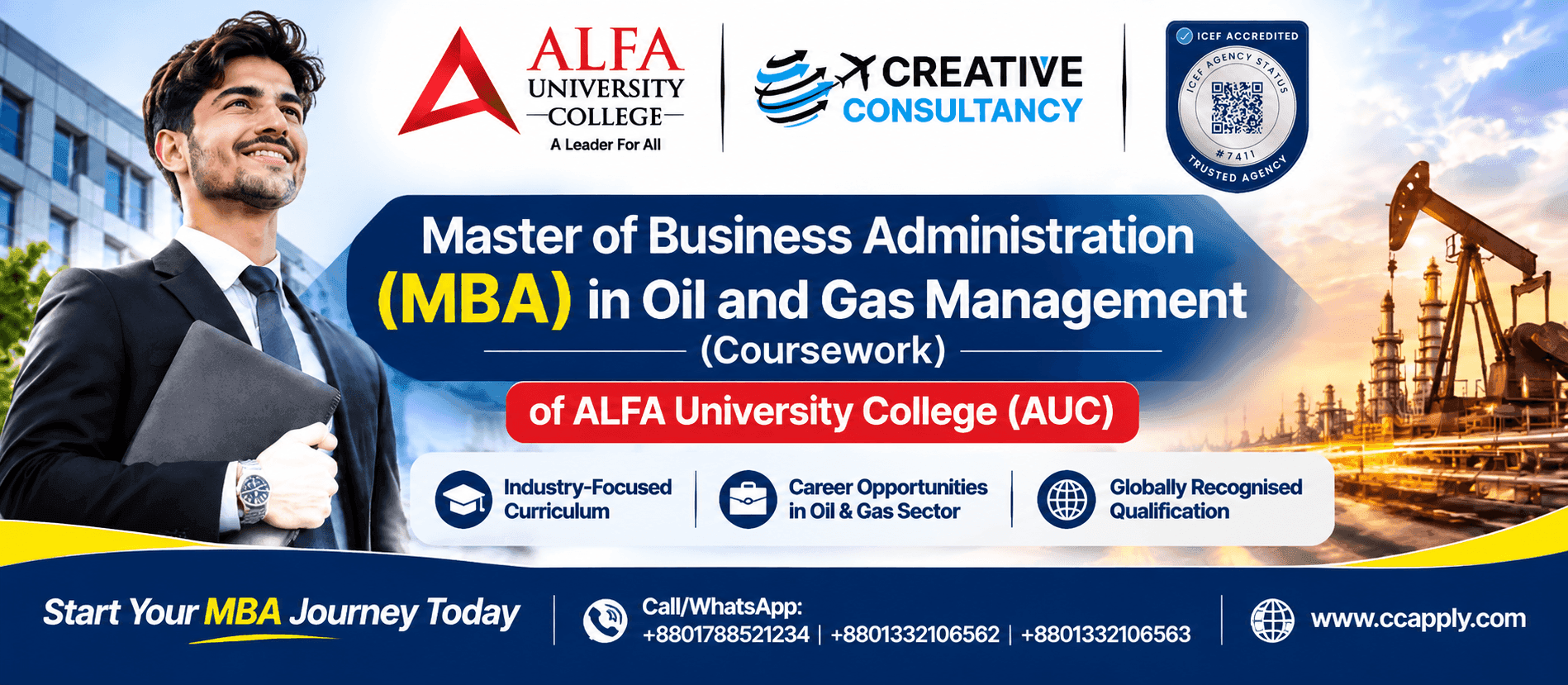
Want to pursue an MBA that goes beyond traditional business management? Interested in the global oil and gas industry, energy business, leadership and international project management?
Choosing the right master's degree is an important decision. You want a qualification that develops your business knowledge, strengthens your management capabilities and helps you prepare for the professional opportunities you hope to pursue.
If these are your goals, the Master of Business Administration (MBA) in Oil and Gas Management (Coursework) at ALFA University College (AUC), Malaysia, is a programme worth exploring.
The oil and gas industry is a complex international business environment. It involves much more than petroleum exploration and production. Behind the industry are thousands of professionals working in business strategy, finance, supply chain management, logistics, project coordination, risk management and organisational leadership.
This specialised MBA brings together important business administration subjects and oil and gas industry-related knowledge, giving students an opportunity to understand the commercial and managerial side of the energy sector.
Even if you are not currently working in the oil and gas industry, developing knowledge of business management, leadership, finance and operations can be valuable across different professional environments.
And if you are planning to study in Malaysia from Bangladesh, Creative Consultancy can help you understand the programme, assess your eligibility and navigate your international university application with transparent, professional guidance.
Let's take a closer look at the programme, its subjects, benefits, admission requirements and the reasons to apply through Creative Consultancy.
The MBA in Oil and Gas Management at ALFA University College is a postgraduate business programme focusing on leadership and management within the oil and gas sector.
The programme combines core business subjects with specialised topics such as the oil and gas value chain, energy policy, operations, logistics, health and safety, and project management.
According to ALFA University College, the programme aims to develop leadership and management skills relevant to the global energy industry through theoretical and practical learning.
Programme Information | Details |
|---|---|
University | ALFA University College (AUC) |
Programme | Master of Business Administration in Oil and Gas Management |
Study Level | Master's Degree |
Study Structure | Coursework |
Study Mode | Full-Time |
Minimum Duration | 1.5 Years |
Study Destination | Malaysia |
Course Code | N/0414/7/0285 (PA 18245) |
Why is this programme interesting?
Because it connects two important areas of professional development: business administration and energy-industry management.
Students have the opportunity to explore how companies manage people, finances, operations, projects and international business activities within a specialised industrial environment.
When people think about the oil and gas industry, they often imagine offshore platforms, petroleum engineers, drilling operations and energy production.
However, there is another important side to this industry: business management.
Every major energy organisation needs professionals who can coordinate operations, manage financial resources, understand international markets, lead teams and make strategic decisions.
Consider how many different activities are involved in running an energy business:
Planning and managing large-scale projects.
Coordinating international supply chains.
Managing procurement and logistics.
Controlling operational costs and budgets.
Developing business strategies.
Managing employees and organisational performance.
Understanding energy policies and contracts.
Identifying operational risks and safety responsibilities.
These activities require more than technical knowledge. They also require business understanding, management capabilities and leadership skills.
This is where an MBA in Oil and Gas Management becomes relevant.
Rather than focusing exclusively on the technical side of petroleum operations, the programme explores the business and management principles that help energy-related organisations function effectively.
For students interested in the commercial, strategic and managerial side of the energy sector, this can be an appealing postgraduate pathway.
One of the most important things to consider before choosing a master's degree is its course content.
You should understand what you will study, how the subjects connect to your professional interests and what knowledge you can expect to develop.
ALFA University College's published programme outline includes the following subjects.
The first semester introduces students to essential business administration concepts.
Business Ethics
Understand ethical decision-making, professional responsibilities and the importance of responsible business practices.
Organisational Behaviour
Explore how people, teams and organisational structures influence workplace performance and management.
Marketing Management
Develop an understanding of marketing strategies, customer behaviour and how businesses position themselves in competitive markets.
Business Accounting and Finance
Learn about accounting principles, financial information and the importance of financial decision-making in organisations.
Management Information System
Understand how businesses use information systems to organise information and support operational and managerial decisions.
Introduction to Oil and Gas Industry
Explore the structure and business environment of the oil and gas industry and develop a foundation for understanding its operations.
The second semester moves further into strategic business management and specialised industry subjects.
Strategic Management
Learn how organisations establish objectives, evaluate business environments and develop strategies for long-term growth.
Oil and Gas Value Chain
Understand how different stages of the oil and gas industry connect, from upstream activities to downstream operations.
Business Research Methodology
Develop research and analytical skills that help you investigate business questions and evaluate information.
Human Resource Management
Explore recruitment, employee development, workforce management and organisational performance.
Leadership, Communication and Change in Oil and Gas Industry
Understand how leadership, communication and organisational change influence businesses operating in the energy sector.
The final semester focuses on more specialised areas of business and energy management.
Operation and Logistics Management
Learn about operational planning, logistics coordination and supply chain processes.
International Energy Policy and Contract Law
Explore international energy policies and the importance of contractual arrangements in the energy business.
Health, Safety and Risk Management in Oil and Gas Industry
Understand the importance of workplace safety, operational risk assessment and responsible management in the oil and gas sector.
Oil and Gas Economy and Project Management
Explore energy economics and project management through an industry-related academic project.
Together, these subjects provide an opportunity to understand how business strategy, financial management, leadership and operational planning connect within the energy industry.
A specialised MBA can be an interesting choice if you want to develop both general business knowledge and an understanding of a particular industry.
Here are some of the key benefits of considering this programme.
A general MBA provides broad management knowledge. This programme adds an oil and gas focus.
You can explore traditional business concepts while learning how management principles relate to energy-sector operations.
This combination can be useful if you are interested in specialised industrial businesses.
Successful businesses need people who can look beyond daily operations.
Strategic management involves understanding business environments, setting objectives, allocating resources and making decisions that support long-term organisational goals.
These concepts are relevant to energy companies as well as many other industries.
Oil and gas is an internationally connected industry.
Energy policies, supply chains, commercial agreements and market conditions can involve organisations across multiple countries.
Studying the industry from a management perspective can help you develop a broader understanding of international business.
Large industrial projects require planning, coordination, resource allocation and risk management.
The programme's project management content gives students an opportunity to explore how projects are organised and managed.
This knowledge can be relevant to energy projects and other business environments.
Supply chain management is an essential part of many industries.
From procurement to transportation and inventory coordination, organisations depend on efficient supply chain processes.
Understanding these concepts can support your interest in logistics, operations and procurement-related careers.
Managers need to understand the financial side of business decisions.
Subjects related to accounting and finance can help students develop knowledge of budgeting, financial information and resource management.
A good manager needs to communicate clearly, work with different teams and make informed decisions.
The programme includes organisational behaviour, human resource management and leadership-related subjects that explore these important areas.
The oil and gas industry involves complex operational environments.
Understanding health, safety and risk management is important for responsible business operations.
The programme introduces students to these management considerations.
The knowledge gained from an MBA can be relevant to different business and management-related career paths.
It may support your interest in operations, project management, business development, logistics, procurement and energy-sector administration.
Studying in Malaysia gives you an opportunity to experience a different academic and cultural environment.
You can develop independence, interact with people from different backgrounds and broaden your understanding of international business.
A common question students ask before choosing a master's programme is:
"What can I do after completing this degree?"
It is a sensible question because postgraduate education should connect with your long-term professional interests.
An MBA in Oil and Gas Management may be relevant to several business and management career directions.
Some potential areas include:
1. Oil and Gas Operations Management
Work towards roles involving operational coordination, business processes and performance management.
2. Energy Business Development
Explore opportunities involving commercial planning, business relationships and organisational growth.
3. Project Management
Develop towards roles involving project planning, resource coordination, timelines and project delivery.
4. Supply Chain Management
Explore procurement, inventory, logistics and supply chain coordination.
5. Contract and Procurement Management
Develop knowledge relevant to supplier relationships, purchasing activities and contract administration.
6. Business Analysis
Work with organisational information to identify business challenges and support management decisions.
7. Energy Business Consultancy
Explore business analysis, commercial strategy and management-related advisory work.
8. General Business and Operations Management
Apply business administration and leadership knowledge in different organisational environments.
The important thing to remember is that a master's degree is one part of your professional profile. Your previous academic background, relevant work experience, additional qualifications and employer requirements will also influence your career opportunities.
This MBA is a management qualification, not a substitute for technical engineering or petroleum engineering qualifications.
For many Bangladeshi students, choosing an international study destination involves more than selecting a university.
You also need to think about the learning environment, lifestyle, cultural experience and your long-term academic goals.
Malaysia is an option worth exploring for several reasons.
Malaysia has a diverse population and an international student community.
Studying in such an environment can help you interact with people from different cultures and develop your communication skills.
Studying abroad introduces you to different academic approaches and learning environments.
You also have the opportunity to become more independent and confident in managing your responsibilities.
Malaysia is part of Southeast Asia, a region with diverse industries and international business connections.
For students studying business administration, understanding different economic and commercial environments can be a valuable experience.
International education is not only about attending lectures and completing assignments.
It also involves learning how to manage daily responsibilities, adapt to a new environment and communicate with people from different backgrounds.
These experiences can contribute to your personal and professional development.
Before applying for an MBA in Malaysia, it is important to understand whether your academic background meets the university's requirements.
According to ALFA University College's published programme information, the main academic entry pathways include:
A recognised bachelor's degree in a business-related field with a minimum CGPA of 2.50 out of 4.00, or an equivalent qualification accepted by the university.
A business-related bachelor's degree with a CGPA below 2.50 may be considered with a minimum of five years of working experience.
Other qualifications equivalent to a recognised bachelor's degree may be considered.
Applicants without relevant qualifications or experience may be required to complete prerequisite courses determined by the university.
For international students, the university publishes the following English-language requirements or equivalent qualifications:
MUET: Minimum Band 4.
CEFR: Mid B2.
IELTS: Minimum 6.0.
TOEFL iBT: Minimum 60.
Pearson English Test: Minimum 59.
Equivalent English-language qualifications may also be considered.
International students must also undergo the medical check-up in Malaysia arranged by ALFA University College, in accordance with the university's published requirements.
Students should generally prepare the following documents for an initial application assessment:
Valid passport copy.
Bachelor's degree certificate.
Academic transcripts.
English-language proficiency evidence, where applicable.
Updated CV, if requested.
Passport-size photographs.
Employment documents, where required.
Any additional documents requested by the university.
Important: Meeting the general academic requirements does not automatically guarantee admission. The university evaluates individual qualifications and may request additional documents. International student and visa requirements should also be checked before proceeding.
Choosing a university is a major decision. Choosing the right application-support partner can make the process easier to understand.
Many students and parents have similar concerns:
Is the consultancy officially authorised?
Will someone explain the admission requirements clearly?
Are there hidden charges?
Will I receive updates about my application?
Can someone guide me through the student visa process?
Will I know exactly what I am paying for?
At Creative Consultancy, we understand these concerns.
We believe that studying abroad should be an exciting opportunity, not a confusing financial or administrative burden.
Our approach is built around professional guidance, transparent communication and putting students' interests first.
Here are the reasons students should consider applying through Creative Consultancy.
Creative Consultancy works as an official representative for its authorised university partners.
This means we can help students understand relevant university programmes, application procedures and admission requirements for the institutions we represent.
Instead of navigating every step without guidance, you can receive assistance from a team familiar with international student application procedures.
Our representation applies to the institutions for which we hold authorisation.
When choosing an international education consultancy, trust and professional conduct matter.
Creative Consultancy is ICEF certified.
We place importance on professional student recruitment practices, transparent information and responsible guidance.
For students and parents, choosing a consultancy that takes professional standards seriously can provide additional confidence when beginning an international education journey.
This is one of the biggest advantages of choosing Creative Consultancy.
We understand that studying abroad already involves several financial commitments.
Students need to consider tuition fees, accommodation, living expenses, medical costs, visa-related charges and other necessary expenses.
We do not believe students should have to pay unnecessary consultancy charges on top of these expenses.
That is why our commitment is simple:
Zero consultancy service charges.
Zero file-opening charges.
No hidden consultancy fees.
No unnecessary consultancy handling charges.
We want students to receive professional application guidance without paying additional consultancy service fees.
We also believe in being completely honest about the expenses involved.
University tuition fees, institutional application fees, immigration charges, medical expenses and other third-party costs may still apply. We explain these costs rather than misleading students with unrealistic claims of completely free overseas education.
One of the biggest problems students can face during the study-abroad process is not knowing what happens next.
At Creative Consultancy, we believe students deserve clear information at every important stage.
We aim to explain:
Which programme you are applying for.
Whether your academic background is suitable.
What documents you need.
How the application process works.
Which expenses may apply.
What happens after receiving an offer letter.
What the next student visa procedures involve.
We want you to understand your application rather than simply submit documents and wait without information.
We know that the student visa process is one of the biggest concerns for international applicants and their families.
Creative Consultancy has a strong record of successful visa outcomes and experience supporting students through international admission and visa procedures.
Our approach focuses on proper documentation, clear instructions and careful preparation.
We help students understand the relevant requirements and the importance of submitting accurate information.
Of course, no consultancy can guarantee a visa. Final decisions are made by the relevant immigration authorities.
Our commitment is to provide responsible guidance and help students prepare as carefully as possible.
Applying to a university is not simply about sending a few documents.
There are several stages that students need to understand.
Depending on the university and the individual application, these may include:
Initial programme selection.
Academic eligibility assessment.
Document preparation.
Application submission.
University communication.
Offer letter procedures.
Payment guidance.
Student visa documentation.
Pre-departure preparation.
Creative Consultancy aims to guide students through the relevant stages so they know what to expect and what actions they need to take.
Not every student has the same academic history.
Some students have excellent CGPAs. Others may have professional experience, different academic backgrounds or questions about alternative entry requirements.
We believe these differences deserve attention.
Our approach is to understand your academic profile and help you explore appropriate study options rather than encouraging you to apply blindly.
This can help students make more informed decisions before investing time and money in an application.
We understand that studying abroad is often a family decision.
Parents want to know where their children will study, what the financial commitments are and what the application process involves.
Students want to understand their academic opportunities and future possibilities.
At Creative Consultancy, we value clear communication because trust is built through honesty.
We aim to provide realistic information, explain applicable costs and avoid making promises that are outside our control.
For many students, consultancy charges can create an additional financial burden.
By not charging our own consultancy service fees or file-opening fees, we aim to make professional application assistance more accessible.
Our goal is to help students focus on finding suitable education opportunities while understanding the actual costs involved.
We do not believe every student should follow the same path.
Your academic background, budget, interests and career ambitions are important.
That is why we value individual guidance, clear explanations and responsible recommendations.
At Creative Consultancy, we want students to make informed decisions, feel confident about their applications and understand every important step of their international education journey.
You can choose to apply directly to a university. However, if you are unfamiliar with international admissions, professional application assistance can make the process easier to navigate.
Applying independently | Applying through Creative Consultancy |
|---|---|
Research admission criteria yourself | Guidance on programme and admission requirements |
Prepare documents without assistance | Document preparation guidance |
Manage application procedures yourself | Application process assistance |
Research subsequent procedures | Guidance on relevant next steps |
Contact the university independently | Assistance with university-related communication |
Work through questions yourself | Professional support and clarification |
Pay for any consultancy you choose separately | Zero Creative Consultancy service charges |
The university remains responsible for admission decisions, and immigration authorities make visa decisions. Creative Consultancy's role is to help you navigate the relevant procedures with greater clarity.
Before choosing any postgraduate programme, ask yourself what you want to achieve.
The MBA in Oil and Gas Management may be worth considering if:
You have completed a bachelor's degree and want to pursue an MBA.
You are interested in the business side of the oil and gas industry.
You want to understand energy-sector management and operations.
You are interested in strategic management and project management.
You want to develop knowledge of finance, logistics and leadership.
You are considering international postgraduate education in Malaysia.
You want a specialised business qualification rather than a purely general management programme.
However, make sure you review the course content, academic requirements, financial commitments and career relevance before making your final decision.
A good education decision is one that matches your own goals, not simply what is popular.
It is a postgraduate business administration programme focusing on leadership and management knowledge relevant to the oil and gas industry.
The university publishes a minimum full-time study duration of 1.5 years.
The programme is being promoted here as the coursework option. Students should confirm the latest study structure with the university before applying.
The published general entry pathway includes a minimum CGPA of 2.50 out of 4.00 for a recognised business-related bachelor's degree. Other pathways may apply depending on qualifications and working experience.
The university indicates that applicants with a business-related bachelor's degree and a CGPA below 2.50 may be considered with at least five years of working experience, subject to its assessment.
The university publishes IELTS 6.0 as one accepted English-language qualification. Other equivalent qualifications may also be accepted.
The programme includes business ethics, organisational behaviour, marketing management, accounting and finance, strategic management, oil and gas value chain, logistics, energy policy, contract law, risk management and project management.
The qualification may support applications for relevant business and management-related positions. Actual opportunities depend on your previous education, work experience, employer requirements and professional qualifications.
No. Creative Consultancy does not charge consultancy service fees or file-opening charges.
Yes. Creative Consultancy identifies itself as an ICEF-certified education consultancy.
No consultancy can guarantee a visa. Creative Consultancy provides guidance and application preparation assistance, while the final decision belongs to the relevant immigration authorities.
You can contact our team through WhatsApp or our website. We can guide you regarding programme information, academic eligibility, documents and the relevant application procedures.
Your next academic step should be based on the future you want to build.
If you are interested in business administration, energy-sector management, leadership and international project operations, the MBA in Oil and Gas Management at ALFA University College, Malaysia, is a programme worth exploring.
You do not need to figure out every application requirement on your own.
Creative Consultancy is here to make the process easier to understand.
With our official university representation, ICEF certification, transparent working approach, strong visa success experience and zero consultancy service charges, we aim to provide students with the professional guidance they need.
No file-opening charges. No hidden consultancy service fees. Just clear information and student-focused application assistance.
Your international education journey deserves the right guidance. Let's take the first step together.
Have questions about the MBA in Oil and Gas Management at ALFA University College?
Contact our team today to discuss your academic background, admission eligibility and application process.
Call / WhatsApp:
📞 +8801788521234
📞 +8801332106562
📞 +8801332106563
Website: www.ccapply.com
CREATIVE CONSULTANCY
Your Trusted Partner for International Education.
Explore your opportunities. Apply with confidence. Build your future.
More posts you may want to read.
Bachelor of Medical Imaging (Hons) at MAHSA University, Malaysia: Complete Guide to Course Details, Benefits, Admission Requirements and Career Opportunities Explore Medical Imaging in Malaysia Are you planning to build a successful career in the healthcare sector? Do you have an interest in medical science, modern technology, diagnostic procedures and patient care? If so, pursuing a Bachelor of Medical Imaging (Hons) in Malaysia could be an excellent academic pathway to consider. The healthcare industry continues to evolve with the development of advanced diagnostic technologies. Today, medical professionals rely on sophisticated imaging systems to examine the human body, identify injuries, investigate diseases and support important clinical decisions. Technologies such as X-ray, Magnetic Resonance Imaging (MRI), Computed Tomography (CT), ultrasound and other diagnostic imaging methods have become essential components of modern healthcare. For students who are interested in combining healthcare knowledge with advanced technology, Medical Imaging offers an opportunity to enter a specialised and intellectually rewarding academic field. One programme worth exploring is the Bachelor of Medical Imaging (Hons) at MAHSA University, Malaysia . This four-year undergraduate degree focuses on medical diagnostic imaging, radiographic techniques, imaging technology, radiation safety and clinical practice. Through a combination of theoretical education, practical learning and clinical exposure, students develop the foundational knowledge and professional competencies required for a future in medical imaging. In this comprehensive guide, Creative Consultancy explores everything prospective students should know about studying Medical Imaging at MAHSA University, including programme details, subject areas, academic benefits, clinical training, career opportunities, admission requirements and the application process. Whether you are a student who has recently completed higher secondary education or a parent researching international healthcare education opportunities, this guide will help you make a more informed decision. 1. Why Choose Medical Imaging as a Higher Education Pathway? Medical Imaging is one of the specialised disciplines within modern healthcare. It focuses on producing medical images that help healthcare professionals investigate the internal structures of the human body. Unlike some traditional academic disciplines, Medical Imaging combines several areas of knowledge, including: Medical and biological sciences. Human anatomy and physiology. Physics and radiation science. Digital imaging technology. Diagnostic radiography. Patient care and clinical communication. Medical equipment operation. Healthcare ethics and professional practice. A medical imaging professional does much more than operate a machine. The profession requires an understanding of human anatomy, patient positioning, imaging techniques, image quality, radiation protection and clinical responsibilities. For example, when a patient visits a hospital following an accident, diagnostic imaging may be required to investigate a possible fracture or internal injury. A trained radiographer plays an important role in carrying out the imaging procedure and ensuring that the images are suitable for clinical assessment. Similarly, MRI and CT examinations help healthcare professionals investigate complex medical conditions, while ultrasound is used in numerous diagnostic applications. This combination of science, technology and patient interaction makes Medical Imaging an interesting choice for students who want to contribute to the healthcare sector. 2. About MAHSA University, Malaysia MAHSA University is a Malaysian higher education institution with a focus on medical sciences, healthcare education and professional development. The university offers academic programmes across several disciplines, including medicine, dentistry, pharmacy, nursing, allied health sciences, business and technology. Its Faculty of Health Sciences, Nursing and Education provides programmes designed to develop students' theoretical knowledge, practical abilities and understanding of professional healthcare environments. For international students interested in pursuing a healthcare-related degree, MAHSA University is an institution worth considering when comparing undergraduate study options in Malaysia. The university's Bachelor of Medical Imaging (Hons) is particularly relevant to students interested in diagnostic radiography and medical imaging technology. Why consider MAHSA University? A dedicated academic focus on healthcare and medical sciences. A specialised undergraduate Medical Imaging programme. Exposure to different diagnostic imaging technologies. A curriculum covering medical science and imaging principles. Practical and clinical learning opportunities. An international higher education environment in Malaysia. Students should always review the latest university programme information, admission conditions and professional recognition details before making an enrolment decision. 3. Bachelor of Medical Imaging (Hons): Complete Programme Overview The Bachelor of Medical Imaging (Hons) at MAHSA University is a four-year undergraduate programme designed to develop qualified professionals in diagnostic medical imaging. The degree focuses on the scientific principles, technical procedures and clinical applications of different imaging technologies. The Malaysian Qualifications Register lists the qualification at Malaysian Qualifications Framework (MQF) Level 6, with 136 credits and a four-year full-time duration under its listed programme record. Programme Information Programme Details Information University MAHSA University Country Malaysia Programme Name Bachelor of Medical Imaging (Hons) Study Level Bachelor's Degree Programme Duration 4 Years Faculty Faculty of Health Sciences, Nursing and Education Study Area Medical Diagnostic and Treatment Technology Qualification Level MQF Level 6 Credits 136 Study Mode Full-time Main Academic Focus Diagnostic Radiography and Medical Imaging The programme is designed to help students understand how diagnostic imaging technologies are used in healthcare environments. Throughout their studies, students explore different areas of medical science and imaging practice, gradually developing the knowledge required to work with diagnostic imaging equipment and patients. 4. What Will You Study in Bachelor of Medical Imaging (Hons)? One of the most important considerations when choosing a university programme is understanding what you will actually learn. The Bachelor of Medical Imaging (Hons) covers a wide range of subjects that combine medical science, imaging physics, technology and clinical practice. Below are some of the major academic areas included in the programme. 4.1 Human Anatomy and Physiology Human anatomy and physiology form the foundation of medical imaging education. Anatomy focuses on the structure of the human body, while physiology explains how different organs and body systems function. Students develop an understanding of: The skeletal system. The muscular system. The cardiovascular system. The respiratory system. The nervous system. The digestive system. Major internal organs. This knowledge is essential because medical imaging professionals must understand the anatomical structures they are examining. 4.2 General Pathology Pathology is the study of diseases and the changes they cause within the human body. Students learn about different disease processes and how certain medical conditions may appear through diagnostic imaging. This knowledge helps them understand the clinical purpose of different imaging examinations. 4.3 Radiation Physics and Medical Radiation Science Physics plays an important role in diagnostic imaging. Students explore the scientific principles behind radiation production, image formation and the interaction of radiation with human tissue. They also learn why radiation exposure must be carefully controlled during diagnostic procedures. Understanding these principles helps future professionals work responsibly with medical imaging equipment. 4.4 Clinical Radiography and X-ray Techniques Radiography is one of the most widely used diagnostic imaging methods. Students develop knowledge of: X-ray production. Radiographic exposure factors. Patient positioning. Image quality. Radiographic techniques. Radiation protection. They also learn how different radiographic examinations are performed in clinical environments. 4.5 Magnetic Resonance Imaging (MRI) MRI is an advanced imaging technology that uses magnetic fields and radiofrequency signals to produce detailed images of internal body structures. It is commonly used in examinations involving the brain, spinal cord, joints, muscles and other soft tissues. Students explore the principles of MRI technology, its clinical applications and the safety considerations involved in MRI examinations. 4.6 Computed Tomography (CT Scan) Computed Tomography uses X-rays and computer processing to produce cross-sectional images of the human body. CT imaging is widely used in emergency medicine, trauma assessment and the investigation of various medical conditions. Students develop knowledge of CT imaging principles, image acquisition, patient positioning and the technical factors involved in producing quality diagnostic images. 4.7 Ultrasonography Ultrasound imaging uses high-frequency sound waves to create images of internal body structures. It has applications in abdominal examinations, obstetric imaging, vascular assessment and other diagnostic procedures. Students learn the fundamental principles and clinical applications of ultrasound technology. 4.8 Mammography and Digital Vascular Imaging The programme also introduces students to specialised imaging areas such as mammography and digital vascular imaging. Mammography is used in breast imaging, while vascular imaging techniques help healthcare professionals examine blood vessels and related structures. These subjects expand students' understanding of specialised diagnostic procedures. 4.9 Radiation Biology and Safety Patient and occupational safety are essential responsibilities in medical imaging. Students learn about radiation biology, radiation protection principles, safety procedures and the importance of minimising unnecessary radiation exposure. They also develop an understanding of professional responsibilities when working with imaging equipment. 4.10 Image Interpretation and Professional Practice Students explore the principles of evaluating medical images and understanding how imaging findings relate to different clinical conditions. Professional practice also covers communication, ethics, teamwork, patient care and responsibilities within healthcare environments. Together, these subjects help students develop a broad academic foundation for a career in medical imaging. 5. Understanding the Major Medical Imaging Technologies One of the most attractive aspects of studying Medical Imaging is the opportunity to learn about technologies that are widely used in modern hospitals. Let's explore some of the most important imaging modalities. X-ray: A Fundamental Diagnostic Imaging Technology X-ray imaging is commonly used to examine bones, joints and certain internal structures. It is frequently used to investigate fractures, chest conditions and other medical concerns. Students learn how X-ray equipment works, how patients are positioned and how image quality can be maintained while following radiation safety procedures. MRI: Advanced Imaging Without Ionising Radiation Magnetic Resonance Imaging uses powerful magnetic fields and radiofrequency energy rather than ionising radiation. It provides detailed images of soft tissues and is particularly useful in neurological, musculoskeletal and other diagnostic examinations. Learning about MRI introduces students to advanced imaging principles and specialised patient safety considerations. CT Scan: Detailed Cross-Sectional Imaging CT technology combines X-ray measurements with computer processing to create detailed cross-sectional images. It is particularly valuable when healthcare professionals need to examine complex anatomical structures or investigate injuries quickly. Students explore the technical and clinical principles involved in CT examinations. Ultrasound: Real-Time Diagnostic Imaging Ultrasound is widely used in many areas of diagnostic healthcare. It is particularly useful because it can produce real-time images without using ionising radiation. Students learn how ultrasound technology works and how it supports different medical examinations. Nuclear Medicine and Specialised Imaging Nuclear medicine involves the use of radiopharmaceuticals for diagnostic or therapeutic purposes. The programme introduces students to specialised imaging concepts, including radionuclide imaging and related medical radiation science. Exposure to these subjects broadens students' understanding of the different technologies used in contemporary healthcare. 6. Practical Learning and Clinical Training: Why It Matters A medical imaging degree should not be limited to textbooks and classroom lectures. Professional competence requires students to understand how imaging procedures are performed in real healthcare settings. That is why practical learning and clinical exposure are important elements of Medical Imaging education. MAHSA University's programme includes practical learning and clinical placement components. During their training, students develop an understanding of several important clinical responsibilities. Patient Positioning Correct patient positioning is essential for producing appropriate diagnostic images. Students learn how positioning techniques vary depending on the examination and the anatomical area being investigated. Image Quality Management Producing clear and diagnostically useful images is a fundamental responsibility of medical imaging professionals. Students develop knowledge of exposure factors, imaging techniques and factors that influence image quality. Patient Communication Patients may feel anxious or uncomfortable before undergoing diagnostic procedures. Medical imaging professionals must communicate clearly, explain relevant instructions and help patients feel comfortable during examinations. Radiation Protection Radiation safety is a major responsibility in radiographic practice. Students learn the importance of following safety standards, protecting patients and minimising unnecessary exposure. Clinical Teamwork Medical imaging professionals work alongside doctors, nurses and other healthcare practitioners. Developing professional communication and teamwork skills is therefore an important part of clinical education. Practical and clinical learning helps students connect academic knowledge with the responsibilities of a healthcare professional. 7. Top Benefits of Studying Medical Imaging at MAHSA University Choosing the right degree involves considering the academic experience, technical knowledge, professional development and future opportunities. Here are some of the major benefits of studying the Bachelor of Medical Imaging (Hons). Benefit 1: A Specialised Healthcare Qualification Medical Imaging is a specialised field within healthcare. The degree provides students with focused academic knowledge in diagnostic radiography, imaging physics, medical science and clinical procedures. This can be particularly attractive to students who already have an interest in medical and allied health sciences. Benefit 2: Knowledge of Modern Medical Technology Healthcare technology continues to develop. By studying different imaging modalities, students gain an understanding of the technologies used in diagnostic healthcare. This includes X-ray, CT, MRI, ultrasound and other specialised imaging procedures. Benefit 3: A Combination of Science and Technology Some students enjoy biology, while others are interested in physics and technology. Medical Imaging brings these interests together. Students learn how scientific principles are applied through medical equipment to support patient diagnosis and healthcare decisions. Benefit 4: Practical and Clinical Exposure Practical learning provides opportunities to understand how medical imaging procedures are carried out. Clinical placements help students become familiar with professional healthcare environments, patient interaction and imaging workflows. Benefit 5: Development of Analytical Thinking Medical imaging requires attention to detail and a systematic approach to technical procedures. Students develop analytical skills, problem-solving abilities and an understanding of image quality and clinical requirements. Benefit 6: Meaningful Contribution to Patient Care Medical imaging professionals contribute to patient care by performing diagnostic procedures that support medical assessment. Their responsibilities involve both technical competence and compassionate communication. For students who want a healthcare career with direct involvement in patient services, this can be a meaningful professional direction. Benefit 7: Opportunities for Further Specialisation After graduation, eligible professionals may pursue further education and specialised professional development in relevant areas. Depending on their qualifications and experience, they may explore postgraduate study, research and advanced training opportunities. Benefit 8: Transferable Professional Skills The degree also helps students develop skills that are useful across healthcare environments, including: Communication. Teamwork. Professional ethics. Time management. Critical thinking. Problem-solving. Attention to detail. Patient-centred care. These abilities contribute to professional development throughout a healthcare career. 8. Career Opportunities After a Medical Imaging Degree A common question among students and parents is: What can I do after completing a Bachelor of Medical Imaging (Hons)? Medical Imaging graduates may explore different professional opportunities depending on their qualifications, practical experience, professional registration and the requirements of their intended country of employment. 8.1 Diagnostic Radiographer Diagnostic radiographers perform imaging examinations using radiographic equipment. They work with patients, position them appropriately and produce images that support clinical assessment. 8.2 CT Technologist CT technologists work with computed tomography systems. They assist with CT examinations and follow technical and safety procedures to produce appropriate diagnostic images. 8.3 MRI Technologist MRI technologists work with magnetic resonance imaging systems. Their responsibilities include preparing patients, conducting examinations and following MRI safety procedures. 8.4 Medical Imaging Technologist Medical imaging technologists work with different diagnostic imaging technologies depending on their professional training and clinical responsibilities. 8.5 Medical Equipment Application Specialist Graduates with relevant additional technical and industry experience may explore roles involving medical imaging equipment, application support and technical training. 8.6 Clinical Education and Research Further academic qualifications and professional experience may create opportunities in clinical teaching, research and higher education. 8.7 Healthcare Technology and Related Industries Medical imaging knowledge can also be relevant to certain positions within healthcare technology companies, diagnostic equipment providers and medical service organisations. Important career consideration: Completing a degree does not automatically guarantee employment, professional registration or permission to practise in every country. Graduates must meet the licensing and registration requirements of the country in which they intend to work. Students from Bangladesh should investigate the relevant professional recognition requirements before enrolling. 9. Why Study Medical Imaging in Malaysia? Malaysia has become a recognised destination for international higher education, attracting students from different countries. For Bangladeshi students, studying in Malaysia can offer a combination of international exposure, academic development and cultural experience. International Academic Environment Students have opportunities to interact with people from different cultural and educational backgrounds. This can help them develop communication skills, independence and a broader understanding of international society. English-Language Learning Opportunities Many Malaysian higher education programmes use English as their primary language of instruction. Studying in an English-language academic environment can help students strengthen their academic communication and professional confidence. Modern Healthcare Education Malaysia offers higher education institutions with specialised programmes in medical and allied health sciences. Students can explore academic pathways that combine scientific education with practical learning. Cultural Diversity Malaysia is a multicultural country with diverse communities, traditions and lifestyles. International students can experience a different cultural environment while continuing their academic development. Regional Exposure Studying in Southeast Asia gives students the opportunity to experience a dynamic regional environment and build an international educational profile. However, students should evaluate each university and programme individually rather than choosing a destination based only on general expectations. 10. Admission Requirements for Bachelor of Medical Imaging (Hons) Before applying to MAHSA University, international students should carefully review the admission requirements. The university assesses academic qualifications, subject backgrounds and English-language proficiency. The published programme information identifies several possible academic entry pathways. STPM, Matriculation or Pre-University Applicants may be considered with an appropriate pre-university qualification and the required academic performance in relevant subjects. Relevant subjects include: Biology. Physics or Mathematics. Chemistry. A-Level Qualification Applicants with A-Level qualifications may be considered based on the required grades in relevant science subjects. Related Diploma Applicants holding a recognised diploma in a related field may be considered for admission, subject to the university's academic assessment. Additional work experience requirements may apply to certain diploma pathways. English Language Requirements International students must meet the university's English-language requirements. Published MAHSA programme guidance has included IELTS 5.5 or an accepted equivalent qualification. The precise accepted English tests and minimum scores should be confirmed for the intended intake. Important Advice for Bangladeshi Students If you have completed HSC, A-Levels, a diploma or another equivalent qualification, you should not assume that your qualification will automatically meet the admission requirements. The university may need to assess: Your academic transcripts. Your previous subjects. Your examination results. Your English-language qualification. Your overall academic eligibility. Creative Consultancy can help you understand the admission process and prepare your academic documents for university assessment. 11. Documents Required for International Student Applications Preparing the correct documents is an important part of the university application process. Although the exact requirements depend on the student's academic background and the university's instructions, international applicants are commonly asked to prepare the following: Valid passport copy. Recent passport-sized photographs. Academic certificates. Academic transcripts or mark sheets. English-language proficiency certificate, if required. Updated CV, where applicable. Relevant diploma or professional documents, where applicable. Additional documents requested by the university. Applicants should ensure that their documents are complete, accurate and consistent. Any discrepancies in personal information, academic results or passport details should be addressed before submission. 12. Understanding the Student Visa Process in Malaysia For international students, receiving a university offer is an important milestone, but it is not the final step. Students must also complete the applicable student visa and immigration procedures. The process generally involves several stages: Step 1: University Application The student submits the required academic and personal documents for admission assessment. Step 2: Offer Letter If the application is successful, the university issues an offer letter according to its admission procedures. Step 3: Acceptance and Enrolment Requirements The student follows the university's instructions regarding offer acceptance and any required payments. Step 4: Student Pass Application The relevant student pass application is prepared and processed through the applicable Malaysian international student procedures. Step 5: Immigration Assessment The relevant authorities review the application and supporting documentation. Step 6: Travel and Arrival Preparation Once the necessary approvals are obtained, students can follow the university's instructions regarding travel, registration and arrival. Visa approval is not guaranteed and remains subject to immigration assessment. Students should also carefully review official payment instructions and avoid making payments to unauthorised individuals. 13. Why Choose Creative Consultancy for Your MAHSA University Application? Selecting the right university is important, but choosing a reliable education consultancy can also make a significant difference to your application experience. Studying abroad involves several decisions, including programme selection, academic eligibility, document preparation, university admission and student visa procedures. At Creative Consultancy , we understand that students and parents need accurate information, professional guidance and transparent communication throughout this process. Our aim is to make the journey towards international higher education more straightforward and accessible. Official University Representatives Creative Consultancy works as an official representative of its partner universities. We assist prospective students in exploring suitable programmes and understanding the relevant university application procedures. For students interested in MAHSA University, our team can help them understand the admission process and prepare their applications. ICEF Accredited – Trusted Agency #7411 Creative Consultancy is an ICEF-accredited trusted agency, with agency identification number 7411 . We value professional standards, responsible student recruitment and transparent communication. This accreditation is an important part of our professional identity in the international education sector. Transparent Application Process We believe that every student deserves to understand the process before making an important educational decision. Our approach focuses on: Clear admission information. Honest communication. Proper documentation guidance. Transparent discussion of applicable expenses. Regular application updates. Responsible student support. We do not believe in misleading students with unrealistic promises. Strong Visa Success Record Creative Consultancy has substantial experience supporting students through international student visa applications. Our team understands the importance of accurate documentation, careful preparation and following the relevant application procedures. We guide students through the process while recognising that final visa decisions are made exclusively by the relevant immigration authorities. Zero Consultancy Service Charges One of the key advantages of applying through Creative Consultancy is our commitment to accessible application support. We do not charge students any consultancy service fees. Students can receive our consultancy assistance without paying a separate service charge to us. Zero File Opening Charges We do not charge students a file-opening fee. Our objective is to make the application process accessible without introducing unnecessary consultancy costs. No Hidden Consultancy Charges Transparency is central to our service. We do not impose hidden consultancy charges or unexpected file-opening fees. Any applicable university tuition fees, official application expenses, student visa charges, insurance, medical examination costs or other third-party payments are separate and should be clearly understood by the student. Professional Student Guidance We believe that every student's academic background and future plans are different. Our team aims to understand individual requirements before providing guidance about university programmes and applications. We want students to make informed decisions rather than simply choosing a course without understanding its academic and professional implications. 14. How Creative Consultancy Supports Students from Bangladesh For many Bangladeshi students, studying overseas is a major personal and financial decision. Students and their families often have questions about admission eligibility, tuition fees, documentation, university selection and visa procedures. Creative Consultancy aims to provide assistance at different stages of this journey. Our support can include: Initial Consultation: Understanding the student's academic background, interests and study plans. Programme Selection: Exploring relevant university programmes and helping students understand their options. Eligibility Assessment: Reviewing academic documents before submitting an application. Application Preparation: Helping students prepare the documents required by the university. Admission Follow-up: Assisting with communication and updates during the application process. Offer Letter Guidance: Explaining the next steps after receiving an admission offer. Student Visa Guidance: Helping students understand the applicable student visa documentation and procedures. Pre-Departure Support: Providing relevant information to help students prepare for their journey to Malaysia. Our goal is to provide consistent support and make the application process easier to understand for both students and parents. 15. Frequently Asked Questions About Medical Imaging at MAHSA University Q1. How many years does the Bachelor of Medical Imaging (Hons) take at MAHSA University? The programme has a published duration of four years for full-time study. Q2. Is Medical Imaging a good subject to study? Medical Imaging may be a suitable option for students interested in healthcare, medical technology, diagnostic procedures and patient care. It combines scientific knowledge with technical and clinical learning. Q3. What subjects are covered in Medical Imaging? Students study areas such as human anatomy, physiology, pathology, radiation physics, radiography, MRI, CT, ultrasound, mammography, image interpretation and radiation safety. Q4. Does the programme include hospital training? Yes. The programme includes practical learning and clinical placement components to help students develop an understanding of professional healthcare environments. Q5. Can students from Bangladesh apply? Bangladeshi students can explore admission, subject to meeting the university's academic, English-language and international student requirements. Q6. Do I need a science background to study Medical Imaging? The programme has specific academic entry requirements involving relevant science subjects or recognised equivalent qualifications. Students should have their previous academic qualifications assessed before applying. Q7. What is the English-language requirement? Published programme guidance has included IELTS 5.5 or an accepted equivalent. Students should confirm the current English-language requirements for their intended intake. Q8. What jobs can I pursue after graduation? Potential career pathways include diagnostic radiography, CT imaging, MRI imaging, medical imaging technology, application support and relevant research or educational roles. Professional registration and employment eligibility depend on the regulations of the country where graduates intend to work. Q9. Is the degree suitable for students interested in MRI and CT technology? Yes. MRI and CT are important areas covered by the Medical Imaging programme. Students develop knowledge of their scientific principles, technical applications and clinical uses. Q10. Can I work abroad after completing this degree? International employment may be possible, but it is not automatic. Graduates must meet the professional registration, qualification recognition, language and employment requirements of their intended country. Q11. Does Creative Consultancy charge a service fee? No. Creative Consultancy does not charge consultancy service fees or file-opening fees. There are no hidden consultancy charges. Official university and third-party expenses remain separate. Q12. Is Creative Consultancy ICEF accredited? Yes. Creative Consultancy identifies itself as an ICEF-accredited trusted agency under agency number 7411. Q13. Can Creative Consultancy help with the admission and visa process? Yes. We provide guidance and assistance with university applications, supporting documents and the student visa application process. Final admission and visa decisions remain with the relevant institutions and authorities. Q14. How can I contact Creative Consultancy? You can contact our team through the telephone and WhatsApp numbers listed at the end of this article or visit our website at www.ccapply.com . 16. Is Bachelor of Medical Imaging (Hons) at MAHSA University the Right Choice for You? Choosing a university degree requires careful consideration of your interests, academic strengths and future ambitions. The Bachelor of Medical Imaging (Hons) may be worth considering if: You have an interest in healthcare and medical sciences. You enjoy learning about technology and scientific principles. You are interested in diagnostic procedures. You want to develop practical and clinical skills. You enjoy working with people and supporting patient care. You are prepared for a demanding science-based academic programme. You want to explore a specialised healthcare profession. However, Medical Imaging is not simply about operating machines. It involves patient interaction, clinical responsibilities, scientific understanding, technical accuracy and a strong commitment to safety. Students should be comfortable with both academic learning and practical responsibilities before selecting this programme. We encourage prospective applicants and their parents to review the course structure, admission requirements, tuition fees and professional recognition arrangements carefully. 17. Final Thoughts: Start Your Medical Imaging Journey in Malaysia The healthcare sector depends on skilled professionals who understand modern diagnostic technologies and the importance of patient-centred care. Medical Imaging brings together medical science, advanced technology and clinical practice in a specialised academic discipline. The Bachelor of Medical Imaging (Hons) at MAHSA University, Malaysia , provides students with an opportunity to explore diagnostic radiography, MRI, CT, ultrasound, radiation safety and other important areas of medical imaging. With a four-year academic structure, practical learning opportunities and a broad range of medical imaging subjects, the programme is worth exploring for students who want to pursue a future in healthcare. For Bangladeshi students considering this pathway, the next step is to understand the admission requirements, assess academic eligibility and prepare the necessary documents. This is where Creative Consultancy can support your journey. We believe that studying abroad should begin with clear information, honest guidance and transparent service. Your future deserves the right guidance. Let Creative Consultancy help you take the next step towards international education. Apply to MAHSA University Through Creative Consultancy CREATIVE CONSULTANCY Your Global Education Partner Why apply through us? Official university representatives. ICEF Accredited – Trusted Agency #7411. Transparent application process. Strong visa success record. Zero consultancy service charges. Zero file-opening charges. No hidden consultancy fees. Contact Our Admission Team Call / WhatsApp: +8801788521234 +8801332106562 +8801332106563 Website: https://www.ccapply.com University Programme: https://ccapply.com/universities/mahsa-university Let us help you explore your opportunities in Malaysia. Your Dream. Your Ambition. Our Commitment.
Bachelor of Multimedia (Honours) in 3D Animation at University of Cyberjaya, Malaysia – Course Details, Fees, Entry Requirements & Career Opportunities Study 3D Animation in Malaysia | Turn Your Creativity into a Professional Career with University of Cyberjaya Are you passionate about animation, digital art, character design, video games or visual storytelling? Do you enjoy creating digital characters, exploring creative software or imagining how animated films and games are made? If you want to turn your creativity into a professional qualification, studying 3D Animation could be an exciting academic pathway to consider. The world of digital entertainment is constantly evolving. Animated films, video games, advertisements, digital content, visual effects and immersive virtual experiences are now important parts of the global creative industry. Behind these experiences are skilled professionals who combine artistic imagination with technical knowledge. For students who enjoy both creativity and technology, the Bachelor of Multimedia (Honours) in 3D Animation at University of Cyberjaya (UoC), Malaysia , offers an opportunity to explore this growing creative field. Located in Cyberjaya, Selangor, University of Cyberjaya offers a three-year full-time undergraduate programme designed to develop students' knowledge of 3D modelling, character animation, digital illustration, visual storytelling and multimedia production. The programme combines artistic creativity with modern animation technology. Students learn how to develop digital characters, create animation projects, understand production processes and build a portfolio that demonstrates their creative and technical abilities. For Bangladeshi students interested in Animation, Game Development, Film Production, Digital Media or Visual Effects, this programme is worth exploring. In this article, we will discuss University of Cyberjaya, programme details, course structure, practical learning, facilities, admission requirements, English language requirements, career opportunities, tuition fees and how Creative Consultancy can assist Bangladeshi students with their study abroad journey. 1. Why Choose University of Cyberjaya in Malaysia? Choosing a university is about more than selecting a degree. Students should consider the learning environment, programme structure, available facilities, practical exposure and opportunities to develop skills for their future careers. University of Cyberjaya (UoC) is a private higher education institution located in Cyberjaya, Selangor, Malaysia. The university offers academic programmes across several disciplines, including: Medicine and Health Sciences Pharmacy Psychology and Social Sciences Business and Technology Creative Arts and Design Multimedia and Digital Media Engineering and Technology Safety and Health For students interested in creative education, the Faculty of Creative Arts and Design provides an academic environment focused on design, creativity and technology. Here are some reasons why international students may consider University of Cyberjaya. 1.1 A University with a Diverse Academic Environment University of Cyberjaya offers programmes across different academic disciplines, creating opportunities for students from varied educational backgrounds. The university's academic environment includes healthcare, business, technology and creative arts. Its Undergraduate Prospectus 2026 also highlights the university's international student community and its range of academic programmes. For students planning to study in Malaysia, this provides an opportunity to experience a university environment with different academic interests and cultural backgrounds. 1.2 Faculty of Creative Arts and Design One of the most relevant features for students interested in animation is the university's Faculty of Creative Arts and Design. The faculty focuses on preparing students for creative and technology-related careers through design education and practical learning. Its facilities include: Drawing Studios Design Studios Mac Laboratories Animation Laboratories Photography and Videography Studio Sound Studio Information Technology Laboratories Students also have access to Mac technology, Wacom tablets and creative software tools such as Adobe Creative Cloud and Blender. These facilities provide a learning environment where students can explore digital design, animation and multimedia production. 1.3 Practical and Project-Based Learning Creative education requires more than theoretical knowledge. Students need opportunities to practise their skills, experiment with different ideas and develop their own creative projects. University of Cyberjaya incorporates practical activities into its 3D Animation programme. These include: Hands-on Workshops Collaborative Projects Guest Lectures Industry Simulations Portfolio Development Animation Jams Virtual Reality Experiences Field Trips Industry Challenges Showcase Events Such activities help students connect classroom learning with practical creative work. 1.4 Modern Animation and Digital Creative Tools Animation is closely connected with technology. Students need to understand how digital software and creative tools are used to produce professional visual content. The Faculty of Creative Arts and Design highlights the availability of Mac technology, Wacom tablets, Creative Cloud and Blender. These tools support creative activities such as digital illustration, animation, modelling and visual content development. 1.5 Study in Cyberjaya, Malaysia University of Cyberjaya is located in Cyberjaya, Selangor, Malaysia. Cyberjaya is known as one of Malaysia's technology-oriented urban areas and provides a modern environment for students. Students can experience: A multicultural environment Modern educational facilities Student accommodation options Shopping and recreational facilities Public transportation connections Access to nearby Kuala Lumpur A growing technology and business environment For Bangladeshi students, studying in Cyberjaya can provide an opportunity to experience international education while living in a modern Malaysian city. 2. About the Bachelor of Multimedia (Honours) in 3D Animation at University of Cyberjaya The Bachelor of Multimedia (Honours) in 3D Animation is a three-year full-time undergraduate programme offered at University of Cyberjaya's main campus. The programme is designed for students who are interested in creating three-dimensional animations and interactive multimedia experiences. It combines two important areas: Artistic Creativity + Technical Knowledge Students explore how to create 3D models, develop digital characters, understand animation principles and produce multimedia projects. The programme also introduces students to emerging creative technologies, including Augmented Reality (AR) and Virtual Reality (VR). Throughout their studies, students work on different creative assignments and projects that help them develop their practical abilities and build a professional portfolio. Programme Overview Programme Details Information University University of Cyberjaya (UoC) Country Malaysia Campus Cyberjaya Programme Bachelor of Multimedia (Honours) in 3D Animation Study Level Bachelor's Degree Duration 3 Years Study Mode Full-Time Intakes March, July and October Programme Code N/0211/6/0009 MQA Reference MQA/PA 16514 Programme Availability International and Domestic Students The programme information and intake schedule are based on the university's published programme page. Students should confirm the latest intake and admission availability before applying. 3. What Is 3D Animation and Why Is It Important? Before choosing this degree, it is useful to understand what 3D Animation actually means. 3D Animation is the process of creating moving digital objects, characters and environments in a three-dimensional space. Unlike traditional 2D animation, where images are created on a flat surface, 3D animation involves creating digital models with height, width and depth. These models can then be animated to create realistic or imaginative movements. For example: Animated characters in movies. Characters in video games. Digital advertisements. Product demonstrations. Architectural visualisations. Virtual reality experiences. Educational animations. Special visual effects in films. A 3D animator may work on a character's facial expressions, body movements, walking style or interaction with objects. A 3D modeller may create the character, environment or product before the animation process begins. Different professionals contribute to the production of a finished animation. This is why the industry requires a combination of artistic, technical and storytelling skills. 4. What Will You Study in the 3D Animation Programme? The Bachelor of Multimedia (Honours) in 3D Animation covers different areas of creative design, digital arts, animation and multimedia production. The programme gradually develops students' knowledge, starting with fundamental creative skills and progressing towards advanced animation projects. According to the university's published course structure, the programme is organised across three academic years. Year 1 – Fundamentals of Design and Digital Arts The first year focuses on developing foundational creative and technical knowledge. Students are introduced to drawing, digital illustration, design principles, storytelling and basic 3D modelling. Key Subjects: History of Design Fundamentals of Digital Arts Creative Studies Basic Drawing Design Fundamental Public Speaking and Presentation Skills Digital Illustration Digital Drawing Story and Script Design Visual Communication 3D Modelling 3D Rigging What Will Students Learn in Year 1? Digital Illustration Students explore how to create visual artwork using digital tools and techniques. Basic Drawing and Design Fundamentals Drawing and design principles help students understand shapes, proportions, composition and visual presentation. Story and Script Animation is not only about creating attractive characters. It is also about communicating ideas through stories. Students explore how stories and scripts can be developed for visual content. 3D Modelling Students learn the fundamentals of creating three-dimensional digital objects and models. 3D Rigging Rigging involves preparing a digital character with a structure and controls that allow it to move during animation. The first year helps students develop the creative foundation needed for more advanced animation work. Year 2 – Advanced Animation and Multimedia Skills The second year moves towards more specialised animation techniques and multimedia production. Students explore character animation, motion graphics, storyboarding, asset development and animation production processes. Key Subjects: Multimedia and Motion Graphic Storyboard 3D Character Animation 1 Asset Development 3D Animation Principles Film Studies Entrepreneurship Academic Writing Project Management Marketing and Advertising Strategy 3D Character Animation 2 3D Character Modelling Content Development and Entrepreneurship Animation Production Pipeline What Will Students Learn in Year 2? 3D Character Animation Students develop an understanding of how digital characters are animated to perform different movements and actions. Storyboard Development A storyboard is a visual plan that helps explain how a story or animation will progress from one scene to another. Motion Graphics Motion graphics involve combining graphic design and movement to create engaging digital content. Asset Development Students explore the development of digital elements required for animation and multimedia projects. Animation Production Pipeline An animation production pipeline explains the different stages involved in producing an animation, from planning and modelling to final output. 3D Character Modelling Students learn how digital characters are designed and developed in three-dimensional environments. The second year helps students move beyond basic design and develop more specialised animation skills. Year 3 – Advanced Animation, Portfolio and Industry Training The final year focuses on advanced animation techniques, professional portfolio development and project work. Students apply their previous knowledge to more comprehensive creative assignments. Key Subjects: Digital Rendering and 3D Compositing Character Animation 3 Animation Portfolio Project 1 (Proposal) Animation Techniques Project 2 (Final Project) Industrial Training What Will Students Learn in Year 3? Digital Rendering Rendering is the process of generating the final visual output from a 3D scene. 3D Compositing Compositing involves combining different visual elements to create a finished scene or visual presentation. Character Animation 3 Students continue developing their character animation knowledge through more advanced techniques. Animation Portfolio A portfolio is a collection of creative projects that demonstrates a student's abilities and development. Final Year Project Students prepare and complete a final project based on their academic learning and creative interests. Industrial Training Industrial training provides an opportunity to experience a professional working environment and understand how creative skills are applied in the industry. By the end of the programme, students will have explored different aspects of 3D animation and multimedia production. 5. Practical Learning and Creative Experience at UoC One of the most important parts of studying 3D Animation is practical experience. Students cannot develop strong animation skills simply by reading textbooks. They need to practise drawing, modelling, character development, animation and visual storytelling. University of Cyberjaya incorporates different practical activities into the learning experience. 5.1 Hands-On Workshops Workshops allow students to practise creative and technical skills through guided activities. Students can explore different animation techniques and work on practical tasks. 5.2 Collaborative Projects Animation production often involves teamwork. Artists, designers, animators and other creative professionals work together to complete projects. Collaborative activities help students understand how ideas can be developed and communicated within a team. 5.3 Portfolio Development A creative portfolio is an important part of building a career in animation. It demonstrates what a student can create and how their technical and artistic abilities have developed. Portfolio development encourages students to collect and present their strongest creative work. 5.4 Virtual Reality Experiences Virtual Reality creates an immersive digital environment where users can interact with computer-generated experiences. Students are introduced to VR-related experiences as part of the programme's practical activities. 5.5 Guest Lectures and Industry Challenges Guest lectures and industry challenges help students explore different professional perspectives. They can also provide opportunities to understand the expectations of creative industries. 5.6 Field Trips and Showcase Events Field trips and showcase events provide additional exposure to creative environments and opportunities to present completed projects. These activities complement the academic learning process. 6. Software, Technology and Creative Facilities A modern animation programme requires access to suitable creative tools and learning facilities. The Faculty of Creative Arts and Design at University of Cyberjaya highlights several facilities and technologies relevant to creative students. Facilities Include: Drawing Studios Design Studios Mac Labs Animation Labs Photo and Videography Studio Sound Studio IT Labs Creative Tools and Technologies The faculty also highlights access to: Adobe Creative Cloud A collection of creative software used for digital design, illustration, photography, video and other creative activities. Blender A 3D creation tool used for modelling, animation and other digital production activities. Wacom Tablets Digital drawing tablets that allow artists and designers to create artwork using a digital pen. These resources support the development of creative and technical skills. Students should remember that becoming a skilled animator also requires regular practice, experimentation and independent learning. 7. Career Opportunities After Bachelor of Multimedia (Honours) in 3D Animation One of the most interesting aspects of studying 3D Animation is the variety of career paths available across creative and digital industries. Graduates can explore opportunities in animation studios, game development, advertising, film production, digital media and visual effects. The career path may depend on a graduate's interests, portfolio, technical abilities and professional experience. Here are some potential career opportunities. 1. 3D Animator A 3D Animator creates movement and expressions for digital characters, objects and environments. They may work on animated films, advertisements, video games and other digital productions. 2. Visual Effects (VFX) Artist VFX Artists create or enhance visual elements used in films, television, advertisements and digital media. Their work may involve creating digital environments, effects and computer-generated imagery. 3. Game Animator and Character Designer Game Animators work on character movements and actions used in video games. Character Designers develop the visual appearance and creative identity of game characters. 4. 3D Modeller A 3D Modeller creates digital models of characters, products, buildings, environments and other objects. These models may be used in games, films, advertisements and visual presentations. 5. Motion Graphics Designer Motion Graphics Designers create animated graphic elements for advertisements, promotional videos, social media and digital presentations. 6. Storyboard Artist A Storyboard Artist develops visual sequences that explain how a story or animation will progress. Storyboards help production teams understand scenes, camera positions and visual storytelling. 7. Architectural Visualisation Specialist Architectural visualisation specialists create 3D representations of buildings, interiors and architectural designs. These visual presentations help clients understand how a proposed project may look. 8. Augmented Reality and Virtual Reality Animator AR and VR professionals develop digital visual experiences that combine computer-generated elements with interactive environments. These technologies are used across entertainment, education, training and other industries. 9. Advertising Animator Advertising Animators create animated promotional content for brands, products and marketing campaigns. 10. Multimedia Producer Multimedia Producers coordinate and develop different forms of digital content, including animation, video and interactive media. 11. Art Director With relevant experience and professional development, graduates may progress towards creative leadership roles such as Art Director. An Art Director helps guide the overall visual direction of creative projects. 12. Digital Content Creator Digital content creators develop visual content for websites, social media, advertising and other digital platforms. Animation and multimedia skills can support this type of creative work. 8. Which Industries Can 3D Animation Graduates Work In? 3D Animation is used across several industries, not only in animated movies. As digital communication and interactive content continue to develop, animation skills can be relevant to different professional sectors. Animation Studios Develop animated films, characters, short films and digital productions. Game Development Companies Create digital characters, environments and animations for computer, mobile and console games. Film and Television Production Use animation and visual effects to create scenes and enhance visual storytelling. Advertising Agencies Produce animated advertisements, promotional videos and digital campaigns. Digital Media Companies Develop interactive content, animations and multimedia presentations. Visual Effects Studios Create computer-generated visual effects for entertainment and media production. Architectural Visualisation Develop 3D building models, interior designs and architectural presentations. VR and AR Development Create immersive and interactive digital experiences. Medical Visualisation Use digital graphics and animation to explain complex scientific and medical concepts. Entertainment and Fashion Create digital visual content, product presentations and creative media. The opportunities available to graduates will depend on their specialisation, practical skills, portfolio and employer requirements. 9. Entry Requirements for Bachelor of Multimedia (Honours) in 3D Animation Students interested in applying for this programme must meet the university's academic admission requirements. Unlike some science-based degrees, 3D Animation is a creative and multimedia-focused programme. The university lists several academic entry pathways for prospective students. According to the published University of Cyberjaya requirements, the entry routes include: A-Level A pass in A-Level. Minimum Grade D in any two subjects. STPM A pass in STPM. Minimum Grade C (GP 2.00) in any two subjects. STAM A pass in STAM. Minimum Grade Jayyid. Matriculation / Foundation Matriculation or Foundation qualification. Minimum CGPA 2.00. Diploma A Diploma at Level 4 of the Malaysian Qualifications Framework (MQF). Minimum CGPA 2.00. Advanced Diploma An Advanced Diploma at Level 5 of MQF. Minimum CGPA 2.00. Diploma Kemahiran Malaysia (DKM) / Diploma Vokasional Malaysia (DVM) Applicants holding DKM or DVM qualifications may be considered subject to university approval. Diploma Lanjutan Kemahiran Malaysia (DLKM) Applicants holding DLKM qualifications may be considered subject to university approval. Other Equivalent Qualifications Other relevant qualifications recognised by the Malaysian Government may also be considered, subject to the university's acceptance. Additional Admission Requirement The university may require applicants to: Pass an interview, which may be conducted online, virtually or conventionally; OR Submit a student portfolio. The university determines whether an interview or portfolio submission is required. 10. English Language Requirements for International Students International students must also satisfy the university's English-language requirements. According to University of Cyberjaya's published programme information: Minimum English Requirement: MUET Band 3; OR Equivalent to CEFR Low B2. Students holding IELTS or other English-language qualifications should request confirmation from the university regarding the accepted equivalency and minimum score. English-language requirements and accepted qualifications may be subject to university policy and applicable international student admission rules. Bangladeshi applicants should confirm their English-language eligibility before submitting an application. 11. Admission Opportunities for Bangladeshi Students Bangladeshi students interested in studying Animation, Multimedia or Digital Arts can explore the Bachelor of Multimedia (Honours) in 3D Animation at University of Cyberjaya. Students with recognised qualifications such as HSC, A-Level, Foundation, Diploma or equivalent academic backgrounds may be considered according to the relevant entry pathway. The university must assess the equivalency of Bangladeshi qualifications and confirm the applicant's eligibility. For students completing SSC and HSC in Bangladesh, the admission assessment may depend on: SSC academic results. HSC academic results. Qualification equivalency. Subject background. English-language proficiency. Any additional university requirements. Since the programme is focused on creative and multimedia education, students who enjoy drawing, digital design, animation, visual storytelling and technology may find this programme particularly interesting. Students should also be prepared to develop their practical skills and complete creative projects throughout their studies. Can Students from Different Academic Backgrounds Apply? Students from different educational backgrounds may explore the programme through the university's recognised entry pathways. However, final eligibility depends on the qualification, equivalency and admission assessment. Students should not assume that every academic background automatically qualifies for admission. Creative Consultancy can help applicants review their academic profiles before proceeding with an application. 12. Documents Required for Admission Students generally need to prepare academic and personal documents when applying to a Malaysian university. For the initial application assessment, Bangladeshi students may be asked to provide: SSC Certificate. SSC Academic Transcript / Marksheet. HSC Certificate. HSC Academic Transcript / Marksheet. A-Level or other qualification documents, if applicable. Full passport scan. Recent passport-sized photograph. English-language test result, if available. Creative portfolio, if requested by the university. Additional supporting documents, if required. The exact document checklist may vary depending on the applicant's academic background and university requirements. Providing complete and accurate documents can help avoid unnecessary delays during the admission process. 13. Programme Duration and Intakes Students should consider the programme duration and intake schedule when planning their international education. The Bachelor of Multimedia (Honours) in 3D Animation is a full-time three-year degree. Programme Duration 3 Years (Full-Time) Available Intakes According to the university's published programme information: March Intake July Intake October Intake Intake availability may change depending on the university's academic calendar. Students should confirm the latest application deadlines and available seats before applying. 14. Tuition Fees and Study Costs for International Students Tuition fees are an important consideration for students and families planning to study abroad. Before selecting a university, students should understand the total financial commitment involved in completing their degree. For the Bachelor of Multimedia (Honours) in 3D Animation, the latest official international student fee quotation should be requested from University of Cyberjaya. Rather than relying on an outdated fee estimate, students should obtain a current programme-specific breakdown. Expenses to Consider When preparing a financial plan, consider the following: 1. Tuition Fees The academic fees payable for the three-year programme. 2. Application and Registration Fees Charges associated with university application and registration, where applicable. 3. International Student and Visa Fees Relevant student visa and EMGS-related charges. 4. Medical Examination and Insurance Applicable medical screening and insurance expenses. 5. Accommodation The cost of student accommodation in or around Cyberjaya. 6. Food and Daily Living Expenses Monthly expenses for meals and personal necessities. 7. Transportation Travel between accommodation, campus and other locations. 8. Personal Expenses Other individual expenses during the study period. Want to Know the Current Tuition Fees? Contact Creative Consultancy to request assistance with the latest programme fee quotation and an estimated study budget. The final amount should always be confirmed with the university before making a financial commitment. 15. Why Study 3D Animation in Malaysia? Malaysia has become an attractive destination for international students looking for undergraduate and postgraduate education. For Bangladeshi students, Malaysia offers the opportunity to experience an international academic environment while living in a culturally diverse country. Here are some reasons students consider Malaysia for higher education. 15.1 Multicultural Environment Malaysia is home to people from different cultural and ethnic backgrounds. International students can interact with classmates from different countries and develop cross-cultural communication skills. 15.2 English-Medium Academic Environment Many Malaysian universities offer programmes taught in English. This gives international students an opportunity to develop their academic and professional communication skills. Students should always confirm the language of instruction for their chosen programme. 15.3 Modern Educational Facilities Malaysian universities offer different learning environments, including laboratories, studios, workshops and other specialised facilities. For creative programmes, access to suitable digital tools and practical learning spaces is particularly important. 15.4 International Exposure Studying abroad helps students develop independence, adaptability and confidence. Students also get opportunities to experience different educational approaches and cultural environments. 15.5 Different Academic Pathways Malaysia offers a variety of programmes in business, engineering, healthcare, information technology, design, animation and other disciplines. Students can explore academic pathways according to their interests and future plans. For students interested in animation and digital media, University of Cyberjaya's 3D Animation programme is one option worth considering. 16. Is 3D Animation a Good Career Choice? 3D Animation can be an interesting academic and professional pathway for students who enjoy creativity, digital technology and visual storytelling. However, choosing this degree should involve more than simply looking at the popularity of animated movies or video games. Students should understand the skills required in the industry. Who Should Consider Studying 3D Animation? This programme may be suitable for students who: Enjoy drawing and digital illustration. Have an interest in animation and cartoons. Like designing characters and objects. Enjoy video games and digital entertainment. Are interested in film production. Want to learn 3D modelling. Have an interest in visual effects. Enjoy creative problem-solving. Want to explore digital media and interactive technology. Skills That Can Help Students Succeed Students should work towards developing: Creativity and imagination. Drawing and visual design skills. Technical software knowledge. Attention to detail. Storytelling ability. Communication skills. Teamwork. Time management. Problem-solving. Portfolio development. A university degree provides an academic foundation, but practical experience and a strong portfolio are also important when pursuing employment in the creative industry. 17. Why Choose Creative Consultancy for Your Study Abroad Journey? Creative Consultancy – Your Trusted Partner for International Education Choosing a university in another country is an important decision. Students and parents often have questions about admission requirements, tuition fees, available programmes, academic eligibility and the student visa process. For Bangladeshi students, understanding all these requirements before applying can make the process easier to manage. At Creative Consultancy , we believe students deserve transparent information and responsible education guidance. We are an ICEF-accredited education agency (Agency Status #7411) and support students who wish to explore international education opportunities, particularly in Malaysia. Our approach is based on three important principles: Transparency | Professional Guidance | Student-Focused Support 17.1 ICEF-Accredited Education Agency Trust is an important consideration when choosing an education consultancy. Creative Consultancy holds ICEF agency accreditation under Agency Status #7411. We believe in providing clear information about universities, programmes, admission requirements and application procedures. Our goal is to help students make informed decisions about their education. 17.2 Personalised Academic Counselling Every student has a different academic background, budget and career goal. A programme that is suitable for one student may not necessarily be suitable for another. Our counselling process considers: Previous academic qualifications. SSC and HSC results. Academic background. Preferred subject. Career interests. University requirements. Tuition fees. English-language requirements. Future education plans. For creative programmes such as 3D Animation, we also encourage students to consider their interest in design, digital art and multimedia production. 17.3 University Selection and Admission Guidance Choosing the right university is one of the most important steps in the study abroad process. We help students understand available academic options and identify programmes that may match their qualifications and interests. Our guidance includes: University selection. Programme information. Academic profile assessment. Admission eligibility guidance. Intake information. Application requirements. Tuition fee guidance. 17.4 Application and Documentation Assistance Preparing university applications can sometimes feel complicated, especially for students applying internationally for the first time. Creative Consultancy can assist students with: Document checking. Application preparation. Academic document submission. University application coordination. Additional document guidance. Application progress follow-up. Offer letter assistance. Our objective is to make the application process more organised and easier to understand. 17.5 Student Visa and EMGS Guidance After receiving an admission offer, international students need to proceed with the applicable Malaysian student visa process. Creative Consultancy provides procedural guidance regarding the student visa and EMGS application stages. Our support may include: Student visa application guidance. Document preparation. EMGS process explanation. Medical examination guidance. Visa application progress follow-up. Pre-arrival preparation. Final student visa decisions are made by the relevant Malaysian authorities. No consultancy can guarantee visa approval. 17.6 Scholarship Assessment Students often ask whether scholarships are available for international applicants. Scholarship availability depends on the university's current policy, programme, academic performance and eligibility criteria. Creative Consultancy can help students understand available scholarship opportunities and assess whether they may meet the relevant requirements. Scholarships are subject to university approval and are not guaranteed. 17.7 Transparent Service Policy We believe transparency is essential when students are making important educational and financial decisions. Our aim is to explain the relevant application process, university requirements and applicable costs clearly. Creative Consultancy does not charge file opening fees or consultancy service charges for its student application assistance. University tuition fees, application charges, EMGS fees, medical expenses, insurance and other third-party costs remain separate and are payable according to the relevant university or authority requirements. 17.8 Pre-Departure Guidance Receiving a student visa is an important milestone, but preparing to travel and begin university life is equally important. Our guidance may cover: Travel preparation. Student documentation. Accommodation considerations. University enrolment information. General Malaysian student life. Arrival preparation. Important pre-departure information. We want students to feel more confident as they prepare to begin their education in Malaysia. 18. Frequently Asked Questions (FAQs) 1. What is the Bachelor of Multimedia (Honours) in 3D Animation? It is an undergraduate degree programme offered by University of Cyberjaya, focusing on 3D modelling, character animation, digital arts, multimedia production and animation technology. 2. How many years does the programme take? The programme takes three years of full-time study. 3. Where is University of Cyberjaya located? The university is located in Cyberjaya, Selangor, Malaysia. 4. What are the available intakes? The published programme intakes are March, July and October. 5. Can Bangladeshi students apply? Yes. Bangladeshi students can explore admission using recognised academic qualifications, subject to the university's equivalency assessment and entry requirements. 6. What is the minimum CGPA for Foundation applicants? The published minimum requirement for Matriculation or Foundation is CGPA 2.00. 7. Can Diploma students apply? Yes. Applicants with a Level 4 MQF Diploma may be considered with a minimum CGPA of 2.00. 8. Is a Science background compulsory? The published entry requirements do not specify a compulsory Science background for this programme. Applicants must meet the relevant academic qualification requirements. 9. Is IELTS required? The university publishes a minimum requirement of MUET Band 3 or equivalent to CEFR Low B2 for international students. Accepted IELTS equivalency should be confirmed with the university. 10. Do students need to submit a portfolio? The university may require an interview or student portfolio submission, depending on its assessment. 11. What subjects are included in the programme? Subjects include 3D Modelling, 3D Rigging, Digital Illustration, Storyboard, 3D Character Animation, Motion Graphics, Digital Rendering, Compositing and Animation Portfolio. 12. Does the programme include industrial training? Yes. Industrial Training is listed in the final-year course structure. 13. What are the career opportunities after graduation? Potential career paths include 3D Animator, VFX Artist, Game Animator, Character Designer, 3D Modeller, Motion Graphics Designer, Storyboard Artist and Multimedia Producer. 14. What is the MQA reference for this programme? The published programme reference is MQA/PA 16514, with programme code N/0211/6/0009. 15. How much is the tuition fee? The latest official international student tuition fee should be confirmed directly through a current university quotation. 16. Can students apply without previous animation experience? The published entry requirements are based on recognised academic qualifications. The university may additionally request an interview or portfolio, depending on its assessment. Students should confirm any specific portfolio expectations before applying. 17. Does Creative Consultancy provide admission assistance? Yes. Creative Consultancy provides academic profile assessment, university selection guidance, application assistance, documentation support and admission follow-up. 18. Does Creative Consultancy provide student visa guidance? Yes. We provide guidance regarding the Malaysian student visa and EMGS application procedures. 19. Does Creative Consultancy charge a file opening fee? No. Creative Consultancy does not charge file opening fees or consultancy service charges for its student application assistance. 20. How can I apply through Creative Consultancy? You can contact our team through WhatsApp or phone to discuss your academic qualifications, preferred programme and admission requirements. 19. Start Your Creative Journey with University of Cyberjaya! If you are interested in animation, digital art, character design, gaming or multimedia production, the Bachelor of Multimedia (Honours) in 3D Animation at University of Cyberjaya, Malaysia , could be an interesting academic pathway to explore. With a three-year study duration, creative course structure, practical learning activities, animation laboratories and opportunities to develop a professional portfolio, the programme offers students an opportunity to build their knowledge in the field of 3D Animation. For Bangladeshi students who want to combine creativity with technology, this programme is worth considering. Before applying, make sure you understand the admission requirements, English-language criteria, tuition fees and any additional university requirements. Let Creative Consultancy help you take the next step. We believe in transparency, honest communication and responsible education guidance. Our team is ready to assist you with university selection, academic assessment, application preparation and Malaysian student visa guidance. Your creativity can become your future profession. Start exploring your opportunities today! Contact Creative Consultancy CREATIVE CONSULTANCY Your Trusted Partner for International Education ICEF-ACCREDITED EDUCATION AGENCY Agency Status: #7411 Our Services Free Initial Student Counselling University and Programme Selection Academic Profile Assessment Admission Eligibility Guidance Application and Documentation Assistance Scholarship Assessment Offer Letter Assistance Student Visa and EMGS Guidance Pre-Departure Guidance Call / WhatsApp +8801788521234 +8801332106562 +8801332106563 Website: https://ccapply.com Office Address: Lift-3, Ka-7/B, Bashundhara Residential Main Road, Near Jamuna Future Park Pocket Gate, Dhaka-1229, Bangladesh. Study in Malaysia with Creative Consultancy. We believe in transparency and honest guidance. Let us help you explore the right academic pathway for your future.
Bachelor of Laws (LLB) External with University of London, UK at SEGi College Sarawak, Malaysia: Course Details, Fees, Admission Requirements and Complete Guide for International Students Interested in studying Law and building a career in the legal profession, corporate sector, government services or international business? Explore the Bachelor of Laws (LLB) External with the University of London, UK, offered through SEGi College Sarawak, Malaysia. Choosing a Law degree is a significant decision. It is not simply about studying legal subjects or learning how courts operate. It is about understanding how society functions, how laws protect people's rights, how businesses operate within legal frameworks and how legal systems influence everyday life. Students interested in Law often have several questions before choosing a university programme: Which university awards the degree? How long does the LLB programme take? What subjects will students study? Can Bangladeshi HSC students apply? Is IELTS required? How much does the programme cost? Is the qualification recognised by MQA? What career opportunities are available after graduation? These are important questions, particularly for international students planning to study abroad. Malaysia has several higher education institutions offering law-related programmes. One option worth exploring is the Bachelor of Laws External with the University of London, UK, at SEGi College Sarawak . This programme provides an opportunity to study a University of London law qualification while receiving local academic support in Malaysia. Its curriculum introduces students to important areas of law, including Criminal Law, Contract Law, Public Law, Tort Law, Property Law, Family Law, Company Law and Jurisprudence. For Bangladeshi students considering a Law degree in Malaysia, this guide covers the programme structure, admission requirements, tuition fee considerations, MQA accreditation, student life and possible career pathways. Let's explore the programme in detail before making an admission decision. 1. Getting to Know the Bachelor of Laws (LLB) External Programme A Bachelor of Laws, commonly known as an LLB, is an undergraduate academic qualification designed to develop students' understanding of legal principles, legislation, legal institutions and the application of law. Law is connected to almost every part of modern society. For example: Businesses need legal professionals to understand contracts and commercial regulations. Families may require legal assistance with marriage, property and inheritance matters. Governments depend on legal systems to establish rules and maintain public order. Individuals need legal protection when their rights are violated. Companies require professionals who understand corporate responsibilities and legal compliance. This is why studying Law can open academic and professional opportunities across different sectors. The Bachelor of Laws External programme at SEGi College Sarawak is associated with the University of London, United Kingdom . The programme is listed as a Bachelor's degree, with the University of London identified as the awarding institution. Students receive academic support through the recognised teaching centre while studying towards the University of London qualification. Programme at a Glance Programme Details Information Programme Name Bachelor of Laws External with University of London, UK Awarding Institution University of London, UK Teaching Institution SEGi College Sarawak Qualification Level Bachelor's Degree Study Duration 3 Years (SEGi published programme listing) Study Area Law Programme Code R4/0421/6/0020 MQA Reference A6194 MQF Level Level 6 Total MQA Credits 134 Study Mode Full-Time Campus Location Kuching, Sarawak, Malaysia Important: The programme's official SEGi listing identifies SEGi College Sarawak as the teaching campus. Students should confirm the exact campus, delivery arrangement and awarding institution stated in their offer letter before applying. 2. Understanding the University of London External Degree One of the most interesting aspects of this programme is its connection with the University of London. The University of London has a long history of providing legal education through its international programmes. Its LLB qualification has been studied by students in different countries, allowing them to pursue a University of London law degree without necessarily relocating to the United Kingdom. But what does External mean? An external or internationally delivered degree allows students to study a university qualification outside the awarding university's main campus, subject to the programme's approved arrangements. In this programme: University of London, UK: The degree-awarding institution. SEGi College Sarawak: The recognised teaching centre providing local academic support. Students: Complete the academic requirements and assessments according to the University of London's applicable regulations. The University of London confirms SEGi College Sarawak as a recognised teaching centre supporting its LLB programme. Why Is This Arrangement Important? For students who want an international academic qualification but prefer to study in Malaysia, a recognised local teaching centre can provide a useful learning environment. Students can receive local academic guidance while working towards the qualification awarded by the University of London. However, students should understand that teaching-centre admission and University of London registration are separate processes. The applicable tuition and registration payments may also be separate. Before enrolling, confirm the complete registration process, assessment arrangements and fee responsibilities with both institutions. 3. Where Will You Study? A Look at SEGi College Sarawak The location of a university is an important part of the international student experience. It influences accommodation choices, daily transportation, food expenses, lifestyle and access to everyday facilities. The Bachelor of Laws External programme is listed at SEGi College Sarawak , located in Kuching, Sarawak, Malaysia. Campus Address No. 211, Jalan Bukit Mata Kuching, 93100 Kuching, Sarawak, Malaysia. Kuching is the capital of Sarawak, situated on the island of Borneo. It offers an urban environment with residential areas, shopping facilities, restaurants, educational institutions and commercial activities. What Should International Students Know About Kuching? Accommodation Students can explore shared rooms, private rooms and apartment rentals in the wider Kuching area. The best option depends on personal preferences, budget and distance from the campus. Food and Daily Expenses Malaysia has a multicultural food environment, with different local and international food options. Students should explore the availability and cost of food around their accommodation before deciding where to stay. Transportation Students should check available transportation options and actual travel time between their accommodation and SEGi College Sarawak. Student Lifestyle Living in a different country can provide opportunities to experience new cultures, meet international students and develop independence. For Bangladeshi students, planning accommodation, food, transportation and monthly expenses before travelling can make the transition easier. 4. Why Consider Studying Law at SEGi College Sarawak? Selecting a Law programme requires more than looking at the university name. Students should also consider the curriculum, academic support, qualification, recognition and future career objectives. Here are some reasons students may consider exploring this programme. 4.1 A University of London Qualification One of the main features of this programme is its association with the University of London. The University of London provides the academic framework and awards the qualification, subject to successful completion of the applicable requirements. This gives students an opportunity to pursue a British university law qualification while studying through a recognised teaching centre in Malaysia. 4.2 A Three-Year Study Pathway at SEGi SEGi's published programme information lists a three-year duration. This provides students with a defined undergraduate study pathway. The exact study schedule, examination arrangements and progression requirements should be confirmed before enrolment. 4.3 A Broad Foundation in Legal Studies Law is not limited to courtroom procedures. Students explore different areas of the legal system, including criminal justice, business relationships, property rights, family matters and public administration. The programme's published modules cover these important legal areas. 4.4 Understanding Business and Commercial Law Modern businesses operate within complicated legal environments. Companies need to understand contracts, ownership, commercial responsibilities, corporate structures and regulatory requirements. Subjects such as Contract Law and Company Law introduce students to legal principles relevant to business activities. This knowledge can be useful for students interested in corporate environments and commercial organisations. 4.5 Developing Critical Thinking and Research Skills Law students regularly work with legal cases, legislation, arguments and different interpretations of legal principles. They need to examine information carefully, identify relevant facts and develop logical conclusions. These skills can be valuable beyond traditional legal practice. 4.6 Studying in an International Academic Environment Studying in Malaysia while pursuing a University of London qualification can provide exposure to different academic and cultural environments. Students can develop communication skills, independent learning habits and a broader understanding of legal education. However, the academic workload should not be underestimated. Law requires consistent reading, research, writing and preparation for examinations. 5. Course Structure: What Will You Study During the LLB Programme? Before choosing a degree, it is important to understand what you will actually study. The published SEGi curriculum includes several core areas of law, covering legal systems, criminal justice, business relationships, property, family matters and legal theory. The programme structure is organised across three years. Year 1: Understanding the Foundations of Law The first year introduces students to fundamental legal concepts and the structure of the legal system. Published Year 1 Modules: Criminal Law Public Law Legal System and Method Contract Law Bahasa Kebangsaan A / Effective Listening Philosophy and Current Issues (International) / Penghayatan Etika dan Peradaban (Malaysian) What Will Students Learn? Criminal Law Criminal Law introduces students to offences, criminal responsibility and the legal principles used to determine whether an individual has committed a crime. Students develop an understanding of how criminal justice systems operate. Public Law Public Law explores the relationship between individuals, government institutions and the state. It introduces important concepts relating to constitutional principles, government powers and the legal responsibilities of public authorities. Legal System and Method This subject provides an introduction to legal institutions, legal sources, legal reasoning and the methods used to study and interpret law. It helps students understand how legal arguments are developed. Contract Law Contract Law explores agreements between individuals and organisations. Students learn about the formation of contracts, contractual obligations, breach of contract and possible legal remedies. For example, when two businesses enter into an agreement, contract law helps determine their respective rights and responsibilities. The first year provides the foundation needed to understand more specialised legal subjects. Year 2: Exploring Different Areas of Law During the second year, students move towards more specialised legal topics. Published Year 2 Modules: Tort Law Property Law Family Law EU Law Bahasa Melayu Komunikasi 2 (International) / Philosophy and Current Issues (Malaysian) Co-curriculum: Sustainability Thinking What Will Students Learn? Tort Law Tort Law deals with civil wrongs and situations where one person may cause harm or loss to another. For example, negligence, personal injury and certain forms of damage may involve principles of tort law. Property Law Property Law introduces the legal principles governing ownership, rights and interests in property. Students explore how property rights are established, protected and transferred. Family Law Family Law covers legal matters involving family relationships. Topics may include marriage, divorce, parental responsibilities and other family-related legal issues. EU Law EU Law introduces students to the legal framework and institutions of the European Union. Students explore the relationship between European legal principles and the member states. These subjects help students develop a broader understanding of legal systems and the different ways law affects individuals and organisations. Year 3: Advanced Legal Knowledge and Corporate Law The final year introduces more advanced legal topics. Students explore legal theory, evidence, company-related regulations and the principles governing trusts and equitable rights. Published Year 3 Modules: Equity and Trusts Jurisprudence and Legal Theory Evidence Company Law Integrity and Anti-Corruption (Integriti dan Anti Rasuah / KIAR) What Will Students Learn? Equity and Trusts This subject explores equitable principles and the legal framework surrounding trusts. Students develop an understanding of how property and responsibilities may be managed for the benefit of others. Jurisprudence and Legal Theory Jurisprudence focuses on the philosophical and theoretical foundations of law. Students explore questions about justice, rights, legal authority and the purpose of legal systems. Evidence Evidence introduces students to the principles governing the use and evaluation of evidence in legal proceedings. It helps students understand how facts are established and how evidence is considered in legal cases. Company Law Company Law examines the legal framework governing companies and business organisations. Students explore topics relating to company formation, corporate responsibilities, directors' duties and business regulation. Integrity and Anti-Corruption This subject introduces students to integrity, ethical responsibilities and the importance of preventing corruption. It helps develop awareness of professional conduct and accountability. Additional MPU Subjects The programme listing also includes compulsory general education subjects under the Malaysian higher education framework. These subjects may include language, ethics, current issues and co-curricular learning. Students should confirm the exact subjects and requirements applicable to their intake. 6. Admission Requirements for International Students Admission requirements are one of the first things students should check before applying. The published SEGi programme information lists several academic entry pathways for prospective students. General Published Entry Requirements Qualification Published Requirement UEC Minimum 5 credits STPM Grade C in 2 subjects A-Level Passes in 2 subjects Matriculation Accepted qualification, subject to assessment Foundation Accepted qualification, subject to assessment SAM / AUSMAT Minimum ATAR 60 Related SKM Level 5 Related Diploma Subject to assessment MQA-APEL T6 Additional Academic Requirements The published SEGi programme information also specifies: Credits in Mathematics and Science at SPM / O-Level or equivalent. A pass in English. International applicants should confirm how these additional requirements apply to their own national qualifications. Can Bangladeshi HSC Students Apply? This is an important question for students from Bangladesh. Students who have completed HSC can submit their academic documents for an initial eligibility assessment. However, the published SEGi entry table does not specifically state an HSC GPA requirement. Therefore, direct admission should not be assumed based only on an HSC certificate. The institution needs to assess the applicant's academic qualifications and determine whether they meet the applicable entry requirements. The assessment may consider: SSC academic results. HSC academic results. Individual subject grades. Mathematics and Science qualifications. English language background. Qualification equivalency. Any additional University of London admission requirements. Students should submit their complete academic documents to receive accurate guidance. Can A-Level Students Apply? Yes. The published SEGi entry requirement lists passes in two A-Level subjects. Applicants must still satisfy the relevant additional requirements and institutional assessment. Can Foundation Graduates Apply? Students who have completed an accepted Foundation or equivalent qualification can explore admission. The institution should assess whether the qualification meets its entry criteria and whether the applicant fulfils the relevant requirements. Can Diploma Holders Apply? Students with a related Diploma may also explore admission. Applicants should submit their complete Diploma certificate and academic transcript. Any credit transfer or exemption must be separately assessed and approved. What If Your Academic Qualification Is Different? Students with other recognised qualifications should not automatically rule themselves out. The most appropriate approach is to submit complete academic documents for assessment by SEGi and confirm the University of London registration requirements. 7. English Language Requirements: Do You Need IELTS? English proficiency is particularly important when studying Law. Students need to read legal documents, understand complex academic materials, prepare written assignments and explain legal arguments clearly. The University of London also publishes English language requirements for its international programmes. However, the SEGi programme page does not specify a single IELTS score for international applicants. For this reason, students should confirm the current English language requirements with both the teaching centre and the University of London before applying. What If You Do Not Have IELTS? If you do not have IELTS, you can ask the admissions team whether any alternative English qualifications are accepted. Depending on the applicable policy, students may enquire about: Other recognised English proficiency tests. Accepted Medium of Instruction certificates. Previous English-medium qualifications. Other approved English language assessment routes. An MOI certificate should not automatically be considered a replacement for IELTS. The acceptance of alternative qualifications depends on the current institutional and programme requirements. Our suggestion: Confirm the accepted English test, minimum score, validity period and any alternative options before submitting your application. 8. Documents to Prepare Before Applying Preparing the required documents early can make the application process more organised. The exact checklist may vary depending on the applicant's nationality, academic background and admission pathway. Academic Documents SSC certificate and academic transcript. HSC certificate and academic transcript. A-Level results, if applicable. Foundation certificate and transcript, if applicable. Diploma certificate and transcript, if applicable. Other relevant academic documents. Personal Documents Complete scanned copy of a valid passport. Passport-size photographs according to the required specifications. Completed application form. Other personal documents requested by the institution. English Language Documents IELTS or another accepted English test result, if applicable. Medium of Instruction certificate, if accepted. Other supporting English proficiency documents. Important Document Checklist Before submitting your documents: Make sure your passport details are correct. Check that your name matches across your academic certificates and passport. Submit clear scans of all pages requested. Make sure your certificates and transcripts are complete. Confirm whether any additional documents or certified copies are required. Preparing these documents early can help avoid unnecessary application delays. 9. Tuition Fees and Study Budget: How Much Should You Prepare? Tuition fees are an important consideration for students planning to study Law in Malaysia. For Bangladeshi students and their families, understanding the total financial commitment before enrolment is particularly important. One important point about the University of London LLB is that students may have separate financial responsibilities towards the awarding university and the local teaching centre. University of London Fees for 2026–2027 The University of London has published the following fee schedule for its Undergraduate Laws programmes for the 2026–2027 academic year. Fee Category Published Amount Application Fee £65 Initial Registration Fee £696 Module Fee £216 Examination Fee (per 30-credit module) £276 Credit Transfer / RPL Fee (per module) £144 Dissertation Fee (LLB, if applicable) £574 These are University of London charges. They should not be treated as the complete cost of studying through SEGi. What Other Costs Should You Consider? 1. SEGi Teaching and Academic Support Fees Students should request the current local tuition fee quotation from SEGi College Sarawak. This may be separate from the University of London registration and examination charges. 2. University of London Registration and Examination Fees Students should budget for applicable registration, module and examination charges. 3. Application and Administrative Charges There may be additional application, registration or administrative charges depending on the institution's current fee policy. 4. International Student and Visa Costs International applicants should also consider applicable student pass, EMGS and immigration-related expenses. 5. Medical Screening and Insurance Medical screening and insurance expenses should be included in the financial plan. 6. Accommodation Monthly rent depends on room type, location, facilities and accommodation arrangements. 7. Food and Transportation Students should budget for daily meals, local transport, mobile data, study materials and personal expenses. How Can You Calculate the Total Programme Cost? Before accepting an offer, request a written financial breakdown covering: Total SEGi tuition fee. University of London registration charges. Module and examination fees. Application and administrative charges. International student and visa-related expenses. Accommodation and living expenses. Any additional academic or assessment charges. Important: The total programme fee for the SEGi teaching arrangement should be confirmed directly with the institution. Do not use a fee estimate from another SEGi programme as the LLB tuition fee. Creative Consultancy can help students request the latest programme-specific fee information and understand the different payment components. 10. MQA Accreditation and Recognition: What Should Students Know? Before choosing an international degree, students should carefully check its academic accreditation and professional recognition. In Malaysia, the Malaysian Qualifications Agency (MQA) is responsible for quality assurance in higher education. The Malaysian Qualifications Register (MQR) provides official information about accredited qualifications. MQA Information for the SEGi LLB Programme The Malaysian Qualifications Register lists the following details: Accreditation Details Information Qualification Bachelor of Laws External with University of London, UK Institution SEGi College Sarawak MQA Reference A6194 MQF Level Level 6 Field Law Total Credits 134 Study Mode Full-Time Published Duration 3 Years Accreditation Date Starting 23 June 2010 Accreditation Status Full Accreditation The MQA record also states that the Accreditation Committee Meeting on 12 December 2023 agreed to maintain Full Accreditation. This is an important programme-specific record for students researching the qualification. What Does Full Accreditation Mean? Full accreditation indicates that the qualification has been assessed under the relevant Malaysian quality assurance framework. However, students should understand that academic accreditation and professional licensing are not the same thing. A qualification may be academically accredited without automatically granting the graduate permission to practise law in every country. Is the University of London LLB Recognised for Malaysia's CLP Examination? The Legal Profession Qualifying Board (LPQB) Malaysia publishes a list of recognised law degrees for the purpose of the Certificate in Legal Practice (CLP) examination. Its January 2026 list includes: University of London – Bachelor of Laws (External). This is an important point for students interested in the Malaysian legal profession. However, eligibility to sit for the CLP examination is subject to the Board's applicable requirements and regulations. Passing the examination and satisfying other professional requirements are separate matters. Can Bangladeshi Students Practise Law in Bangladesh After Graduation? This is another important question. A foreign Law degree should not automatically be assumed to provide direct eligibility for enrolment as an advocate in Bangladesh. Under the Bangladesh Legal Practitioners and Bar Council Order, 1972, a foreign law degree must meet the relevant recognition requirements of the Bangladesh Bar Council. Students who intend to return to Bangladesh and practise law should obtain written confirmation from the relevant authority about the recognition and eligibility of the exact qualification before enrolling. Official Recognition Sources Malaysian Qualifications Agency: https://www.mqa.gov.my/ Malaysian Qualifications Register: https://www2.mqa.gov.my/mqr/ Legal Profession Qualifying Board Malaysia: https://lpqb.org.my/ Bangladesh Laws: https://bdlaws.minlaw.gov.bd/ Important: MQA accreditation, University of London degree-awarding status and professional recognition by a country's Bar Council are three different matters. Students should check all three according to their future plans. 11. Career Opportunities After Completing a Law Degree A Law degree can provide knowledge and transferable skills relevant to different professional environments. Although many students associate Law with becoming a lawyer, the subject has applications in business, government, corporate administration, compliance, education and research. Graduates may explore several career directions, depending on their qualifications, professional recognition and applicable licensing requirements. Legal Practice and Advocacy Students interested in the legal profession may explore further professional training and the relevant qualification requirements. Potential career directions include: Legal Executive. Legal Research Assistant. Advocate, subject to professional eligibility. Legal Associate, subject to employer requirements. Litigation Support Professional. Corporate and Business Sector Companies require professionals who understand legal responsibilities, contractual obligations and corporate regulations. Potential career directions include: Corporate Legal Executive. Contract Administrator. Legal Compliance Executive. Corporate Affairs Executive. Commercial Documentation Executive. Government and Public Services Law graduates may explore opportunities in public administration and government-related organisations, subject to the relevant recruitment requirements. Possible career areas include: Government Services. Administrative Services. Legal Research. Public Policy Support. Regulatory Administration. Banking and Financial Institutions Banks and financial organisations operate within detailed regulatory and contractual frameworks. Graduates with relevant knowledge may explore roles involving: Compliance. Documentation. Risk Administration. Contract Management. Regulatory Support. Legal Research and Education Students interested in academic work may consider further education and research. Possible career pathways include: Legal Research Assistant. Academic Support Officer. Law Lecturer, subject to further qualifications and institutional requirements. Legal Analyst. Research Associate. International Business and Legal Outsourcing International businesses often need support with legal documentation, contract administration, research and compliance. A legal education may provide a foundation for exploring these areas. A useful reminder: A Law degree does not automatically qualify a graduate to practise as a lawyer. Professional eligibility depends on the jurisdiction, the relevant Bar Council and any additional training or examinations required. 12. Student Life in Malaysia: What Should Bangladeshi Students Expect? Moving from Bangladesh to Malaysia is an important life decision. Students may be excited about studying abroad but also have practical questions about accommodation, food, transportation, cultural differences and everyday expenses. Malaysia has a multicultural society, which gives international students opportunities to interact with people from different backgrounds. However, adjusting to a new country still requires planning. Food and Daily Lifestyle Malaysia offers a variety of local and international food options. Students can explore different food choices according to their preferences and budget. Bangladeshi students should also check the availability of familiar food options near their accommodation. Accommodation Options Students may explore: Shared student accommodation. Private rooms. Shared apartments. Private rental apartments. The right option depends on budget, location and personal preferences. Before paying a deposit, students should confirm the rental agreement, facilities, utility arrangements and distance from campus. Cultural Adjustment Studying abroad provides an opportunity to learn about different cultures and lifestyles. Students should be prepared to communicate with people from different backgrounds and manage their studies, finances and everyday responsibilities independently. For Law students, developing strong communication and interpersonal skills can also support their academic development. 13. Malaysian Student Visa Process for Bangladeshi Applicants Admission to a university programme is an important first step, but international students must also complete the applicable Malaysian student pass procedures. International student applications involve the relevant institution, Education Malaysia Global Services (EMGS) and Malaysian immigration authorities. The general process may include the following stages. Step 1: Choose Your Programme Select the Bachelor of Laws programme after reviewing its academic requirements, campus, awarding institution, accreditation information and fees. Step 2: Submit Your Application Prepare and submit your academic certificates, transcripts, passport copy and other required documents. Step 3: Receive Your Offer Letter If your application is successful, the institution may issue an offer letter. Check the programme title, teaching campus, awarding institution and fee information carefully. Step 4: Proceed with Student Pass Application After completing the required admission and payment procedures, follow the institution's instructions for the student pass application. Step 5: Visa Approval Letter (VAL) The relevant authorities assess the application. If approved, a Visa Approval Letter may be issued. Step 6: Prepare for Travel Follow the latest instructions regarding travel, immigration documents and entry requirements. Step 7: Complete Post-Arrival Formalities After arriving in Malaysia, students must follow the applicable medical screening, passport endorsement and student pass procedures. The process, documentation and fees may change. Always follow the latest guidance from SEGi, EMGS and the Malaysian immigration authorities. Official EMGS website: https://visa.educationmalaysia.gov.my/ Please remember: Receiving a university offer letter does not guarantee student pass approval. Final approval depends on the relevant authorities. 14. Is Law the Right Subject for You? Law can be an interesting academic choice, but it requires dedication, discipline and a genuine interest in understanding legal systems. Before applying, think about your interests and future career plans. Law May Be a Suitable Choice If You: Enjoy reading and analysing information. Have an interest in justice and human rights. Like understanding rules, regulations and legal systems. Enjoy research and problem-solving. Can communicate your ideas clearly. Are interested in business and corporate regulations. Want to understand how governments and institutions operate. Are willing to develop strong writing and analytical skills. What Should You Expect as a Law Student? Law is not simply about memorising legal definitions. Students need to read extensively, understand legal cases, interpret legislation and develop arguments based on evidence. Assignments and examinations may require detailed analysis and structured writing. Therefore, students should be comfortable with independent study and consistent academic preparation. If you enjoy critical thinking, research and understanding how society works, Law may be an interesting academic direction. 15. Who May Benefit from the University of London LLB Programme? The programme may be worth exploring for different types of students. HSC Graduates from Bangladesh Students who have completed HSC and want to pursue an undergraduate Law degree abroad can submit their academic records for an eligibility assessment. A-Level Graduates Students with recognised A-Level qualifications may explore admission under the published two-subject pass requirement. Foundation Graduates Students with an accepted Foundation qualification may explore the relevant admission pathway. Diploma Holders Applicants with a related Diploma can submit their certificates and transcripts for assessment. Students Interested in International Legal Education Students who want to pursue a University of London qualification while studying through a recognised teaching centre in Malaysia may find this programme worth exploring. Students Interested in Corporate and Commercial Law Those interested in contracts, company regulations, corporate responsibilities and business-related legal matters may find the curriculum relevant to their academic interests. Ultimately, admission eligibility depends on the applicant's academic qualifications, English proficiency, University of London registration requirements and the institution's assessment. 16. Frequently Asked Questions (FAQs) Q1. What is the Bachelor of Laws External with University of London? It is an undergraduate Law qualification awarded by the University of London, UK, with teaching support provided through a recognised teaching centre at SEGi College Sarawak, Malaysia. Q2. How long does the programme take? SEGi's published programme information lists a three-year duration. Students should confirm the current academic schedule and progression requirements. Q3. Which university awards the degree? The University of London, United Kingdom, is identified as the awarding institution. Q4. Where is the programme taught? The programme is listed at SEGi College Sarawak, No. 211, Jalan Bukit Mata Kuching, 93100 Kuching, Sarawak, Malaysia. Q5. Can Bangladeshi students apply after HSC? Bangladeshi HSC graduates can submit their academic records for assessment. The institution must confirm whether the qualification meets the applicable admission and equivalency requirements. Q6. What are the general A-Level entry requirements? The published SEGi entry requirement lists passes in two A-Level subjects, subject to the additional requirements and institutional assessment. Q7. Can Foundation students apply? Applicants with an accepted Foundation or equivalent qualification may explore admission, subject to assessment. Q8. Can Diploma holders apply? Students with a related Diploma can submit their academic documents for assessment. Credit transfer or exemptions are not automatic. Q9. Is IELTS compulsory? The SEGi programme listing does not publish a specific IELTS score. Applicants should confirm the latest English language requirements with SEGi and the University of London. Q10. What subjects are included in the programme? The published curriculum includes Criminal Law, Public Law, Legal System and Method, Contract Law, Tort Law, Property Law, Family Law, EU Law, Equity and Trusts, Jurisprudence and Legal Theory, Evidence and Company Law. Q11. Is the programme accredited by MQA? The Malaysian Qualifications Register lists the Bachelor of Laws External with University of London, UK, at SEGi College Sarawak under reference A6194 with Full Accreditation. Q12. What is the MQA level of the qualification? The qualification is listed at MQF Level 6. Q13. Is the University of London LLB recognised for Malaysia's CLP examination? The Legal Profession Qualifying Board Malaysia's January 2026 recognised-degree list includes the University of London Bachelor of Laws (External) for CLP examination purposes. Applicants must still satisfy the applicable eligibility requirements. Q14. Can I become a lawyer in Bangladesh after completing this degree? Not automatically. Students intending to practise in Bangladesh must confirm the recognition and equivalency of the foreign qualification with the Bangladesh Bar Council and satisfy all applicable enrolment requirements. Q15. How much is the tuition fee? The total SEGi teaching fee and applicable University of London charges should be confirmed through a current programme-specific quotation. The two institutions may have separate fees. Q16. Can I study this programme in Malaysia without going to the UK? SEGi College Sarawak is listed as a recognised University of London teaching centre supporting the LLB. Students should confirm the current local teaching and assessment arrangements before enrolment. Q17. What are the career opportunities after graduation? Graduates may explore opportunities in legal research, corporate administration, compliance, legal support, government services, education and other related sectors. Professional legal practice requires additional jurisdiction-specific eligibility. Q18. Where can I find the official programme information? You can review the programme through the following official sources: SEGi College Sarawak: https://colleges.segi.edu.my/sarawak/course/bachelor-of-laws/ University of London: https://www.london.ac.uk/study/where-study/teaching-centre/malaysia/segi-college-sarawak Malaysian Qualifications Register: https://www2.mqa.gov.my/mqr/ Q19. How can Bangladeshi students start the application process? Students can begin by preparing their SSC and HSC certificates, transcripts and passport copy. They can then request an initial academic eligibility assessment and updated fee information. 17. Final Thoughts: Is the University of London LLB at SEGi Worth Exploring? A Law degree can create opportunities across a wide range of professional fields. Some graduates may wish to continue towards legal practice, while others may prefer corporate law, business compliance, government services, legal research or further academic studies. The Bachelor of Laws External with the University of London, UK, at SEGi College Sarawak is an option for students interested in pursuing an international Law qualification while studying in Malaysia. Its published curriculum covers important areas of legal education, including Criminal Law, Contract Law, Public Law, Tort Law, Property Law, Family Law and Company Law. The programme is also listed in the Malaysian Qualifications Register under reference A6194 with Full Accreditation. However, choosing a Law programme requires careful consideration. Before applying, make sure you understand: The exact admission requirements. Whether your HSC or other qualification is accepted. The English language requirements. The total cost of studying. The University of London registration arrangements. The MQA accreditation details. The professional recognition requirements in your intended country of practice. For Bangladeshi students, checking the foreign degree recognition requirements before enrolment is particularly important if the long-term goal is to practise law in Bangladesh. The right decision starts with understanding the programme, its requirements and how it fits your future plans. Planning to Study Law in Malaysia? Creative Consultancy Can Help. If you are interested in the University of London LLB programme at SEGi College Sarawak but are unsure where to begin, getting guidance based on your academic background can make the process easier. Every student has a different academic profile. Some have recently completed HSC, some have A-Level qualifications, while others have completed Foundation or Diploma programmes. That is why admission eligibility should be assessed individually. Creative Consultancy supports Bangladeshi students who are exploring higher education opportunities in Malaysia. Our team can help you understand programme options, prepare your application documents and navigate the admission process. How Creative Consultancy Can Support You Guidance on selecting a suitable university and programme. Initial academic profile assessment. Admission eligibility guidance. Assistance with requesting updated tuition fee information. Application and document preparation support. Offer letter guidance. Student pass and EMGS application assistance. Pre-departure guidance. We believe students should understand the important details before making an academic or financial commitment. That includes admission requirements, tuition fees, programme recognition, awarding institutions and future academic opportunities. Interested in the University of London LLB Programme at SEGi? If you are a Bangladeshi student considering this programme, share your academic background and preferred intake with our team. We can help you understand the possible admission pathway and the information you should confirm before proceeding. Your Future Starts with an Informed Decision. Creative Consultancy – Your Guide to Studying in Malaysia. Website: https://www.creativeconsultancy.com.bd/ Explore the Programme: https://ccapply.com/programs/bachelor-of-law-secara-external-with-university-of-london-uk-segi-university-colleges Official SEGi Programme Page: https://colleges.segi.edu.my/sarawak/course/bachelor-of-laws/ Official University of London Teaching Centre: https://www.london.ac.uk/study/where-study/teaching-centre/malaysia/segi-college-sarawak Call / WhatsApp: +8801788521234 +8801332106562 +8801332106563 Let Creative Consultancy help you explore your options and take the next step towards studying Law in Malaysia.
Share your details and our experts will contact you.