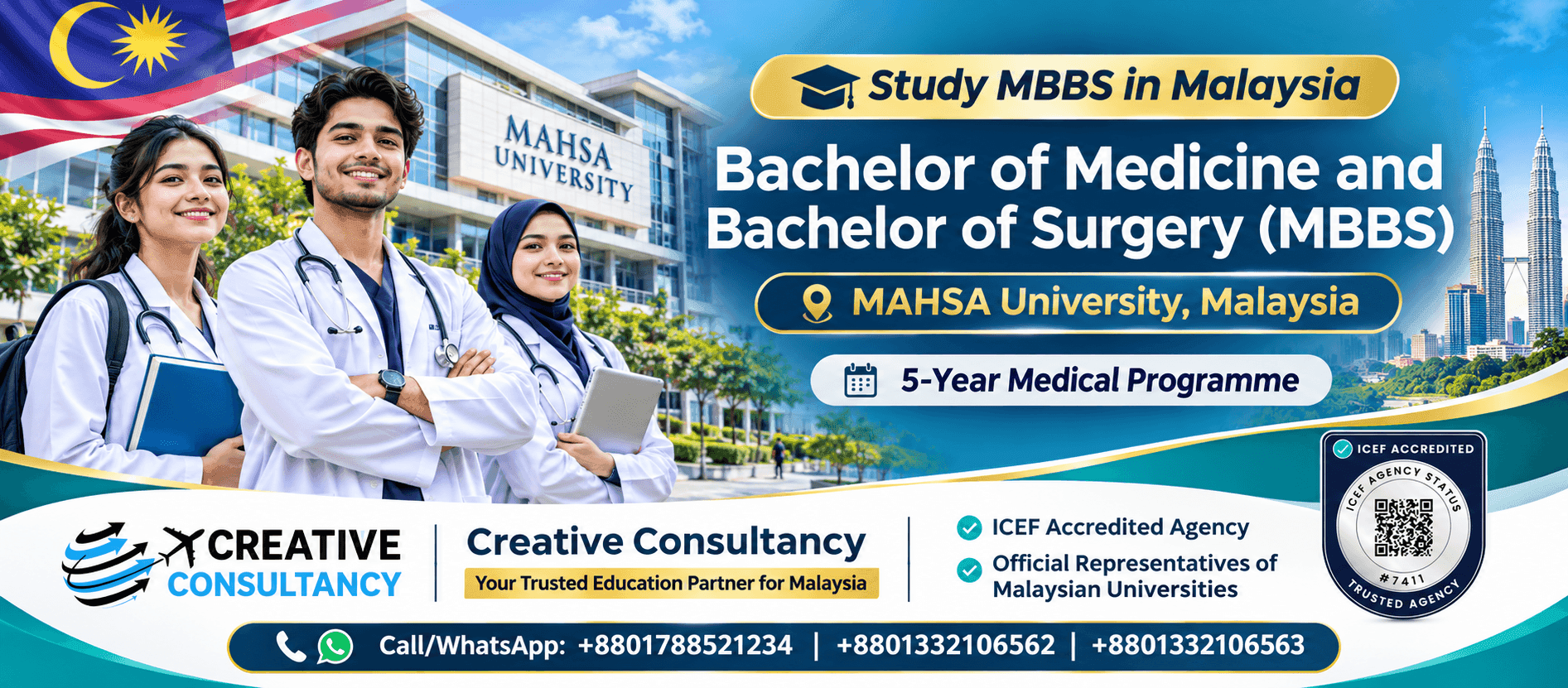
Becoming a doctor is more than choosing a profession. It is a commitment to learning, caring for others and making a meaningful difference in people's lives. For students who dream of entering the medical field, choosing the right university is one of the most important decisions they will ever make.
Every year, thousands of students from Bangladesh explore opportunities to study medicine abroad. While academic quality is a major consideration, students and parents also want to understand the university's learning environment, clinical facilities, admission requirements, overall expenses and future career opportunities.
Malaysia has become an attractive destination for international higher education, offering a multicultural environment and a range of universities with internationally oriented academic programmes.
One institution worth exploring is MAHSA University, Malaysia, particularly for students interested in medicine and healthcare education.
MAHSA University offers a five-year Bachelor of Medicine and Bachelor of Surgery (MBBS) programme that combines foundational medical sciences, integrated learning, early clinical exposure and hospital-based clinical education.
The programme is designed to help students develop an understanding of the human body, medical conditions, clinical reasoning, patient communication and professional responsibilities.
But is MAHSA University the right choice for your medical education? What makes its MBBS programme different? What will you study during the five years? Can Bangladeshi HSC students apply? And what should you know about practising medicine after graduation?
In this comprehensive guide, we explore everything prospective students and parents should understand before considering MBBS at MAHSA University.
If you are planning to study MBBS in Malaysia, this guide will help you take your next step with better information and confidence.
MAHSA University is a private higher education institution located in Bandar Saujana Putra, Selangor, Malaysia.
The university has developed a strong academic focus on medicine, healthcare and professional education. Its academic portfolio includes disciplines such as medicine, dentistry, pharmacy, nursing, biomedical sciences and other health-related fields.
For students interested in becoming doctors, MAHSA provides an academic environment where healthcare education is an important part of the institution's identity.
Medical education requires more than classroom teaching. Students need to understand scientific principles, develop practical skills, observe clinical practices and gradually learn how medical professionals approach patient care.
MAHSA's MBBS programme brings these elements together through a structured five-year curriculum.
There are several features of MAHSA's medical programme that prospective students should explore.
Healthcare-focused academic environment: MAHSA has an established academic focus on medical and health sciences education.
Integrated medical curriculum: Students explore the human body through interconnected organ systems, helping them understand the relationship between anatomy, physiology and disease.
Early Clinical Exposure: Students are introduced to selected aspects of clinical learning during their preclinical education.
Problem-Based Learning: The programme incorporates clinical scenarios and problem-based activities to encourage independent thinking and medical reasoning.
Hospital-based clinical education: Students gain exposure to different medical disciplines through designated teaching hospitals and healthcare clinics.
Digital anatomy learning: MAHSA highlights Anatomage technology among its medical learning resources.
Professional development: Students are encouraged to develop communication, teamwork, ethical awareness and professional responsibility alongside medical knowledge.
These features make MAHSA University an institution worth considering when researching medical universities in Malaysia.
MAHSA University is situated in Bandar Saujana Putra, Selangor.
Its location offers access to the wider Selangor and Kuala Lumpur region, where several healthcare facilities and other essential services are available.
For international students, location is an important consideration when planning accommodation, transportation and everyday living expenses.
Students should explore the university's available accommodation arrangements and transport options before confirming their admission.
Choosing the right country is just as important as choosing the right university.
Students planning to study medicine abroad will spend several years adapting to a different education system, developing professional skills and building a new lifestyle.
Malaysia offers several features that make it an interesting destination for international students.
Malaysia is home to people from different ethnic, cultural and national backgrounds.
International students can experience a diverse society, interact with people from different countries and develop a broader understanding of different cultures.
For Bangladeshi students, Malaysia also offers an Asian environment where they can experience a new country while remaining within a familiar regional setting.
Studying MBBS overseas gives students the opportunity to experience different academic approaches and learning environments.
Students develop independence, improve their communication skills and learn to adapt to new academic expectations.
These experiences can contribute to personal development throughout medical school.
English is widely used in Malaysian higher education.
For medical students, English proficiency is particularly important because medical textbooks, academic lectures, research materials and clinical discussions frequently involve specialised terminology.
Studying in an international academic environment can help students develop their professional communication abilities.
The specific teaching language and English requirements should always be confirmed with the university.
Medical education is not limited to textbooks and examinations.
Students need to understand how healthcare systems operate and how medical professionals interact with patients.
Malaysia provides an opportunity to experience healthcare in a different national setting.
At MAHSA, the clinical phase includes exposure to designated teaching hospitals and primary healthcare clinics.
This allows students to understand different aspects of hospital medicine and community healthcare.
Malaysia attracts students from different countries, creating opportunities for international friendships and cultural exchange.
Students can learn to work with people from different backgrounds, an experience that can be valuable in the healthcare profession.
Living abroad teaches students to manage their time, organise their studies, plan their expenses and take responsibility for everyday decisions.
These qualities are particularly important for medical students because MBBS requires discipline, consistency and long-term commitment.
The Bachelor of Medicine and Bachelor of Surgery (MBBS) is a professional medical degree designed to provide students with the academic and clinical foundation needed for further medical training.
MAHSA University's MBBS programme follows a five-year full-time structure.
The programme is organised into two main educational phases.
Phase 1: Preclinical Education – Years 1 and 2
The first two years focus on the scientific foundations of medicine. Students study the human body's structure, functions, organ systems and disease mechanisms.
Phase 2: Clinical Education – Years 3, 4 and 5
The final three years focus on clinical disciplines, patient assessment and hospital-based learning.
Programme Information | Details |
|---|---|
University | MAHSA University |
Country | Malaysia |
Programme | Bachelor of Medicine and Bachelor of Surgery |
Degree | MBBS |
Duration | 5 Years |
Study Mode | Full-Time |
Faculty | Faculty of Medicine |
Qualification Level | MQF Level 6 |
MQA Reference | MQA/FA09142 |
Location | Bandar Saujana Putra, Selangor |
The programme is listed in the Malaysian Qualifications Register under reference MQA/FA09142. The published accreditation record covers 6 March 2023 to 5 March 2028. Students planning to enrol should verify the applicable accreditation status for their intended intake.
One of the most important questions students ask before choosing a medical university is what they will actually learn during the programme.
Medical education involves understanding the human body, identifying abnormalities, studying diseases and learning how medical professionals assess and manage patients.
At MAHSA University, the five-year MBBS programme gradually develops students' knowledge from basic medical sciences to clinical medicine.
Let's look at the different stages of the curriculum.
The first year introduces students to the fundamental scientific principles behind medicine.
Before understanding complex medical conditions, students must first understand how the human body works under normal conditions.
They begin exploring the structure of the body, biological processes and the functions of different organ systems.
Major learning areas include:
Introduction to Medical Science
Students are introduced to the basic concepts of medical education and the scientific principles that support modern medicine.
Human Body in Health
This area focuses on the normal structure and function of the human body.
Students explore how organs, tissues and body systems work together to maintain health.
Human Body in Disease
Students begin understanding how normal body functions can become disrupted by different diseases and pathological processes.
Cardiovascular System
Students study the heart, blood vessels and circulation.
Important learning areas include:
Structure and function of the heart.
Blood circulation.
Cardiac physiology.
Blood pressure regulation.
Cardiovascular disorders.
Haematology and Immunology
Students learn about blood, blood cells and the immune system.
They explore how the body protects itself against infections and how abnormalities in blood components can affect health.
Respiratory System
This subject focuses on the lungs and respiratory tract, including breathing, gas exchange and oxygen supply.
Students also begin understanding conditions affecting respiratory function.
Clinical Sciences and Professional Development
Students are introduced to clinical concepts and the importance of professional behaviour, communication and patient-centred healthcare.
Why is the first year important?
The first year establishes the scientific foundation for advanced medical learning.
A strong understanding of anatomy, physiology and basic disease mechanisms helps students approach more complicated medical subjects in the following years.
During the second year, students expand their understanding of the body's different organ systems and the conditions that affect them.
They also begin strengthening their clinical reasoning and understanding of medical research.
Epidemiology, Research Methodology and Biostatistics
Students learn how diseases are distributed within populations and how researchers investigate health-related questions.
Learning areas include:
Disease frequency and distribution.
Risk factors.
Research methods.
Study populations.
Statistical interpretation.
Public health information.
These subjects introduce students to the importance of scientific evidence in medicine.
Gastrointestinal System
Students explore the digestive system, including the stomach, intestines, liver and pancreas.
They study digestion, absorption, metabolism and related medical conditions.
Nervous System
This area focuses on the brain, spinal cord and peripheral nerves.
Students learn about neurological function, nerve signalling and disorders affecting the nervous system.
Urinary System
Students study the kidneys and urinary tract, including their role in waste removal, fluid regulation and electrolyte balance.
Musculoskeletal System
This subject focuses on bones, muscles, joints and connective tissues.
Students learn how the body moves and how different conditions affect movement and physical function.
Reproductive System
Students develop an understanding of male and female reproductive anatomy and physiology.
Endocrine and Metabolism
Students explore hormones, endocrine glands and the regulation of metabolic activities.
Preclinical Electives
Students may also explore additional learning opportunities through the programme's elective components.
An important feature of MAHSA's medical curriculum is Early Clinical Exposure.
Students are introduced to selected clinical activities before entering the full hospital-based phase.
This helps them understand how theoretical medical knowledge is connected to actual patient care.
Early clinical exposure may include:
Simulated patient interactions.
Basic history-taking.
Clinical observation.
Introduction to physical examinations.
Patient communication.
Basic clinical reasoning.
For example, students may learn how to ask a patient about their symptoms, collect relevant medical information and understand why a structured patient history is important.
This approach helps students begin thinking about medicine from a clinical perspective.
The third year marks an important transition towards clinical education.
Students begin exploring major medical disciplines and understanding how healthcare professionals assess patients and manage different conditions.
Internal Medicine
Students learn about diseases affecting internal organs and body systems.
They explore symptoms, medical histories, physical examinations and diagnostic investigations.
General Surgery
Students are introduced to surgical conditions and the principles of surgical management.
Learning areas include preoperative assessment, postoperative care and common surgical conditions.
Paediatrics
Students study the medical needs of infants, children and adolescents.
They explore child development, common childhood diseases and the principles of paediatric care.
Obstetrics and Gynaecology
This discipline focuses on pregnancy, childbirth, maternal health and conditions affecting the female reproductive system.
Primary Care Medicine
Students explore the role of primary healthcare in disease prevention, early diagnosis and ongoing patient management.
Community Health
Community medicine introduces students to population health, health promotion and the social factors that influence healthcare.
Dermatology
Students learn about common skin conditions and the principles of dermatological assessment.
During the fourth year, students expand their clinical understanding through additional medical specialties.
Anaesthesia and Critical Care
Students are introduced to anaesthesia, patient monitoring and the principles of caring for critically ill patients.
Emergency Medicine
Students explore the initial assessment and management of patients requiring urgent medical attention.
Ophthalmology
This subject focuses on eye anatomy, vision and conditions affecting the eyes.
Otorhinolaryngology (ENT)
Students study diseases and conditions affecting the ear, nose and throat.
Orthopaedics
Students learn about injuries and diseases affecting bones, joints and muscles.
Psychiatry
Students develop an understanding of mental health conditions, psychiatric assessment and patient care.
Forensic Medicine
Students explore the medical and legal aspects of healthcare, including the role of medical professionals in legal investigations.
Medical Jurisprudence
This area introduces the legal responsibilities of medical professionals and the relationship between medicine and law.
The final year focuses on strengthening students' understanding of major clinical disciplines.
Students continue clinical learning in:
Internal Medicine.
General Surgery.
Paediatrics.
Obstetrics and Gynaecology.
Orthopaedics.
Psychological and Behavioural Medicine.
The objective is to consolidate medical knowledge and develop the clinical understanding required for the next stage of professional training.
Students must complete the programme's required assessments and pass the Final Professional Examination at the end of Year 5 to graduate.
A medical degree requires more than theoretical knowledge.
Students need to understand how medical professionals evaluate patients, recognise symptoms, investigate diseases and make clinical decisions.
This is why clinical education is such an important part of the MBBS programme.
MAHSA's clinical phase provides exposure to designated teaching hospitals and primary healthcare facilities.
The university's published programme information identifies the following hospitals:
1. Hospital Sungai Buloh
Students can gain exposure to hospital-based healthcare and different medical disciplines in a major hospital environment.
2. Hospital Kuala Lumpur
Hospital Kuala Lumpur is a major referral hospital in Malaysia, providing exposure to a broad range of medical and specialist services.
3. Hospital Tanjung Karang
This hospital setting contributes to students' understanding of district and community healthcare services.
The published programme information also identifies the following clinical facilities:
Klinik Kesihatan AU2.
Klinik Kesihatan Rawang Perdana.
Klinik Kesihatan Taman Ehsan.
Klinik Kesihatan Taman Medan.
Different healthcare facilities serve different purposes.
A major hospital may manage complex medical conditions that require specialist care, while a primary healthcare clinic focuses on preventive services, early diagnosis and continuing patient management.
By experiencing different healthcare settings, students can understand how medical services work together.
For example, a patient with a chronic condition may first visit a primary healthcare clinic for assessment and ongoing care before being referred to a specialist hospital.
Understanding this relationship helps future doctors appreciate the importance of coordinated patient care.
Depending on their clinical rotation and level of training, students can develop experience in:
Medical history-taking.
Basic physical examination.
Patient communication.
Clinical observation.
Understanding diagnostic procedures.
Medical documentation.
Clinical reasoning.
Patient safety.
Professional ethics.
Healthcare teamwork.
Clinical activities are undertaken according to the programme's supervision and training requirements.
The quality of medical education depends not only on what students study but also on how they learn.
MAHSA's published MBBS programme materials describe a combination of theoretical teaching, practical activities and student-centred learning approaches.
Problem-Based Learning encourages students to investigate clinical scenarios rather than simply memorising information.
For example, students may receive a medical case involving a patient experiencing chest discomfort.
They can discuss possible causes, identify relevant body systems, explore symptoms and consider the investigations that may be needed.
This approach encourages independent research, collaborative learning and clinical reasoning.
Lectures introduce students to essential medical concepts and scientific principles.
Tutorials provide opportunities to discuss difficult topics, ask questions and strengthen understanding.
Laboratory sessions allow students to explore different aspects of medical science through structured practical activities.
This helps connect scientific theory with practical understanding.
Clinical cases help students understand how medical concepts relate to real patient conditions.
Assignments and case portfolios also encourage students to organise their learning and demonstrate their understanding.
Bedside teaching introduces students to clinical learning in hospital environments.
It helps them observe how medical professionals communicate with patients, conduct examinations and discuss clinical findings.
Community-based activities help students understand preventive medicine, health education and population health.
Medicine is a continuously developing field.
Students are encouraged to take responsibility for their learning, review academic resources and strengthen their understanding outside scheduled classes.
Medical students need appropriate learning environments to understand complex scientific and clinical concepts.
MAHSA highlights several educational facilities and learning resources within its medical programme.
Anatomy is one of the most important subjects in medical education.
Students must understand the structure and relationships of organs, tissues, muscles, bones, nerves and blood vessels.
MAHSA highlights the use of Anatomage digital anatomy tables as part of its medical learning resources.
Anatomage provides interactive digital visualisation of human anatomical structures.
Students can explore different body systems and understand the relationships between organs and anatomical structures.
This technology complements conventional anatomy learning and can help students visualise complex parts of the human body.
Anatomy learning facilities support students in understanding human body structures through practical and visual learning opportunities.
Clinical skills training introduces students to selected practical procedures and patient interactions.
These facilities provide structured environments where students can practise appropriate techniques before progressing to supervised clinical settings.
Simulation-based learning allows students to practise selected clinical scenarios in a controlled environment.
Depending on the equipment and learning activities available, this can support the development of:
Patient assessment.
Clinical communication.
Basic practical procedures.
Teamwork.
Clinical decision-making.
Patient safety awareness.
These learning opportunities help students become more familiar with clinical situations before applying their knowledge in supervised patient care.
A good doctor needs more than medical knowledge.
Patients need healthcare professionals who can listen, communicate, demonstrate empathy and make responsible decisions.
MAHSA's MBBS programme includes Personal and Professional Development components to help students develop these important qualities.
Communication: Learning to communicate effectively with patients, families and healthcare professionals.
Empathy: Understanding patients' concerns and treating individuals with dignity and respect.
Professional Ethics: Recognising confidentiality, honesty and professional responsibility.
Teamwork: Understanding how doctors work alongside nurses, pharmacists and other healthcare professionals.
Patient Safety: Appreciating the importance of safe clinical practices.
Lifelong Learning: Understanding that medical knowledge continues to develop and that doctors must continue learning throughout their careers.
The programme also highlights buddy and mentor-mentee arrangements that encourage interaction between students and academic staff.
These initiatives can help students navigate academic challenges and build a supportive university experience.
Admission to an MBBS programme requires careful academic preparation.
Medical programmes have specific entry requirements because students need a strong foundation in science subjects.
MAHSA's published MBBS admission requirements, effective from 1 January 2027, include several academic pathways.
Applicants applying through A-Level or STPM must meet the specified minimum academic requirements in:
Biology.
Chemistry.
Physics or Mathematics.
The published minimum requirement includes Grade B in each of the three required subjects. For STPM, an acceptable CGPA pathway of 3.0 in the three subjects is also specified.
Applicants with a relevant foundation, matriculation or pre-medical qualification of at least one year may be considered.
The published requirements include:
Minimum CGPA of 3.0 out of 4.0 in Biology, Chemistry and Physics/Mathematics.
Five Bs in the specified SPM/O-Level or equivalent subjects, including Biology, Chemistry, Physics, Mathematics/Additional Mathematics and one additional subject.
Applicants holding a relevant Health Sciences diploma may also be considered.
The published requirements include:
A diploma of at least five semesters or 2.5 years.
Minimum CGPA of 3.5.
Required grades in relevant science subjects.
Specified English and Mathematics school-level requirements.
An MQA-accredited diploma under the applicable NEC classification.
Open and Distance Learning diplomas are not accepted under the published pathway.
Applicants with a degree in Health Sciences, Pure Sciences or Applied Sciences may be considered with the required minimum CGPA of 3.0.
Other international qualifications are assessed according to the university's current equivalency requirements.
Students should also confirm:
Minimum age requirements.
English language proficiency.
Required academic subject combinations.
Medical fitness requirements.
International applicant documentation.
Any additional conditions established by the university or relevant authorities.
Meeting minimum academic requirements does not guarantee admission. MAHSA University makes the final decision after assessing the applicant's qualifications and supporting documents.
For Bangladeshi students, this is one of the most important questions when exploring MBBS in Malaysia.
Students who have completed HSC in the Science group can explore the international admission pathway at MAHSA University.
However, eligibility depends on the university's assessment of the student's academic qualifications and equivalency.
Prospective applicants should prepare:
SSC certificate and transcript.
HSC certificate and transcript.
Biology results.
Chemistry results.
Physics results.
Mathematics results, where applicable.
Details of additional academic qualifications.
English proficiency results, if required.
Different countries have different education systems.
A Bangladeshi HSC qualification must be assessed against the university's accepted international entry requirements.
The university may need to consider the student's science subjects, individual grades and overall academic background.
This is why students should not assume that a particular HSC GPA automatically guarantees MBBS admission.
At Creative Consultancy, we encourage students to have their academic documents reviewed before proceeding with an application.
Our team can help prospective applicants understand the information required for an initial eligibility assessment.
English proficiency is an important part of studying medicine in an international academic environment.
Medical students need to understand lectures, read scientific publications, learn medical terminology and communicate effectively during clinical learning.
MAHSA's published MBBS information includes the following English proficiency benchmarks:
English Examination | Published Requirement |
|---|---|
IELTS | 6.0 |
TOEFL | 550 |
MUET | Band 4 |
Applicants should confirm currently accepted test formats, minimum component scores, exemptions and validity periods directly with the university.
Medical terminology can be complex, and students must understand scientific explanations accurately.
Strong English communication can also help students participate in:
Academic discussions.
Group presentations.
Clinical case discussions.
Medical research.
Patient communication.
Professional interactions.
Students should work on their English communication skills before beginning their medical education.
Preparing documents correctly is an important part of the international admission process.
Applicants should generally prepare:
Valid passport.
Recent passport-size photographs.
SSC certificate.
SSC academic transcript.
HSC certificate.
HSC academic transcript.
Additional academic qualifications, if applicable.
English proficiency certificate, if required.
Completed university application form.
Other documents requested by MAHSA University.
Additional documentation may be required depending on the applicant's academic pathway.
Students should also ensure that their passport information and academic records are consistent.
Creative Consultancy can guide students through the document preparation process and help them understand the relevant university application requirements.
Studying MBBS abroad is a significant investment for both students and their families.
When comparing medical universities, it is important to look beyond the first-year tuition fee.
Students should understand the estimated financial commitment for the complete five-year programme.
Tuition Fees
Tuition is generally the largest academic expense and covers the university's programme charges.
Registration and Administrative Fees
Students may need to pay initial registration and other administrative charges.
Student Visa and International Processing Fees
International applicants should budget for the applicable student pass, processing and related charges.
Medical Insurance
Students should account for the required international student insurance and applicable medical coverage.
Accommodation
Students can explore university residence options or private accommodation, depending on availability and personal preference.
Food and Daily Living Expenses
Meals, groceries, personal items and other everyday expenses should be included in the monthly budget.
Transportation
Students should consider local transportation costs when travelling between accommodation, campus and clinical facilities.
Academic Materials
Medical students may need textbooks, stationery and other learning resources.
A practical way to organise the expenses is to divide them into three categories.
Expense Category | Examples |
|---|---|
Academic Expenses | Tuition, registration and examination charges |
Living Expenses | Accommodation, food and transportation |
Additional Expenses | Visa, insurance, books and personal costs |
The exact programme fee should be confirmed through an official, intake-specific quotation from MAHSA University.
Before accepting an offer, students and parents should also ask about:
Payment schedules.
Fee revision policies.
Refund conditions.
Additional international student charges.
Accommodation expenses.
Insurance and visa costs.
Creative Consultancy can help families understand the available fee information and plan their application more effectively.
Scholarships can make international education more financially manageable.
However, not every scholarship applies to every academic programme or international applicant.
Students interested in MBBS at MAHSA University should specifically ask which scholarship opportunities are available for international medical students.
Programme Eligibility: Confirm whether MBBS is included in the scholarship scheme.
Academic Requirements: Check the minimum grades or academic achievements required.
International Student Eligibility: Some awards may be restricted to Malaysian citizens or permanent residents.
Scholarship Amount: Determine whether the award covers full tuition, partial tuition or a specific amount.
Renewal Conditions: Some scholarships require students to maintain a minimum academic performance throughout their studies.
Creative Consultancy helps students explore available scholarship opportunities and understand the relevant application procedures.
Our team can guide students regarding eligibility requirements, supporting documents and application information.
Students should always obtain written confirmation of any scholarship award, including its amount, duration and renewal conditions.
Studying abroad is not only about academic qualifications. It is also about experiencing a new environment, building friendships and developing independence.
At MAHSA University, international students become part of a university environment in Selangor, Malaysia.
Students can explore the university's academic and student resources, including:
Library and study facilities.
Medical learning laboratories.
Clinical skills facilities.
Student support services.
Health and wellness facilities.
Student activities and societies.
The availability of specific services and facilities should be confirmed with the university before enrolment.
Finding suitable accommodation is one of the first practical steps after receiving admission.
Students may explore university residence options and private accommodation depending on availability.
Before choosing a place to stay, consider:
Distance from the university.
Monthly rental cost.
Transportation access.
Internet availability.
Safety and security.
Utility charges.
Nearby food and grocery facilities.
Malaysia offers a diverse food culture with different cuisines and dining options.
Bangladeshi students can explore local food while also looking for familiar South Asian meals.
Planning a realistic food budget can help students manage their expenses during their first months abroad.
Students should understand local transport options before selecting accommodation.
It is particularly important for medical students to consider travel arrangements between the university and designated clinical training facilities.
Adapting to a new country can take time.
Students may need support with academic planning, communication, accommodation and everyday responsibilities.
MAHSA highlights student support initiatives, including buddy and mentor-mentee arrangements, which can help students develop connections within the university environment.
An MBBS degree provides an academic foundation for pursuing a career in medicine.
However, graduation is not the same as obtaining unrestricted permission to practise as a doctor.
Graduates must satisfy the applicable internship, licensing, registration and professional requirements of their intended country of practice.
After meeting the relevant professional requirements, graduates may pursue clinical medical roles in hospitals, clinics and other healthcare settings.
Doctors who meet the applicable requirements may pursue postgraduate training in different medical specialties, including:
Cardiology.
Neurology.
General Surgery.
Paediatrics.
Obstetrics and Gynaecology.
Orthopaedics.
Psychiatry.
Dermatology.
Radiology.
Anaesthesiology.
Specialisation generally requires additional postgraduate education and supervised clinical training.
Graduates interested in scientific investigation may explore clinical research, biomedical sciences, public health research and medical education.
Depending on additional qualifications and role requirements, graduates may explore opportunities in:
Clinical research.
Medical affairs.
Medical information.
Medical science liaison roles.
Healthcare administration.
Pharmaceutical industries.
Some graduates may choose to continue their education through postgraduate medical qualifications or additional professional training.
The appropriate pathway depends on the country in which they intend to work and the relevant professional requirements.
This is one of the most important considerations for Bangladeshi students planning to study medicine overseas.
Before enrolling in any foreign MBBS programme, students should understand how their qualification may be assessed in their intended country of practice.
If you plan to return to Bangladesh after graduation, you must verify the current requirements of the Bangladesh Medical and Dental Council (BMDC).
Students should obtain clear information about:
Eligibility of the foreign medical qualification.
Applicable foreign medical graduate requirements.
Relevant academic and admission conditions.
Required examinations or assessments.
Internship or supervised training requirements.
Provisional and full registration procedures.
Any changes in professional regulations.
MAHSA's published MBBS brochure states that international students are not eligible for internship posts in Malaysia.
This is particularly important for Bangladeshi students because they need to understand where and how they will complete the relevant post-graduation training.
Students should obtain written clarification from MAHSA University and BMDC regarding their individual pathway before committing to the programme.
Choosing a university is important, but having the right guidance throughout the application process can make the journey easier to understand.
International university applications involve several stages, including academic assessment, document preparation, university communication, scholarship enquiries and student visa procedures.
For students and parents, having access to professional guidance can help make these steps more organised.
This is where Creative Consultancy can support your journey.
Creative Consultancy is one of Bangladesh's leading education agencies specialising in Malaysian university admissions.
We are official representatives of Malaysian universities and an ICEF Accredited Agency, committed to maintaining professional standards and transparent communication.
Our aim is to help students make informed decisions and understand the application process before moving forward.
Professional standards matter when selecting an international education consultancy.
Creative Consultancy is an ICEF Accredited Agency.
We are committed to maintaining professional practices and providing students with a transparent and organised application experience.
Our specialisation in Malaysian higher education helps students explore academic opportunities at Malaysian universities.
We guide prospective applicants in understanding university programmes, admission requirements and application procedures.
Every student's academic background is different.
An HSC Science student may have a different admission pathway from an A-Level student or an applicant holding a foundation qualification.
Our team helps students understand the relevant requirements and identify the information needed for their application.
International applications involve multiple steps.
Creative Consultancy assists students with:
Understanding university admission requirements.
Reviewing academic profiles.
Preparing application documents.
Completing application procedures.
Submitting university applications.
Understanding admission decisions.
Following the relevant next steps.
We aim to make the process easier to understand from the beginning.
We understand that studying abroad requires financial planning.
Our team helps students explore available scholarship opportunities and understand the relevant eligibility requirements.
We also guide applicants through applicable scholarship application procedures.
Obtaining the appropriate student visa is an essential part of studying in Malaysia.
Creative Consultancy provides guidance and assistance throughout the relevant student visa application process.
We help students understand documentation requirements and the procedures involved.
All visa decisions remain subject to the relevant authorities.
We believe students and parents deserve clear information.
Our approach focuses on explaining admission requirements, application procedures and relevant costs without making unrealistic promises.
We encourage students to ask questions and understand the important details before proceeding.
Trust is one of the most important factors when selecting an education consultancy.
Creative Consultancy welcomes prospective students and parents to review our visa success records to learn more about our work.
We believe transparency and professional communication are essential to building long-term confidence.
At Creative Consultancy, we understand that studying abroad is more than submitting an application.
It represents a student's ambition, a family's investment and the beginning of an important educational journey.
Our objective is to support students with professional guidance, transparent communication and assistance throughout the relevant university admission, scholarship and student visa procedures.
We want you to understand your options, make informed decisions and move forward with confidence.
Starting your medical education journey in Malaysia does not have to be confusing.
Creative Consultancy can guide you through the major stages of the application process.
Get in touch with our team and let us know that you are interested in studying MBBS at MAHSA University.
Share your academic background and intended admission intake.
Provide your academic documents so that your qualifications can be reviewed against the university's current admission requirements.
This helps identify whether your academic pathway may be suitable for MBBS admission.
Learn about the five-year curriculum, clinical training, admission requirements, tuition fees and other important programme information.
Prepare the necessary academic certificates, transcripts, passport and other supporting documents.
Our team can guide you through the relevant documentation requirements.
We assist with submitting your application to MAHSA University through the applicable admission process.
The university reviews your application and determines whether you meet its admission requirements.
If your application is successful, the university may issue an admission offer.
After completing the relevant admission steps, you can proceed with the Malaysian student visa application.
Creative Consultancy provides guidance and assistance with the applicable procedures.
Once the necessary arrangements have been completed, you can prepare for your journey to Malaysia.
This includes accommodation planning, travel arrangements, financial preparation and university registration.
Admission offers, scholarship awards and visa decisions remain subject to the relevant university and authorities.
The MBBS programme takes five years of full-time study. The first two years focus on preclinical education, while the final three years focus on clinical education.
MAHSA University is located in Bandar Saujana Putra, Selangor, Malaysia.
Bangladeshi students can explore the international admission pathway, subject to the university's current academic and other entry requirements.
HSC Science students can request an academic eligibility assessment. Their SSC and HSC qualifications, subject combinations and academic results will need to be evaluated by the university.
Biology is one of the essential subjects in the published academic entry requirements. Students should review the requirements for their particular qualification pathway.
MAHSA's published MBBS entry information includes IELTS 6.0 and TOEFL 550 as proficiency benchmarks. Applicants should confirm current accepted tests and exemptions.
Yes. The clinical phase includes training through designated teaching hospitals and healthcare facilities.
Early Clinical Exposure introduces students to selected clinical activities during their preclinical education, helping them connect theoretical medical knowledge with patient care.
The university's published medical education information highlights Anatomage digital anatomy technology as one of its medical learning resources.
Students should enquire about current scholarship opportunities and confirm whether international applicants to the MBBS programme are eligible.
The total cost depends on the applicable tuition fees, registration charges, visa, insurance, accommodation and other living expenses. Students should request an updated official fee quotation for their intended intake.
MAHSA's published MBBS brochure states that international students are not eligible for internship posts in Malaysia. Students should confirm their post-graduation pathway before enrolment.
Graduates must meet the applicable BMDC requirements for foreign medical graduates, including eligibility, assessments, internship and registration conditions. Students should obtain confirmation directly from BMDC before enrolling.
Creative Consultancy is an ICEF Accredited Agency and specialises in Malaysian university admissions. We provide assistance with university applications, scholarship opportunities and student visa procedures.
You can contact Creative Consultancy by phone or WhatsApp for an initial consultation and guidance regarding your academic eligibility and the application process.
Becoming a doctor requires dedication, patience and years of continuous learning.
Choosing the right university is the first important step towards that goal.
MAHSA University's five-year MBBS programme offers an integrated medical education pathway combining foundational medical sciences, early clinical exposure, practical learning and hospital-based clinical education.
Its emphasis on organ-system-based learning, Problem-Based Learning, digital anatomy resources and professional development provides several areas for prospective medical students to explore.
For Bangladeshi students, however, choosing a medical university should involve more than comparing tuition fees or programme duration.
It is equally important to understand academic eligibility, programme accreditation, clinical training, financial requirements, internship arrangements and future medical registration pathways.
Taking the time to evaluate these factors can help students and parents make a more informed decision.
If you are considering studying MBBS in Malaysia, MAHSA University is an institution worth exploring.
And when you are ready to take the next step, Creative Consultancy is here to help.
As an ICEF Accredited Agency and a specialist in Malaysian university admissions, we provide professional guidance with university applications, scholarship opportunities and student visa procedures.
Your journey towards becoming a doctor begins with an informed decision. Let Creative Consultancy help you explore the opportunities ahead.
CREATIVE CONSULTANCY
Your Trusted Education Partner for Malaysia
Are you planning to study MBBS in Malaysia?
Our team is ready to help you explore your academic eligibility, understand the admission requirements and learn more about studying medicine at MAHSA University.
Get in touch with Creative Consultancy today.
Call / WhatsApp:
+8801788521234
+8801332106562
+8801332106563
Start your international education journey with professional guidance and transparent support from Creative Consultancy.
More posts you may want to read.
Bachelor of Aircraft Engineering Technology (Hons.) in Mechanical at Universiti Kuala Lumpur (UniKL), Malaysia Turn Your Passion for Aircraft into an Engineering Career Have you ever wondered what makes an aircraft fly thousands of feet above the ground? How do aircraft engines generate the power needed for flight? Who ensures that an aircraft's mechanical systems, landing gear and structures remain safe and reliable? Behind every successful flight is a team of highly trained aviation professionals, including aircraft engineers, maintenance specialists and technical experts. While many students associate the aviation industry with pilots and cabin crew, there is another exciting side of aviation: aircraft engineering. Aircraft engineering combines mechanical engineering, advanced technology, scientific knowledge and practical problem-solving. It focuses on understanding how aircraft systems work, how technical problems are identified and how aircraft components are maintained to meet aviation safety requirements. For students who enjoy Mathematics, Physics, mechanical systems and understanding how machines operate, this field can offer an interesting academic direction. If you are looking for a specialised engineering degree abroad, the Bachelor of Aircraft Engineering Technology (Hons.) in Mechanical at Universiti Kuala Lumpur (UniKL), Malaysia , is a programme worth considering. Offered through the Malaysian Institute of Aviation Technology (UniKL MIAT), this four-year undergraduate programme focuses on aircraft engineering technology, mechanical aircraft systems and maintenance-related engineering. Throughout the programme, students explore a variety of subjects, including aircraft structures, piston engines, gas turbine engines, hydraulic and pneumatic systems, landing gear, aircraft electrical systems and flight control systems. The programme also introduces students to engineering mathematics, aerodynamics, materials science, computer-aided engineering, aircraft structural repairs and professional aviation practices. What makes this programme particularly interesting is its combination of engineering fundamentals, specialised aircraft-related subjects, a final-year project and industrial training. For Bangladeshi students who want to pursue an international engineering qualification, UniKL offers an opportunity to study within a specialised aviation education environment in Malaysia. In this comprehensive guide, Creative Consultancy explains everything prospective students should know before applying, from university information and course structure to tuition fees, entry requirements and future career opportunities. 1. About Universiti Kuala Lumpur (UniKL), Malaysia Universiti Kuala Lumpur (UniKL) is a Malaysian higher education institution established in 2002, with a strong focus on engineering, technology and technical education. The university has developed an academic structure centred on specialised institutes, each focusing on particular areas of professional and technical expertise. One of UniKL's distinctive educational concepts is "One Institute, One Specialisation." Rather than concentrating every academic discipline within a single generalised environment, UniKL operates different specialised institutes that focus on specific industries. Its academic areas include: Aviation and Aircraft Maintenance Technology Mechanical and Manufacturing Engineering Automotive Engineering Electrical and Electronic Engineering Information Technology Medical and Health Sciences Business and Management Chemical and Bioengineering Technology Maritime and other technical disciplines This specialised approach is particularly relevant for students who already have a clear career interest and want to pursue a focused technical qualification. Why Consider Universiti Kuala Lumpur? Specialised technical education: UniKL focuses on professional and technology-oriented disciplines, giving students opportunities to explore specific engineering fields. Industry-oriented learning: Its programmes combine academic foundations with technical subjects, practical learning and industry-related exposure. Dedicated aviation institute: UniKL has a specialised aviation institute, MIAT, which concentrates on aviation and aircraft-related education. International learning environment: Students can experience Malaysian higher education and interact with people from different cultural and academic backgrounds. Multiple engineering pathways: Students interested in technology can explore different engineering specialisations across UniKL's institutes. For students who want to study aviation engineering rather than a general engineering programme, UniKL is an institution worth exploring. UniKL QS World University Ranking 2027 Universiti Kuala Lumpur is listed in the #1401+ band of the QS World University Rankings 2027 , according to the ranking information provided for this programme article. QS World University Rankings offer an international reference for comparing universities through indicators relating to academic reputation, employer reputation, research and international engagement. However, students should not select a specialised engineering programme based on university ranking alone. For aircraft engineering, other important considerations include: Programme accreditation and recognition Specialised aviation curriculum Aircraft maintenance-related subjects Engineering facilities and practical learning Industrial training Professional development opportunities Career pathways A university's overall ranking does not automatically represent the ranking or quality of every individual programme. Students should therefore evaluate UniKL based on its academic structure, programme recognition and specialised aviation education. 2. About UniKL Malaysian Institute of Aviation Technology (MIAT) The Malaysian Institute of Aviation Technology (UniKL MIAT) is the aviation-focused institute of Universiti Kuala Lumpur. Located in Dengkil, Selangor, Malaysia, MIAT specialises in education and training related to aircraft engineering, aviation technology and aircraft maintenance. Aircraft are highly sophisticated machines. Their safe and efficient operation depends on several interconnected systems, including engines, mechanical components, electrical systems, aircraft structures and hydraulic technologies. Understanding these systems requires more than general engineering knowledge. Students must develop an understanding of aviation-specific technical requirements, maintenance procedures and safety principles. This is where a specialised aviation learning environment becomes particularly relevant. What Makes UniKL MIAT Interesting for Aviation Students? Aviation-focused education Students study within an institute dedicated to aviation-related academic and technical disciplines. Aircraft engineering fundamentals The programme introduces students to the engineering principles behind aircraft structures, propulsion systems and mechanical components. Aircraft maintenance knowledge Students explore maintenance practices, aircraft structural repairs and other technical subjects relevant to aviation maintenance environments. Industrial training The programme includes an industrial training component, allowing students to gain exposure to professional working environments. Professional development Students also study aviation legislation, human factors, engineering ethics and technical communication. These subjects are important because aviation professionals need more than technical knowledge. They must also understand safety, teamwork, communication and professional responsibility. 3. Bachelor of Aircraft Engineering Technology (Hons.) in Mechanical – Programme Overview The Bachelor of Aircraft Engineering Technology (Hons.) in Mechanical is a specialised undergraduate engineering technology programme offered through UniKL MIAT. It is designed for students who want to understand the engineering principles behind aircraft mechanical systems and maintenance-related technologies. During the four-year programme, students progress from fundamental engineering subjects to specialised aircraft systems, advanced technical subjects and industrial training. Programme Information Programme Details Information University Universiti Kuala Lumpur University Abbreviation UniKL Institute Malaysian Institute of Aviation Technology Campus Location Dengkil, Selangor, Malaysia Programme Bachelor of Aircraft Engineering Technology (Hons.) in Mechanical Study Level Bachelor's Degree Study Mode Full-Time Duration 4 Years Academic Structure 8 Semesters Total Credits 146 MQF Level Level 6 MQA Reference MQA/FA15372 Specialisation Aircraft Engineering Technology Industrial Training Included Intake January and July, subject to confirmation Is the UniKL Aircraft Engineering Technology Degree MQA Accredited? Yes. The qualification is listed in the Malaysian Qualifications Register (MQR) under reference number MQA/FA15372 . The current MQA register uses the updated qualification title: Bachelor of Aircraft Engineering Technology with Honours. The programme was previously listed under the title Bachelor of Aircraft Engineering Technology (Hons.) in Mechanical. According to the current MQA record, the qualification includes: MQF Level: 6 Qualification Level: Bachelor's Degree Total Credits: 146 Study Duration: Four Years Study Mode: Full-Time Accreditation Period: 1 January 2026 to 31 December 2031 The programme is also identified by UniKL as having Engineering Technology Accreditation Council (ETAC) accreditation. Students interested in professional recognition should check the applicable requirements of the Board of Engineers Malaysia and relevant aviation regulatory authorities. 4. What Will You Learn in Aircraft Engineering Technology? Aircraft engineering technology is about applying engineering principles to aircraft systems, components and maintenance-related processes. An aircraft consists of many interconnected mechanical and technical systems. Each system must perform its intended function within specific operating requirements. For example, an aircraft engine must generate sufficient thrust, landing gear must support the aircraft during ground operations, and flight control systems must respond correctly to pilot inputs. Students studying aircraft engineering technology explore how these systems work and how engineering knowledge can be applied to their inspection, maintenance and technical support. Major Areas of Study Aircraft Engine Technology Students explore piston engines and gas turbine engines, including their operating principles and mechanical components. Aircraft Structures This area focuses on aircraft structural components, engineering materials, stress, strain and structural repair principles. Hydraulic and Pneumatic Systems Students learn how hydraulic and pneumatic technologies operate and how they are applied in aircraft systems. Landing Gear Systems Students explore the mechanical components and operating principles of aircraft landing gear. Aircraft Flight Control Systems This area introduces the systems responsible for controlling aircraft movement and flight attitude. Aircraft Electrical Systems Students develop knowledge of electrical systems used in aircraft and their technical applications. Aircraft Composite Materials Students explore composite materials and the principles associated with aircraft composite repairs. Computer-Aided Engineering Students are introduced to computer-based engineering tools used to analyse and solve technical problems. These areas provide a foundation for understanding the mechanical and technical requirements of modern aircraft. 5. Detailed Course Curriculum – Semester by Semester One of the most important things to understand before choosing an engineering degree is its academic structure. The UniKL Aircraft Engineering Technology programme is organised across eight semesters over four years. The curriculum starts with engineering fundamentals and gradually introduces more advanced aircraft systems and specialised technical subjects. Semester 1 – Engineering and Aviation Fundamentals The first semester establishes the foundation for future engineering studies. Students study: Material and Hardware Electrical Fundamental I Engineering Mathematics I Physics and Aerodynamics Communicative Aviation English I Philosophy and Current Issues Applicable General Education Subjects Co-Curriculum Foreign Language 1 Students develop an understanding of engineering materials, mathematical calculations, electrical fundamentals and aerodynamic principles. They are also introduced to aviation-related communication and general academic development. Semester 2 – Electrical Systems and Maintenance Practices The second semester develops students' engineering knowledge and introduces important aircraft maintenance concepts. Subjects include: Communicative Aviation English II Electrical Fundamental II Maintenance Practices Electronics Fundamental Engineering Mathematics II Human Factors Foreign Language 2 Integrity and Anti-Corruption Course Maintenance Practices introduces students to maintenance-related procedures and technical responsibilities. Human Factors is particularly important in aviation because communication, fatigue, teamwork and human performance can influence safety. Semester 3 – Aircraft Structures and Engine Fundamentals Students begin exploring more specialised aircraft engineering subjects. Subjects include: Technical Drawing Engineering Ethics Aviation Legislation Aircraft Structure Digital Techniques Piston Engine I Thermo Fluid Professional Aviation English Students learn about aircraft structural components, technical drawings, piston engine fundamentals and the importance of aviation regulations. Semester 4 – Aircraft Mechanical Systems The fourth semester focuses on mechanical aircraft systems and their engineering applications. Subjects include: Applied Engineering Mechanics Air Conditioning and Pressurisation Systems Hydraulic and Pneumatic Systems Aircraft Cabin Interior Systems Computer Programming Piston Engine II Electronics Instrument Systems These subjects introduce students to the mechanical and technical systems that support aircraft operation. Semester 5 – Aircraft Propulsion and Landing Gear Students explore more advanced aircraft engineering technologies. Subjects include: Landing Gear System Aircraft Electrical System Gas Turbine Engine I Computer-Aided Engineering Propeller Mechanics of Materials Innovation Management This semester introduces important concepts related to aircraft propulsion, structural materials and mechanical systems. Semester 6 – Advanced Aircraft Systems The sixth semester focuses on advanced technical subjects and final-year project preparation. Subjects include: Integrated Information System Aircraft Flight Control System Gas Turbine Engine II Aircraft Structure Repairs Technopreneurship Instrument and Avionics Systems Final Year Project I Students develop a deeper understanding of aircraft control systems, propulsion and structural repairs. They also begin their final-year engineering project. Semester 7 – Composite Repairs and Technical Electives The seventh semester includes advanced technical learning and project development. Core subjects include: Aircraft Composite Repairs Final Year Project II Students also explore elective subjects. Elective Group 1: Quality Assurance and Reliability Aircraft Maintenance and Logistics Elective Group 2: Material Fabrications and Processes UAV Design and System Integration Elective Group 3: Project Management Airport Management These elective subjects allow students to explore additional technical or management-related areas. Semester 8 – Industrial Training The final semester is dedicated to industrial training. This component provides students with an opportunity to understand how engineering knowledge is applied in professional working environments. Students can develop workplace skills such as: Technical communication Teamwork Professional responsibility Time management Workplace safety awareness Understanding of industry procedures Practical problem-solving Actual placement arrangements depend on university and industry availability. Curriculum at a Glance Semester Main Academic Focus 1 Engineering fundamentals, mathematics and aerodynamics 2 Electrical systems, electronics and maintenance practices 3 Aircraft structures, piston engines and aviation legislation 4 Hydraulic systems, aircraft mechanics and cabin systems 5 Gas turbine engines, landing gear and propulsion 6 Flight control systems, aircraft repairs and final-year project 7 Composite repairs, technical electives and project completion 8 Industrial training 6. Practical Benefits of Studying Aircraft Engineering at UniKL A specialised engineering degree should help students understand how engineering principles are applied to real technical systems. The UniKL curriculum introduces students to several important aircraft engineering areas. Understanding Aircraft Engines Aircraft engines are responsible for generating the power required for flight. The programme introduces two important engine categories. Piston Engines Piston engines operate through the movement of pistons inside cylinders. They are commonly used in smaller aircraft. Students explore their mechanical components and fundamental operating principles. Gas Turbine Engines Gas turbine engines are widely used in commercial aviation. They operate through a process involving air compression, combustion and expansion to produce thrust. Students explore their major components and engineering principles. Learning About Aircraft Structures Aircraft structures must withstand different forces during flight, landing and ground operations. Students explore engineering materials, structural components and repair principles. Understanding Hydraulic and Pneumatic Systems Hydraulic systems use pressurised liquid to transmit force, while pneumatic systems use compressed gas. These technologies are used in various aircraft mechanical applications. Exploring Aircraft Landing Gear Landing gear supports an aircraft during take-off, landing and ground movement. Students learn about its mechanical components and operating principles. Aircraft Composite Repair Technology Modern aircraft use composite materials in different structural applications. Students explore the properties of these materials and the engineering principles involved in composite repairs. Computer-Aided Engineering Digital engineering tools are increasingly important in technical industries. Students are introduced to computer-aided engineering and its role in technical analysis and problem-solving. 7. Career Opportunities After Graduation The aviation industry requires professionals with knowledge of aircraft systems, engineering technology, maintenance procedures and technical operations. Graduates of the UniKL Aircraft Engineering Technology programme may explore different career pathways depending on their technical competency, experience and additional professional requirements. Aircraft Maintenance Engineer – Turbine/Piston Engine These professionals work with aircraft engines and related mechanical systems. Their responsibilities may include technical inspections, maintenance support, troubleshooting and documentation. Relevant licensing and authorisation requirements apply. Aircraft Simulator Engineer Aircraft simulator engineers work with flight simulation equipment and technical systems. Their work may involve equipment maintenance, troubleshooting and technical support. Aircraft Manufacturing Component Engineer These professionals work with aircraft components and manufacturing processes. They may contribute to engineering support, component quality and production-related activities. Aircraft Maintenance Planner Maintenance planners help organise aircraft maintenance activities. Their responsibilities may include maintenance scheduling, technical documentation, material coordination and work planning. Continuing Airworthiness Management (CAMO) CAMO stands for Continuing Airworthiness Management Organisation. Professionals in this area may work with airworthiness records, maintenance planning, compliance monitoring and technical documentation. Aircraft Quality Assurance Professional Quality assurance professionals help ensure that engineering and maintenance activities follow established quality standards. Their work may involve inspections, process monitoring, documentation review and compliance activities. Other Potential Career Areas Depending on experience and additional qualifications, graduates may also explore opportunities in: Aircraft manufacturing Aviation technical support Aircraft component services Flight simulator support Aviation logistics Engineering project management Aircraft maintenance organisations Important: The degree provides an academic foundation in aircraft engineering technology. It does not guarantee a specific job, professional licence or aircraft certification authority. These depend on applicable regulatory requirements, practical experience and employer approvals. 8. Does an Aircraft Engineering Degree Automatically Make You a Licensed Aircraft Maintenance Engineer? This is an important question for students considering an aviation engineering degree. An academic qualification in Aircraft Engineering Technology and an aircraft maintenance licence are two different things. Completing a bachelor's degree does not automatically grant an aircraft maintenance licence or the authority to certify aircraft maintenance work. Depending on the licensing authority and licence category, additional requirements may include: Approved theoretical training Practical maintenance experience Relevant examinations Competency assessments Technical records Regulatory approval Students interested in aircraft maintenance licensing should investigate the applicable requirements of the Civil Aviation Authority of Malaysia (CAAM). Understanding this distinction before applying helps students make realistic academic and career plans. 9. Admission Requirements for International Students Students interested in studying the Bachelor of Aircraft Engineering Technology at UniKL must meet the university's academic and English language requirements. The programme is particularly relevant for students with an interest in Mathematics, Physics and Science. Academic Requirements According to the published international admission requirements, applicants should: Complete 12 years of schooling. Hold a recognised High School Certificate, A Levels or equivalent qualification. Obtain at least Grade C (60%) in Mathematics. Obtain at least Grade C (60%) in one relevant Science subject. Relevant Science subjects include: Physics Chemistry Biology Final eligibility is determined by UniKL after evaluating the applicant's qualifications. Can Bangladeshi HSC Students Apply? Yes. Students from Bangladesh with an HSC qualification can explore admission to the programme. Their academic results, Mathematics and Science subjects must meet the applicable university requirements. Can A Level Students Apply? Students with recognised A Level qualifications can submit their academic documents for university assessment. Admission depends on qualification equivalency and the programme's entry requirements. Can Diploma Holders Apply? Applicants with recognised technical qualifications may also explore diploma entry pathways. The published requirements include: Recognised Diploma in Engineering or Engineering Technology: minimum CGPA 2.00. Recognised related technical, vocational or skills diploma: minimum CGPA 2.00. Other pathways may be available subject to MQA requirements and university assessment. English Language Requirements The published English language requirement includes: IELTS: Minimum overall score of 5.0 or equivalent. UniKL also publishes TOEFL equivalencies. Applicants should confirm the currently accepted test formats and scores before applying. Not Sure Whether You Qualify? Creative Consultancy can help you understand the admission requirements based on your educational background. Our team can review your SSC, HSC, A Level or diploma qualifications and guide you regarding the documents needed for university assessment. Final admission decisions remain with UniKL. 10. Documents Required for Admission International applicants should prepare the following documents: Valid passport copy. Recent passport-sized photographs. Academic certificates. Academic transcripts and mark sheets. English language proficiency certificate, if applicable. Completed university application form. Additional documents requested by UniKL. Diploma applicants should also prepare their diploma certificate and complete academic transcript. Preparing documents early can help avoid unnecessary application delays. 11. UniKL Aircraft Engineering Tuition Fees for International Students Tuition fees are an important consideration when planning to study abroad. Students and parents should understand the estimated academic costs before making a decision. According to UniKL's published programme information: International Student Tuition Fee RM10,550 per semester Fee Information Details Tuition per semester RM10,550 Study duration 4 years Number of semesters 8 Indicative total tuition RM84,400 The estimated total is calculated using the published semester fee multiplied by eight semesters. It is not a final university invoice. Additional Expenses Students should also plan for: Registration and administrative charges Student visa processing Medical examination Insurance Accommodation Food and groceries Transportation Books and learning materials Personal expenses Applicable taxes and additional university charges may also apply. Are Scholarships Available? Students can enquire about available scholarships and tuition fee reductions. Scholarship eligibility may depend on academic results, nationality, programme availability and the university's current scholarship policies. Creative Consultancy can help students explore available financial assistance and understand the relevant application procedures. For an updated fee breakdown, contact our team before submitting your application. 12. UniKL Admission Intakes UniKL's published programme information lists the following intake periods: January Intake July Intake However, availability may change depending on programme scheduling and international student admission deadlines. Students from Bangladesh should begin the application process early to allow sufficient time for academic assessment, offer letter processing and student visa procedures. Contact Creative Consultancy to check the availability of the next intake. 13. Why Study Aircraft Engineering in Malaysia? Malaysia has developed a diverse higher education environment, offering specialised programmes in engineering, technology and aviation. For Bangladeshi students, Malaysia can be an attractive option when comparing international study destinations. Specialised Engineering Education Students can explore a variety of technical programmes in areas such as aviation, mechanical engineering, manufacturing and electrical technology. Multicultural Learning Environment Malaysia provides an opportunity to study alongside people from different national and cultural backgrounds. English-Medium Academic Opportunities Many Malaysian universities offer English-medium programmes, allowing international students to develop academic and professional communication skills. The language of instruction should be confirmed for the chosen programme. Practical Learning Opportunities Technical programmes often include practical subjects, projects and industrial training. These components help students connect classroom knowledge with professional applications. Convenient Location for Bangladeshi Students Malaysia's geographical proximity to Bangladesh can make international travel and family visits more convenient compared with some distant study destinations. International Personal Development Studying abroad allows students to develop independence, confidence, communication skills and adaptability. These experiences can contribute to personal and professional development. 14. Student Life at UniKL MIAT, Dengkil Choosing a university involves more than selecting an academic programme. Students should also consider campus location, accommodation, transportation and everyday living expenses. UniKL MIAT is located in Dengkil, Selangor, Malaysia. International students should explore university accommodation and suitable private rental options before travelling. When selecting accommodation, consider: Distance from campus Monthly rental Transportation Food and grocery availability Safety and security Internet and utility costs Students should also prepare a realistic monthly budget covering meals, transportation, personal expenses and learning materials. Living in Malaysia can provide an opportunity to develop independence and experience a multicultural environment while pursuing higher education. 15. Malaysia Student Visa Process for Bangladeshi Students International students must complete the required Malaysian student pass and immigration procedures before beginning their studies. The general process includes: Step 1: Choose your programme Select the Bachelor of Aircraft Engineering Technology at UniKL and review the admission requirements. Step 2: Prepare academic documents Collect your passport, academic certificates, transcripts and other required documents. Step 3: Submit the university application Apply through the appropriate university application channel. Step 4: Receive the offer letter If accepted, UniKL will issue an admission offer. Step 5: Student visa application Proceed with the relevant application through Education Malaysia Global Services (EMGS) or the applicable university system. Step 6: Immigration screening Your documents undergo the required checks. Step 7: Receive the eVAL If approved, the relevant electronic Visa Approval Letter is issued. Step 8: Pre-arrival visa, if required Complete the applicable Single Entry Visa procedure where required. Step 9: Travel to Malaysia Arrange travel after receiving the necessary approvals. Step 10: Medical examination Complete the required post-arrival medical screening within the applicable timeframe. Step 11: Student Pass endorsement Complete the relevant student pass endorsement procedure with university assistance. Student visa approval is subject to Malaysian immigration requirements. An admission offer does not guarantee immigration approval. Creative Consultancy can guide students through the relevant application documentation and student visa procedures. 16. Who Should Choose This Aircraft Engineering Programme? This programme may be suitable for students who: Enjoy Mathematics and Physics. Are fascinated by aircraft and aviation technology. Want to understand how aircraft engines operate. Have an interest in mechanical systems. Enjoy technical and practical learning. Want to explore aircraft maintenance and engineering. Are interested in aircraft structures and propulsion. Want to develop engineering problem-solving skills. Is It Suitable for Students Who Want to Become Pilots? No. This is not a pilot training programme. It focuses on aircraft engineering technology and mechanical aircraft systems. Students whose main ambition is to become pilots should explore flight training programmes. Is It Suitable for Students Interested in Aircraft Engines? Yes. The programme includes several subjects related to piston engines and gas turbine engines. Is It Suitable for Students Interested in Aircraft Design? The programme includes engineering and design-related learning, but its main emphasis is aircraft engineering technology and maintenance fundamentals. Students primarily interested in aircraft design should also compare aerospace engineering programmes. 17. Mechanical vs Avionics vs Aerospace Engineering Students exploring aviation education may encounter several similar programme names. Understanding the differences can help them choose the right academic direction. Field Main Academic Focus Aircraft Engineering Technology – Mechanical Aircraft engines, structures, hydraulics and mechanical systems Aircraft Engineering Technology – Avionics Aircraft electronics, instruments, communication and navigation Aerospace Engineering Aircraft and spacecraft design, aerodynamics, structures and propulsion Aircraft Maintenance Technology Aircraft inspection, maintenance and technical servicing Aviation Management Aviation business, operations and management If you enjoy aircraft engines, mechanical components and structural systems, Mechanical may be worth considering. If you prefer aircraft electronics, navigation and communication technologies, Avionics may be more suitable. If your primary interest is aircraft design and advanced aerospace development, compare Aerospace Engineering programmes. The right choice depends on your interests, strengths and long-term professional ambitions. 18. Further Study Opportunities After Graduation Completing a bachelor's degree can also open the door to further academic development. Subject to the admission requirements of the receiving institution, graduates may explore postgraduate opportunities in related disciplines such as: Aerospace Engineering Mechanical Engineering Engineering Technology Aviation Technology Aircraft Maintenance and Management Engineering Management Quality and Reliability Engineering Students should check the entry requirements and academic recognition policies of their preferred postgraduate institution. 19. Why Apply to UniKL Through Creative Consultancy? Choosing the right university and programme is an important decision. When you are planning to study abroad, the process can involve several steps, from checking academic eligibility to preparing documents and completing student visa procedures. Having professional guidance can make this journey more organised and easier to understand. Creative Consultancy is committed to helping Bangladeshi students explore higher education opportunities in Malaysia. We are one of Bangladesh's leading education agencies for Malaysia, official representatives of Malaysian universities and an ICEF Accredited Agency – Trusted Agency #7411. Our focus is to provide professional, transparent and student-oriented education consultancy services. What Makes Creative Consultancy a Suitable Education Partner? Official University Representation We work with Malaysian universities as their official representatives, helping students explore suitable programmes and admission opportunities. Professional Admission Assistance Our team helps students understand programme details, academic requirements and university application procedures. Academic Eligibility Guidance Whether you have completed HSC, A Levels or a diploma, we can help you understand the relevant admission requirements and prepare for university assessment. Scholarship Guidance We help students explore available scholarships, tuition fee reductions and other financial opportunities, subject to university policies. Student Visa Assistance From documentation guidance to the relevant student visa application procedures, we help students understand the steps involved in preparing for Malaysia. ICEF Accredited Agency Creative Consultancy is an ICEF Accredited Agency – Trusted Agency #7411. We value professional standards, transparent communication and responsible student recruitment practices. Student-Focused Support Every student's academic background, financial situation and career ambitions are different. We aim to understand each applicant's needs and provide guidance that supports informed educational decisions. Our Education Consultancy Services Service Support Provided University Admission Programme selection and application assistance Academic Counselling Entry requirement assessment guidance Scholarship Guidance Available scholarship information Student Visa Assistance Visa documentation and application guidance Document Preparation Application document support Student Counselling Guidance on studying in Malaysia At Creative Consultancy, we believe that choosing the right university is only the beginning. Students also need accurate information, realistic expectations and professional support throughout the application journey. 20. Frequently Asked Questions – Bachelor of Aircraft Engineering Technology at UniKL 1. What is the Bachelor of Aircraft Engineering Technology at UniKL? It is a specialised undergraduate engineering technology programme offered through UniKL MIAT, focusing on aircraft mechanical systems, engineering technology and aircraft maintenance fundamentals. 2. How long is the UniKL Aircraft Engineering Technology degree? The programme takes four years to complete on a full-time basis. 3. How many semesters are there? The programme consists of eight semesters, including industrial training. 4. Is UniKL recognised internationally? UniKL is a Malaysian higher education institution, and this qualification is listed in the Malaysian Qualifications Register under MQA reference MQA/FA15372. Recognition for a particular professional purpose or in another country should be checked with the relevant authority. 5. What is the QS ranking of UniKL in 2027? The university is listed in the #1401+ band of the QS World University Rankings 2027, according to the ranking information used for this article. 6. What is the MQA reference number? The programme's MQA reference is MQA/FA15372. 7. What is the MQF level? The qualification is classified at MQF Level 6. 8. What is the total tuition fee for international students? The published international tuition rate is RM10,550 per semester. Across eight semesters, the indicative tuition calculation is RM84,400, excluding additional expenses and applicable charges. 9. Can Bangladeshi HSC students apply? Yes. Bangladeshi students with a recognised HSC qualification can explore admission, subject to the university's academic assessment. 10. What Mathematics result is required? The published requirement specifies a minimum Grade C (60%) in Mathematics. 11. Which Science subjects are accepted? The published information identifies Physics, Chemistry or Biology as relevant Science subjects. 12. What is the IELTS requirement? The published English language requirement is IELTS overall 5.0 or equivalent. Applicants should confirm the currently accepted alternatives. 13. Can Diploma holders apply? Yes. Applicants with recognised Engineering or Engineering Technology diplomas may explore the diploma entry pathway, subject to the published minimum CGPA and university assessment. 14. What subjects are taught? Students study Mathematics, Physics and Aerodynamics, Aircraft Structures, Piston Engines, Gas Turbine Engines, Hydraulic and Pneumatic Systems, Landing Gear, Flight Control Systems and Aircraft Structural Repairs, among other subjects. 15. Does the programme include industrial training? Yes. Industrial training is included in the final semester. 16. Can graduates become aircraft maintenance engineers? Graduates may explore aircraft maintenance-related careers. However, aircraft maintenance licensing and certification privileges require separate regulatory qualifications and approvals. 17. What is the difference between Mechanical and Avionics? Mechanical focuses on aircraft engines, structures, landing gear and mechanical systems. Avionics focuses more on electronic instruments, communication and navigation systems. 18. Where is UniKL MIAT located? UniKL MIAT is located in Dengkil, Selangor, Malaysia. 19. What are the available intakes? The published programme information lists January and July intakes, subject to availability. 20. Can students receive scholarships? Students can enquire about available scholarship opportunities and tuition fee reductions. Awards depend on the university's current policies and eligibility criteria. 21. Can international students work in Malaysia after graduation? Post-study employment depends on applicable immigration rules, work authorisation and employer requirements. A student pass does not automatically grant permission to remain and work after graduation. 22. How can I apply through Creative Consultancy? You can contact Creative Consultancy for programme information, admission guidance, academic eligibility assessment, scholarship enquiries and student visa assistance. Start Your Aircraft Engineering Journey at UniKL, Malaysia! The aviation industry continues to depend on skilled professionals who understand aircraft technology, mechanical systems and engineering maintenance. For students who are passionate about aircraft and want to develop specialised engineering knowledge, the Bachelor of Aircraft Engineering Technology (Hons.) in Mechanical at Universiti Kuala Lumpur (UniKL) is a programme worth exploring. With a four-year academic structure, aircraft-focused curriculum, MQA-listed qualification, final-year project and industrial training, the programme provides an opportunity to develop knowledge in several important areas of aircraft engineering technology. From aircraft engines and structures to hydraulic systems, landing gear and composite repairs, students explore the technical principles behind modern aviation. If you are a Bangladeshi student planning to study engineering in Malaysia, choosing the right university and understanding the admission process are important first steps. Apply to UniKL with Creative Consultancy You do not have to navigate the international university application process alone. Creative Consultancy is ready to guide you towards your higher education opportunities in Malaysia. Why apply with us? One of Bangladesh's leading education agencies for Malaysia. Official representatives of Malaysian universities. ICEF Accredited Agency – Trusted Agency #7411. Professional university admission assistance. Academic eligibility guidance. Scholarship guidance. Student visa application assistance. Transparent and student-focused consultancy. Contact Creative Consultancy Today Call / WhatsApp: +8801788521234 +8801332106562 +8801332106563 Website: https://ccapply.com/ Creative Consultancy – Your Trusted Partner for Higher Education in Malaysia. Take the first step towards your future in aviation engineering with the right guidance and the right educational choice.
Diploma in Beauty Management at Management and Science University (MSU), Malaysia Build Your Future in the Beauty and Personal Care Industry Are you interested in makeup, skincare, beauty treatments and personal grooming? Would you like to turn that interest into a professional career or eventually establish your own beauty business? The beauty industry offers opportunities across a wide range of professional areas, from beauty therapy and makeup artistry to nail care, personal grooming, customer service and beauty business management. However, building a successful career in this industry requires more than creativity. Professional knowledge, practical skills, customer communication and an understanding of business operations are equally important. The Diploma in Beauty Management at Management and Science University (MSU), Malaysia , offers students an opportunity to explore these areas through a structured academic programme. Located in Shah Alam, Selangor, MSU offers this full-time diploma through its School of Hospitality and Creative Arts. The programme combines beauty-related subjects with management, marketing, professional grooming and customer service. Students gain exposure to subjects such as makeup, manicure and pedicure, body treatment and waxing while developing an understanding of how professional beauty services operate. For Bangladeshi students interested in studying a specialised beauty programme abroad, MSU is an institution worth considering. This guide covers the programme structure, subjects, MQA accreditation, university ranking, admission requirements, tuition fees, career opportunities and the application process for international students. 1. About Management and Science University (MSU), Malaysia Management and Science University (MSU) is a Malaysian private university situated in Shah Alam, Selangor. The university offers programmes across several academic disciplines, including: Business and Management Health and Medical Sciences Pharmacy Engineering and Technology Information Sciences Hospitality and Culinary Arts Education and Social Sciences Creative Arts and Fashion MSU focuses on academic development, practical learning, professional skills and international engagement. Its diverse academic environment provides students with opportunities to explore different educational fields while experiencing university life in Malaysia. MSU QS World University Ranking 2027 MSU has established an international presence through its academic development and participation in global university rankings. According to the QS World University Rankings 2027, Management and Science University is ranked: #608 in the World – QS World University Rankings 2027 The university also holds a 5-Star QS Stars Rating . For international students, university rankings provide one way to compare institutions. However, rankings should not be the only factor when selecting a programme. Students should also consider qualification recognition, curriculum, practical learning, admission requirements and future academic opportunities. 2. Diploma in Beauty Management – Programme Overview The Diploma in Beauty Management is designed for students who want to develop knowledge and professional skills in the beauty and personal care industry. The programme introduces students to different beauty services while covering management and marketing concepts relevant to service-based businesses. One of its key features is the combination of practical beauty-related subjects and broader professional knowledge. For example, students study makeup, manicure and pedicure, body treatment and waxing. They also learn about customer service, professional grooming, promotion and management for the service industry. This combination helps students understand both the service and business sides of the beauty sector. Programme Information Details Information University Management and Science University University Name MSU Location Shah Alam, Selangor, Malaysia Programme Diploma in Beauty Management Study Level Diploma Faculty School of Hospitality and Creative Arts Duration 2 Years and 6 Months Study Mode Full-Time Total Credits 90 Qualification Level MQF Level 4 MQA Reference MQA/FA3133 Delivery Mode Conventional Is the MSU Diploma in Beauty Management MQA Accredited? Yes. The Diploma in Beauty Management is listed in the Malaysian Qualifications Register (MQR). Its official reference number is MQA/FA3133 , and it is classified as a Level 4 qualification under the Malaysian Qualifications Framework (MQF). The official register confirms: Qualification: Diploma in Beauty Management Institution: Management and Science University MQF Level: 4 Total Credits: 90 Field of Study: Hair and Beauty Services Study Mode: Full-Time Duration: 2 Years and 6 Months MQA recognition is an important consideration when choosing a Malaysian higher education programme because it provides an official record of the qualification within the Malaysian qualifications framework. Check the official qualification record: 3. What Will You Study in the Diploma in Beauty Management? Understanding the course subjects is essential before selecting a university programme. The MSU Diploma in Beauty Management introduces students to different aspects of beauty services, professional development and business management. The curriculum includes the following subjects. Year One – Beauty Industry Fundamentals Introduction to Beauty Industry Students develop an understanding of the beauty and personal care industry, its professional environment and the different services offered within the sector. Management for Service Industry This subject introduces management principles relevant to service-based organisations. Students explore how businesses organise services, manage operations and maintain service standards. Professional Grooming Professional presentation is important in the beauty industry. Students learn about personal grooming, workplace appearance and professional behaviour. Customer Service and Etiquette Beauty professionals work closely with customers. This subject introduces students to customer expectations, professional communication and appropriate service etiquette. Year Two – Beauty Services and Marketing Manicure and Pedicure Students explore nail care and professional treatments for hands and feet. Promotion and Marketing Marketing plays an important role in attracting customers and developing beauty businesses. Students are introduced to promotional strategies and marketing concepts. Make Up I This subject introduces students to makeup techniques and professional makeup application. Industrial Training Students gain exposure to professional working environments, helping them understand workplace expectations and the practical operation of beauty services. Year Three – Advanced Beauty Service Subjects Body Treatment Students explore body treatment services and related beauty care procedures. Waxing This subject introduces waxing techniques used in professional beauty services. Make Up II Students continue developing their knowledge of makeup techniques and applications. Curriculum at a Glance Subject Area Subjects Beauty Fundamentals Introduction to Beauty Industry Management Management for Service Industry Professional Development Professional Grooming Customer Relations Customer Service and Etiquette Nail Care Manicure and Pedicure Marketing Promotion and Marketing Makeup Make Up I and Make Up II Practical Exposure Industrial Training Body Care Body Treatment Hair Removal Waxing The combination of these subjects provides a foundation for students interested in developing their knowledge of the beauty and personal care industry. 4. Practical Learning and Industrial Training A professional beauty qualification should provide more than theoretical knowledge. Students need to understand how beauty services are delivered, how customers are handled and what professional standards are expected in the workplace. The MSU Diploma in Beauty Management includes practical beauty-related subjects and industrial training as part of its curriculum. Develop Beauty Service Knowledge Subjects such as makeup, manicure and pedicure, body treatment and waxing introduce students to different areas of beauty services. Understand Professional Customer Service Students explore the importance of communication, customer satisfaction and professional behaviour in service environments. Gain Workplace Exposure Industrial training provides an opportunity to experience professional working environments and understand how beauty-related businesses operate. This exposure can help students connect their academic learning with real workplace expectations. Note: Industrial training is an academic component and does not guarantee a particular job or internship placement. 5. Why Choose the Diploma in Beauty Management at MSU? Selecting a programme is an important decision, particularly for students planning to study abroad. The MSU Diploma in Beauty Management offers several areas of study that may appeal to students interested in the beauty industry. A specialised beauty programme: Students study subjects directly related to beauty and personal care services. Practical beauty subjects: The curriculum includes makeup, manicure and pedicure, body treatment and waxing. Management knowledge: Students are introduced to management concepts relevant to service-based businesses. Marketing exposure: Promotion and marketing help students understand how beauty services can be presented and promoted. Customer service development: Professional communication and customer etiquette are important parts of the programme. Industrial training: Students gain exposure to professional working environments. International education experience: Studying in Malaysia provides opportunities to interact with people from different backgrounds and experience a multicultural university environment. Further learning opportunities: Graduates may explore relevant higher education programmes, subject to the receiving institution's admission and credit-transfer requirements. 6. Career Opportunities After Graduation The beauty and personal care industry includes different professional roles, allowing individuals to develop careers based on their interests, experience and practical skills. According to MSU, the programme's listed career prospects include: Beauty Therapist Beauty therapists provide non-medical beauty and personal care services in suitable professional environments, such as beauty salons and spas. Makeup Artist Makeup artists work in areas such as bridal makeup, photography, fashion, events and personal makeup services. With experience, some professionals establish freelance careers or their own makeup studios. Esthetician Estheticians work in skincare and non-medical beauty service environments within the scope of their qualifications and applicable regulations. Other Related Career Directions With relevant experience and additional skills, graduates may also explore opportunities in: Beauty salon operations Beauty service coordination Customer relationship management Beauty product promotion Nail care services Beauty business entrepreneurship Where Can Graduates Work? Potential professional environments include: Beauty salons Spas and wellness centres Makeup studios Nail care businesses Beauty retail establishments Personal grooming service providers Career opportunities depend on practical competency, additional training, employer requirements and local regulations. The diploma is not a medical qualification and does not automatically authorise graduates to perform regulated medical aesthetic procedures. 7. Can You Start Your Own Beauty Business? If you are interested in entrepreneurship, the beauty industry may offer opportunities beyond traditional employment. Some graduates may choose to work in established salons or studios, while others may eventually want to build their own businesses. The programme's combination of beauty-related subjects, management, marketing and customer service provides useful introductory knowledge for understanding the business side of the industry. Possible business directions include: Beauty Salon: Offering suitable professional beauty and personal grooming services. Makeup Studio: Providing makeup services for weddings, events, photography and personal occasions. Nail Care Studio: Specialising in manicure, pedicure and related nail care services. Beauty Service Centre: Providing a range of non-medical beauty services. Beauty Product Business: Exploring the retail and promotion of cosmetics and beauty products. Running a successful business also requires financial planning, professional experience, customer management and compliance with applicable regulations. 8. Entry Requirements for International Students Students planning to apply for the Diploma in Beauty Management at MSU must meet the university's academic and English language requirements. According to the published programme requirements, applicants may qualify through the following pathways. Academic Requirements SPM: At least three credits in any subjects. SKM: Level 3 in a related field. MQF Certificate: Level 3 Certificate in a related field with a minimum CGPA of 2.00. STPM: A pass with at least Grade C (GP 2.0) in any subject. STAM: A pass with at least Grade Maqbul. Other Qualifications: Equivalent qualifications recognised by the Malaysian Government. English Language Requirements International students must meet the programme's English language competency requirements. The published requirement is: MUET Band 3; or Equivalent to CEFR High B1. Applicants should confirm accepted alternative English language tests and scores with MSU. Can Bangladeshi Students Apply? Yes. Bangladeshi students can apply if their academic qualifications meet the university's admission requirements and they satisfy the applicable English language and international student conditions. Students with SSC, HSC or other equivalent qualifications should submit their academic documents for university assessment. Admission eligibility is determined by MSU after reviewing the applicant's qualifications. Not sure whether your SSC or HSC results meet the requirements? Creative Consultancy can help you review your academic background and understand the appropriate admission pathway. Contact our admission team for programme eligibility guidance. 9. Documents Required for Admission International applicants should prepare their documents before submitting an application. The general document checklist includes: Valid passport copy. Recent passport-sized photographs. Academic certificates. Academic transcripts or mark sheets. English language proficiency certificate, if applicable. Completed application form. Additional documents requested by MSU. Preparing documents early can help reduce unnecessary delays during the admission process. The final document requirements should be confirmed with the university. 10. Tuition Fees and Scholarships Financial planning is an important part of studying abroad. Before applying, students should understand the tuition fees, additional university charges, student visa expenses and expected living costs. Diploma in Beauty Management Fees at MSU MSU publishes an estimated overall programme fee of: RM25,000–RM30,000 This is the published estimate for Malaysian or local students. International students have a different fee structure. Therefore, Bangladeshi applicants should request an updated international student fee quotation from MSU before making financial arrangements. Additional Expenses to Consider Students should also budget for: University registration and administrative charges Student visa and processing expenses Medical examination Student insurance Accommodation Food and groceries Transportation Learning materials Personal expenses Actual expenses depend on the university's current fee structure and individual lifestyle. Scholarship Opportunities Students can enquire about available scholarships, tuition fee reductions and promotional offers. Eligibility may depend on academic performance, nationality, programme availability, application period and university policies. Creative Consultancy can help students explore available scholarship opportunities and understand the relevant application requirements. All scholarships and fee reductions are subject to university approval and availability. For an accurate international student fee quotation, contact Creative Consultancy. 11. Why Study in Malaysia? Malaysia is an attractive destination for students looking for an international higher education experience in a multicultural environment. For Bangladeshi students, it offers an opportunity to study abroad while remaining relatively close to home. Multicultural Environment Malaysia welcomes students from different countries and cultural backgrounds. International students can experience a diverse environment while developing cross-cultural communication skills. English-Medium Education Opportunities Many Malaysian universities offer English-medium programmes. This can help international students develop academic communication skills and improve their confidence in English. The actual teaching language should be confirmed for each programme. International Student Community Students can interact with people from different countries, learn about different cultures and build international connections. Practical Academic Experience Many Malaysian programmes combine classroom learning with practical subjects and industry exposure. This helps students understand how academic knowledge connects with professional environments. Personal Development Living and studying abroad can help students develop independence, adaptability, communication skills and time management. 12. Student Life in Shah Alam, Malaysia MSU is located in Shah Alam, the capital of Selangor. The location provides students with an opportunity to experience Malaysian city life while studying in a university environment. Before travelling, international students should explore suitable accommodation and prepare a realistic monthly budget. Important considerations include: Distance from campus Monthly rental costs Transportation Food and groceries Safety and security Utility expenses Personal living costs Students should also familiarise themselves with Malaysian culture, university policies and immigration conditions. 13. Malaysian Student Visa Process International students must complete the required student pass and immigration procedures before commencing their studies in Malaysia. The general process involves the following stages: Step 1: Programme Selection Select your preferred programme and confirm that you meet MSU's admission requirements. Step 2: University Application Submit your application and supporting academic documents. Step 3: Offer Letter If accepted, receive your official university offer letter. Step 4: Student Pass Application Proceed with the relevant application through the applicable Education Malaysia Global Services (EMGS) process or university system. Step 5: Document Screening Your supporting documents undergo the necessary checks. Step 6: Electronic Visa Approval Letter If approved, the relevant electronic Visa Approval Letter (eVAL) is issued. Step 7: Pre-Arrival Visa Complete the applicable Single Entry Visa procedure if required. Step 8: Travel to Malaysia Arrange your travel according to the official immigration instructions. Step 9: Medical Screening Complete the required post-arrival medical examination within the applicable timeframe. Step 10: Student Pass Endorsement Complete the applicable student pass endorsement process with the university's assistance. Student pass approval is subject to Malaysian immigration requirements. A university offer letter does not automatically guarantee visa approval. Creative Consultancy can guide applicants through the relevant documentation and application procedures. 14. Is This Programme Right for You? The MSU Diploma in Beauty Management may be suitable if you: Have an interest in beauty and personal care. Enjoy learning about makeup and beauty services. Want to develop professional beauty knowledge. Are interested in customer service and professional grooming. Want to understand the management side of beauty businesses. Are interested in marketing and entrepreneurship. Want to explore beauty-related career opportunities. However, if your primary goal is to become a doctor, dermatologist or licensed healthcare professional, you should explore the appropriate medical or healthcare qualifications instead. This diploma focuses on beauty management and non-medical beauty services. Choosing a programme that matches your interests and long-term ambitions is an important step towards building a successful career. 15. Frequently Asked Questions 1. What is the duration of the Diploma in Beauty Management at MSU? The programme takes 2 years and 6 months to complete on a full-time basis. 2. Is the MSU Diploma in Beauty Management MQA accredited? Yes. The programme is listed in the Malaysian Qualifications Register under reference number MQA/FA3133. 3. What is the QS ranking of MSU in 2027? Management and Science University is ranked #608 in the QS World University Rankings 2027. 4. How many credit hours does the programme have? The programme consists of 90 credit hours. 5. What is the qualification level? The programme is classified at MQF Level 4. 6. Can Bangladeshi students apply? Yes. Bangladeshi students can apply if they meet MSU's academic, English language and international admission requirements. 7. What is the minimum academic requirement? The published requirements include SPM with three credits, relevant SKM Level 3, an eligible MQF Level 3 Certificate, STPM, STAM or equivalent recognised qualifications. 8. What is the English language requirement? The published requirement is MUET Band 3 or equivalent to CEFR High B1. 9. What subjects are included in the programme? The programme includes Introduction to Beauty Industry, Management for Service Industry, Professional Grooming, Customer Service and Etiquette, Manicure and Pedicure, Promotion and Marketing, Make Up I, Industrial Training, Body Treatment, Waxing and Make Up II. 10. Does the programme include industrial training? Yes. Industrial training is included in the published curriculum. 11. What career opportunities are available after graduation? MSU lists Beauty Therapist, Makeup Artist and Esthetician as career prospects. 12. Can graduates start their own beauty business? The programme introduces students to beauty services, management and marketing. These subjects can provide a useful foundation for future entrepreneurship, although additional experience and business preparation are necessary. 13. What is the tuition fee? MSU publishes an estimated local student fee of RM25,000–RM30,000. International students must obtain a separate fee quotation. 14. Are scholarships available? Students can enquire about current scholarships and tuition fee reductions, subject to eligibility and university approval. 15. Where is MSU located? MSU is located in Shah Alam, Selangor, Malaysia. 16. Can I continue studying after completing the diploma? Graduates may explore relevant further education opportunities, depending on the receiving university's admission and credit-transfer policies. 17. Is the programme related to medical aesthetics? No. The programme focuses on beauty management and non-medical beauty services. It does not automatically qualify graduates to perform regulated medical procedures. 18. How can I apply from Bangladesh? You can contact Creative Consultancy for admission guidance, academic document assessment, university application support and student visa assistance. Start Your Beauty Management Education Journey at MSU, Malaysia A career in the beauty industry can offer different opportunities for individuals who enjoy creativity, professional services and working with people. The Diploma in Beauty Management at Management and Science University (MSU), Malaysia , provides a structured opportunity to explore beauty services while developing knowledge of customer relations, marketing and service industry management. With a 2.5-year study duration, 90 academic credits and an MQA-listed qualification, the programme is worth considering for students interested in building a foundation in the beauty and personal care sector. Whether your ambition is to become a beauty therapist, develop your makeup skills or eventually establish your own beauty business, selecting the right educational programme is an important first step. Apply to MSU Through Creative Consultancy Planning to study in Malaysia from Bangladesh? Creative Consultancy is here to help you understand your educational opportunities and navigate the university admission process. Why Choose Creative Consultancy? One of Bangladesh's leading education agencies for Malaysia. Official representatives of Malaysian universities. ICEF Accredited Agency – Trusted Agency #7411. Professional university admission assistance. Scholarship guidance. Student visa documentation and application assistance. Transparent and student-focused consultancy services. We believe every student deserves clear information, professional guidance and support when making important educational decisions. Contact Creative Consultancy Call / WhatsApp: +8801788521234 +8801332106562 +8801332106563 Creative Consultancy – Your Trusted Partner for Higher Education in Malaysia.
UCSI University Malaysia: 2027 Admission, Fees and Scholarships for International Students Can you apply to UCSI University after HSC? How much will your family need to pay before you travel? And if you’ve already started university, can any of your credits count towards a UCSI degree? These are the questions worth settling before you choose an intake. UCSI’s admission requirements and fees vary by programme and campus, so start with the exact course you want to study. Creative Consultancy helps students from Bangladesh and overseas apply to UCSI University Malaysia. At our Bashundhara office in Dhaka, you can bring your results, your course shortlist and any offer you’ve already received. We’ll go through your options and the payment schedule with you and your family. You can also start the conversation on WhatsApp from anywhere. UCSI University Malaysia ranking and campus location UCSI University is ranked #282 in the QS World University Rankings 2027. Its Kuala Lumpur campus is in Cheras. The university also has Malaysian campuses in Sarawak and Bandar Springhill. Check which campus teaches your programme before planning where to live and how you’ll get to class. If you’re applying from Bangladesh to study in Malaysia, use the fee schedule and scholarship terms for your Malaysian campus. UCSI’s Bangladesh branch campus has its own admission, fee and scholarship information. What can international students study at UCSI University? UCSI offers foundation, diploma, bachelor’s and postgraduate programmes. If you’re applying after secondary school, start with the degree you eventually want and work backwards to find the entry route. If you already have a degree, check how your academic background fits the requirements for the master’s you’re considering. Two UCSI programmes with similar names are Nutrition with Wellness and Food Science with Nutrition . Here’s how to tell them apart. UCSI programme What you’ll study Bachelor of Science (Honours) Nutrition with Wellness How diet relates to health, how people make food choices and how nutrition education and wellness programmes can support individuals and communities. Bachelor of Science (Honours) Food Science with Nutrition How food products are developed, processed and tested, with attention to food safety, quality and nutritional value. If you’re interested in helping people understand their food habits and make informed choices, look at the Nutrition with Wellness modules. If you’d enjoy working out how a food product is made, what affects its shelf life or how a manufacturer keeps it safe, read the Food Science with Nutrition course outline. The modules will give you a better idea of what your everyday studies would look like. UCSI University tuition fees for international students When you compare university fees, check what each figure includes. UCSI’s international fee schedule lists tuition and a programme total with tax separately. Programme at UCSI Kuala Lumpur Published tuition Published total with tax BSc (Hons) Food Science with Nutrition RM 100,953 RM 137,179 BSc (Hons) Nutrition with Wellness RM 108,104 RM 140,095 These figures are from UCSI’s international fee schedule updated 14 October 2026 . For a 2027 intake, request an itemised quote and payment schedule for your programme. When planning the cost of studying in Malaysia, include accommodation, meals, transport and flights. Check the visa-related charges for your nationality as well. At Creative Consultancy , we can help you work out what you’ll need before departure and what to set aside for the rest of the programme . If you’re applying from Bangladesh, ask for an estimate in BDT alongside the university fees in Malaysian ringgit. That gives your family a clearer picture of what’s due and when. UCSI University admission requirements from Bangladesh Applying after HSC or A Levels If you want to enter a bachelor’s programme directly, share your full marksheets, including individual subject grades. For programmes such as Nutrition with Wellness, your science subjects matter alongside your overall result. If you’re unsure whether your qualifications meet the requirements, ask us to check your preferred course before paying an application fee. Applying after SSC or O Levels If you’re considering a foundation or diploma, start by identifying the bachelor’s degree you want to complete. Ask which pathways can lead to it, how long the full route takes and how much it costs. This makes it easier to compare options before committing to your first programme. Applying for a master’s degree Share your bachelor’s transcript and degree certificate, along with the name of the master’s programme you want to study. If you’re moving into a different field, confirm how UCSI will assess your undergraduate background and whether any prerequisite study applies. Applying from another country or transferring university credits If you’re applying from outside Bangladesh, share the country where you studied, the name of your qualification and your transcript . For academic documents issued in another language, UCSI requests official English translations alongside the originals. If you want to transfer credits to UCSI University , prepare your university transcript and the detailed course outlines for subjects you’ve already completed. For example, if you’ve studied for two years elsewhere, UCSI can use those outlines to assess which subjects may count towards the new degree. Get the outcome of that assessment before planning how many semesters you’ll need to complete or what the remaining tuition will cost. Can international students apply to UCSI University without IELTS? Some UCSI programmes accept alternatives to IELTS. For Nutrition with Wellness , the university lists IELTS Academic 5.5 for international applicants and also lists options including TOEFL iBT, Pearson and Cambridge English. The accepted tests and scores vary by programme. If you have a Medium of Instruction letter or another English test result, share it with us before booking a new test. We can help you check whether it meets UCSI’s requirements for your course. UCSI University scholarships and 2027 intakes UCSI University Trust offers scholarships and education grants to eligible international students. If you receive an award, ask which fees it covers, when it will be applied and whether you need to maintain a certain result to keep it. Once you have those details in writing, you can work out what your family will still need to pay. UCSI’s intake dates depend on the course. The university lists January, May and September for Food Science with Nutrition at its Kuala Lumpur campus. Ask for the application deadline and exact start date for your preferred 2027 intake, especially if you’re waiting for final results or still need to meet the English requirement. How to apply to UCSI University Malaysia with Creative Consultancy Send your results and preferred course. Tell us your latest qualification, where you studied and when you’d like to start. If you’re deciding between two courses, send both names. Check your entry route and costs. We’ll help you review the academic and English requirements, campus, fees and scholarship options. If you’re transferring, we’ll explain which documents to prepare. Prepare your application and review your offer. We’ll help you organise your documents and explain the offer conditions and payment schedule before you decide. Prepare for your Malaysian Student Pass and departure. After you accept an offer, we can help you prepare the documents requested for the process through Education Malaysia Global Services (EMGS) and go through your next steps before travelling. Speak to Creative Consultancy about UCSI Malaysia admission A simple first message is enough: “I’ve completed HSC and want to study Nutrition at UCSI. Can you check if I qualify and tell me what my family should budget?” If you already have an offer, share it with us and we’ll go through it with you. You can visit our Dhaka office with your family or contact us on WhatsApp from Bangladesh or overseas. Creative Consultancy | UCSI University Malaysia Application Support ICEF Accredited Agency #7411 WhatsApp +8801788521234 Call +8801788521234, +8801332106562, +8801332106563 Office Lift-3, Ka-7/B, Bashundhara Residential Main Road, near the Pocket Gate of Jamuna Future Park, behind Talha Healthcare Limited, Dhaka-1229, Bangladesh Website ccapply.com
Share your details and our experts will contact you.